

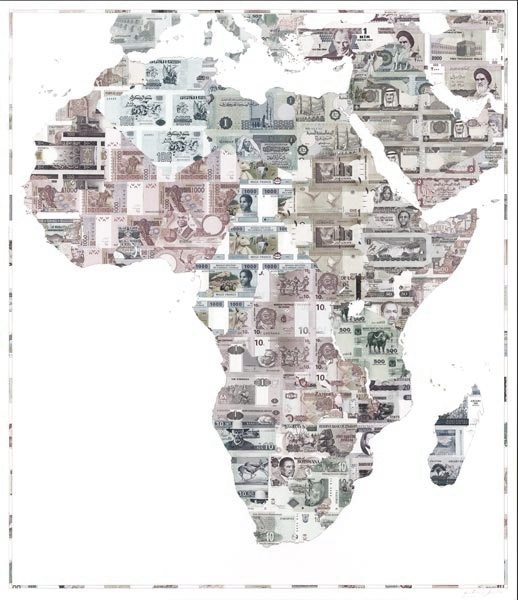
In this article the author assesses how flawed statistics may be exacerbating poverty in Africa.
By Jack Hamilton, 3 Nov, 2011
This week the UN has declared that there are 7 billion people in the world. It is impossible to verify this statistic but the reasoning behind the declaration is clear. It raises awareness of population growth and draws attention to future development issues. But what of the more dangerous statistics that have been exacerbating poverty? In Africa especially poverty estimates have been based upon flawed data with potentially disastrous consequences. With so much being written now about African growth, the data behind it must be questioned to reveal the statistical tragedy of Africa.
‘The Century of Africa’?
In the past decade Africa has surged forward. Its economy is growing faster than that of any other continent. Foreign investment has hit an all time high and the middle class is absorbing consumer goods at rates comparable to China and India. Articles on African optimism abound, normally at the turn of the year when it will inevitably declared that this is to be the ‘Year of Africa’, the ‘Decade of Africa’ or in the new book by Michel Severino and Olivier Ray, the ‘Century of Africa’. That is not to say that it will not be true. Rather the statistics behind this must be evaluated as well as the capacity to harness resources for development.
Africa Rising
Around one third of African growth over the last decade has come from a rise in commodity prices. These have been combined with increased investment from China as a low cost builder. Further investment has come from around the globe from Brazil to Iran, Turkey to South Korea leading to the defensive rhetoric of Hillary Clinton in declaring a ‘neo-colonial’ era on the continent. This is an unfair overestimation of external influence for Africa’s best friend has been Africa itself.
Regional economic cooperation has increased dramatically on the continent. Borders are becoming easier to cross and technology is advancing rapidly. Africa has more mobile phone users than the Americas and mobile financial transfers on a single phone network in Kenya are greater than the annual global transfers of Western Union. At the start of the year there were 17m Facebook users in Africa and this figure is expected to be 28m by the end of the year. As mobiles and data become more affordable the numbers will continue to surge. The political implications of this connectivity have been in the news due to the revolutions in the North but the economic impact on Sub-Sahara could have even greater consequences. The rapid distribution of agricultural information alone has been revolutionary.
While the rest of the world struggles through the economic meltdown Africa is growing and political violence, so long the cancer of growth, is declining. Tensions still simmer in Sudan, Congo and Angola but pale in comparison to their previous intensity and the talk of ‘new wars’ is receding and the markets are opening. This is not to overstate the case as Jean-Michel Severino and Olivier Ray have done in calling the 21st century ‘the century of Africa’. Africa’s rise is impressive but how many Africans are moving to China to set up factories?
The problem with the optimistic projections is that they are supported by figures which cannot be verified. Data is immensely unreliable to the point that we don’t know how many people are living in poverty or how quickly most of the continent is growing. In the words of the World Bank Chief Economist for Africa, Shanta Devarajan, Africa has a statistical tragedy.
Statistical Tragedy
The use of the term ‘tragedy’ is a reference to Bill Easterly and Ross Levine’s ‘African Growth Tragedy’ in their 1997 paper of the same name. This outlined the destructive link between economic growth and poverty in increasingly open markets. The financial gap is seen to be widening with the ‘Growth Tragedy’ placing the exacerbation of poverty at 2-3% per year. This has been placed as high as 6% more recently. World Bank estimates claim that overall poverty in Africa is declining at a rate of around 1% every year but Easterly and Levine demonstrate that this poverty is becoming more acute. The tale of the rising African middle classes does not include the plight of those at the bottom.
The tragedy is this assumption that growth is rising while poverty is declining. The statistical tragedy is that we don’t even know the real poverty rates. World Bank growth rates are based upon the imprecise science of GDP which is itself based upon national accounts. We need to take into account that only 11 Sub-Saharan African states currently use the World Bank GDP system. Most of the countries use older GDP measuring systems with some dating back as far as the 1960s.
In Ghana the system of national accounts was updated by the World Bank leading to a GDP figure that was 62% higher than previously thought. The World Bank took credit for the leap but failed to take account of the fact that it was their system which had systematically undervalued the Ghanaian GDP for the previous twenty years thus hampering long-term economic growth.
Only 39 countries in Africa use GDP systems which can be used to provide comparable estimates. National poverty estimates taken over a long period of time in a single nation are difficult to generalise beyond individual borders and the impact of conflict further limits them. How can one talk about continental poverty with only a single statistical point of reference? Furthermore the estimates are not comparable over time as the methodologies frequently change between estimations. An estimate on Kenya in the late 1980s would incorporate 235 items in the consumption basket whereas the early 1990s model had more than 600. Today this figure is in the 900s and rising.
While economists have been congratulating themselves for the declining poverty rate they have not been looking at the limitations of the data. It is not up to date. There is no uniform 2011 estimate. Of the 39 African countries that use GDP only 11 have comparable data for the same year. For the rest of the continent there is a need to extrapolate back to 2005. In the case of Botswana we need to go back to 1993.
Africa is given as the recurring example as the continent is an especially bad case when it comes to statistical tragedies. There are on average 3.8 poverty estimates from each country to the World Bank. Taking the African continent in isolation this drops to 1.5. In Africa the national estimates for 2005 have just been collated.
Why has this happened?
Statistics are fundamentally political. A poverty estimate involves the government declaring whether or not their people are better off today than they were five years ago. If a government is standing for election it would be in their interests that a negative report is not published. The consequence of this is a delay in the financing of such projects until after the election meaning that much of the raw data is not published or at least withheld until it is anachronistic.
The trope of condescending economic optimism for Africa is often checked with the accusation of poor governance. In this capacity progress can be verified. In Zambia defeated President Rupiah Banda, leader for the last twenty years, bowed out gracefully last month. From 1960 until 1991 no African leader was voted peacefully out of power with the exception of Mauritius. Since 1991 this has occurred in 30 of the 54 nations on the continent. The one party state is no longer the norm. Vast amounts of money are now spent on elections with Nigeria setting the world record earlier this year in spending $580m in an attempt to have a free and fair election, a figure which may be surpassed in Congo later this month. The figures in this case demonstrate the desire for change but also the scale of the problem. Only today it was revealed that a one month old baby is on the government payroll in Nigeria. He is also said to have a diploma.
It remains to be seen whether the winds of democratic change in the North and increased transparency south of the Sahara will see a rise in independent judges and neutral civil services but there is a clear case for optimism in African politics despite the verisimilitude of economic statistics.
Transparent Solutions
If the problem with statistics is the politics then the solution must come through transparency. Kenya’s open data initiative is a shining example of this, especially after the recent electoral violence. Secondly the behaviour of donors should also be evaluated and made public. This would stop organisations taking credit for aiding a negative situation which they helped to create. Thirdly, those found manipulating or withholding statistics must be named and shamed. Unfortunately this most important of factors is entirely dependent on the success of the first two. Much talk remains over neo-colonialism and foreign investment in Africa but it is the African politicians who need to open up, not the markets.
 InPEC Magazine