


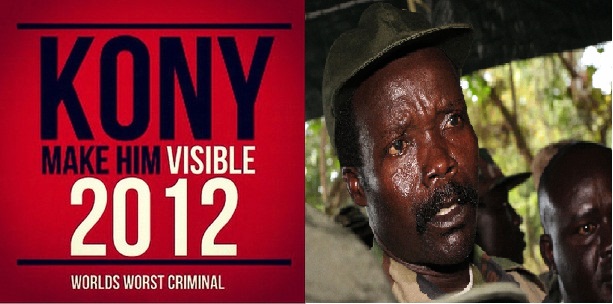
 In this article, the author addresses the criticisms of Invisible Children and the Kony 2012 campaign to highlight the success of the project as an advocacy movement. Sharing a video on Facebook is not tantamount to donating to Invisible Children. Equally, discrediting a video on Facebook is not tantamount to providing a solution. The primary ambition of advocacy must be to highlight the issue. Invisible Children, and their detractors, have been successful in this respect.
By Jack Hamilton, 8th March, 2012
A new human rights campaign has spread across the internet with a solitary aim: make Joseph Kony famous. The idea is that fame will enable Kony, the leader of the brutal Lord’s Resistance Army (LRA) in Uganda, to be brought to justice.
The film was created by the group, Invisible Children, a charity set up to combat the use of child soldiers by raising awareness of the issue and making slick videos fit for popular consumption. This method, as well as the background of charity, has been questioned by other activists following the unprecedented social media success of the #Kony2012 and #StopKony campaign.
StopKony has been trending worldwide since Tuesday and to date ‘Kony 2012’ has over 32 million views on Youtube and Vimeo combined. This article outlines the intentions of the campaign before looking at the ripostes. The key message is, whatever the failings of Invisible Children and their campaign, the ‘tipping point’ of hope and inspiration rings true.
Here is the video for those who have somehow avoided it.
What was the intention?
In order to make sense of the criticism, the key aim of the campaign must be evaluated: make Kony famous. This is the mantra repeated throughout the film. From the reaction on social media sites, to say nothing of the news coverage, this has been a resounding success. It is a viral hit. Kony is famous.
The second aim of the video is to inspire. It is an attempt to arrange collective action on an issue which does not directly impact upon the viewers. Responding to the waves of criticism, Jedediah Jenkins, the director of idea development for Independent Children, called the film a ‘tipping point’ in this regard. It is difficult to refute that. The visceral impact of Kony 2012 and the message that social media can be used a catalyst for good help to explain the sensation that the video has become.
The third aim was to promote Invisible Children. This is where problems abound.
Responses to Invisible Children
There have been three waves of responses to the #Kony2012 campaign. First, there was the initial flood of admiration for the video: the viral success which made this thirty minute video about Uganda a global phenomenon. Second came the IR students flaunting their ‘early adapter’ credentials by pointing out that many had already heard of Joseph Kony long before now and that the campaign, while well presented, is now anachronistic. The third wave has been characterised by direct attacks on Invisible Children and the overt ‘White Man’s Burden’ overtones of the video. Having established that video is a viral success it is necessary to deal with the criticisms of the second and third waves.
1. It is already too late
The argument that the viral assault on Kony is too late carries some weight. As rightly pointed out in a Foreign Policy article, he has already been pushed out of Uganda and may be on his last legs. The fact that ‘Uganda’ is trending on Twitter demonstrates that Kony 2012 does indeed deal in misleading oversimplifications which have now been popularised. However, this does not detract from the power of the video to highlight the plight of child soldiers as well as the blight of the LRA across Central Africa rather than merely northern Uganda. Just because the worst of the atrocities were missed between 1999 and 2004 does not mean that the continued suffering should be ignored.
2. Sanitising Militarism
Direct attacks on Invisible Children carry more weight. Firstly, their proposed solutions sanitise foreign intervention through a viral marketing campaign. There was something a little uncomfortable about watching the scenes of unbridled celebration when Barack Obama announced that US military advisors would be sent into Uganda. It would not be conducive to a slick marketing campaign to evaluate the pros and cons of AFRICOM but the flagrant celebration seemed a little off. It cements the argument that the people of Uganda are portrayed as passive victims with little agency over their own voice, will or power. The support shown for local armies is not paralleled by support for local initiatives. Just ask Betty Bigombe.
The support for local armed forces is also complicated. Many detractors of Invisible Children point to the now famous (and idiotic) picture in which the leaders of the charity pose with Sudan People’s Liberation Army soldiers carrying weapons (see below).

The Last Kings of San Diego?
Critics have eviscerated the Invisible Children campaign on the basis that they support local forces that have also carried out atrocities. This is a failure of logic on two levels. Firstly, while it is clear that Ugandan forces have been guilty of rape and looting they are not on the same scale or systematic nature as the crimes of the LRA. Secondly, if foreign intervention is not the solution and local forces are not the solution then what is?
If the key aim of IC was militarisation, then they had already achieved it with the passing of the bill to send 100 US military advisors to find Kony. The mission, led by the Ugandan military, is not restrained by borders as it was in the past (allowing Kony to flee) but can now move into north-east Democratic Republic of Congo, southern Central African Republic and south-west South Sudan to find the LRA and their leader. That being said, the military commercialism of the UPDF remains a concern.
3. They are smug
Kony 2012 is sickeningly smug and self-congratulatory. There is no doubting this. It is about them and their role in stopping Kony with ‘your support’. In the words of the now viral riposte to IC, Visible Children, “it hints uncomfortably at the White Man’s Burden. Worse, sometimes it does more than hint”.
The movie is certainly more about the film-makers than the cause but it is a film which sets out to inspire people to action who would otherwise be wasting time on social networking sites. One only has to look at the snappy editing and photography to see the target audience and in this sense the video is a monumental success. It sets out to inspire and the response of the social networking community has been breathtaking.
4. Finances
The figures on the funding and expenses of IC have started to waver. There has been intense criticism of the way the charity spends vast amounts on salaries and filmmaking for an NGO. The organisation offers full disclosure of this in addition to positive ratings from Charity Navigator. However, the failure to submit to a full audit remains suspicious. Until this is done the finances will continue to be questioned.
Solutions
The contrarian nature of the anti-Invisible Children articles frequently fail to outline a solution of their own. Attacking Invisible Children for their failings is necessary but it should come with the BBC-style qualification that other charities and solutions are available.
The pursuit of Kony may be anachronistic and many of the criticisms of IC are valid but do not let that detract from the inspirational nature of Kony 2012 and what it has achieved. People are discussing the LRA. People are discussing the pros and cons of intervention. People are discussing charity.
Sharing a video on Facebook is not tantamount to donating to Invisible Children. Equally, discrediting a video on Facebook is not tantamount to providing a solution. The primary ambition of advocacy must be to highlight the issue. Invisible Children, and their detractors, have been successful in this respect.
 InPEC Magazine