India’s Anti-graft Protests: Why Demands for Inclusiveness are Not a Distraction From Fighting Corruption

In this article, the author brings to light some of the criticism that the Anna Hazare led anti-corruption agitation is facing on counts of not being inclusive enough.

_____________________________________________________________________________

By Arvind Iyer, 5 Jan, 2012

Team Anna, as the group of largely ex-bureaucrat activists headed by anti-graft agitator Anna Hazare has been christened by commentators, had earned praise through much of 2011 for being able to articulate a unanimous-sounding consensus of Indian civil society across the barriers that render it notoriously fractious. Even some of their detractors had conceded Team Anna’s success in rallying a typically apathetic citizenry around a cause backed by a mobilization and momentum which is thought of by many educated city-dwellers as grievously lacking in a parliamentary system crippled by the ‘politics of identity’ and coalition compulsions.

By the year-end however, the response to Anna Hazare’s latest edition of his hunger-strike protest was underwhelming and the growing unease with an apparent authoritarian streak in Team Anna became palpable. What was just months ago one of the most successful campaigns in recent Indian history looked no less dysfunctional than the Parliament it takes potshots at. The dilemmas of ‘Coalition Dharma’ which complicate governance in India are no less applicable to Team Anna if it claims to represent Indian society in its identity. The manufactured unanimity of Team Anna seems sustained by a self-assured insularity from dissenting voices, which if heeded would give Team Anna pause. This is in part because activists besides the telegenic Team Anna get scanty mainstream media coverage, thus creating an illusion of nationwide consensus. Following are some voices which ought to give Team Anna and its supporter’s pause, if not from their legislation-obsessed agitation, at least from their repeated accusations of their critics as divisive and unpatriotic.

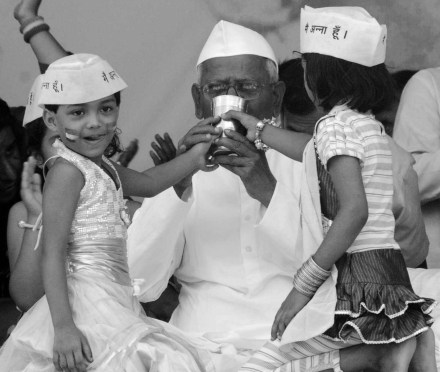
  • Team Anna’s way of addressing concerns about inclusiveness have been transparently stage-managed and tokenist. Shekhar Gupta, the editor of the Indian Express daily, writes: “Representative inclusiveness, they probably believed, was part of our cynical electoral politics though that did not stop them from having a Dalit and a Muslim girl help Anna break his fast, making it the first time that a child was described as “Dalit” on a public stage in a mass rally.” The photo-op which seems to have been hastily ‘Photoshopped’ on to a movement largely indifferent to concerns of diversity, also raised concerns among some viewers about the unintended consequences of religious labeling of children.

  • The boundaries of ‘peaceful protest’ are always in the risk of being breached by Team Anna’s implicit endorsement of elements whose commitment towards adhering to constitutional propriety and prevention of civil unrest, seems questionable. A case in point is a black-flag demonstration against Prime Minister Manmohan Singh by alleged supporters of Team Anna, during his New Year visit to the Golden Temple at Amritsar. The choice of protest venue in Amritsar was irresponsible for the obvious reason that it could potentially open the wounds left by the upheavals of the 1980s in the said shrine, which is viewed by a significant portion of the said community as a site of a government assault on their faith. If this irresponsible choice of protest venue did not lead to something untoward, it is in part due to the unimpressive numbers of the protestors and the overwhelming security presence. Better civic sense is expected of a movement supposedly representing ‘Civil Society’ than such an exacerbating of security concerns. Also, a better explanation is expected from Team Anna than doublespeak simultaneously defending and disowning supporters, if it is to retain its credentials as movement insisting on public probity.

  • When it is well-known that India suffers more from lack of enforcement of existing laws than the absence of laws in statute books, the Lok Pal model is inordinately obsessed with augmenting the lists of penalties, leaving intact the slackness of enforcement and lack of transparency that provide the opportunity for corruption in the first place. Also, an informer-rewarding ‘police-state’ that the proposed Jan Lok Pal regime resembles, may have the side-effect of inducing officials to recruit and reward officials who are pliable and willing to exchange favours for silence, thus exacerbating inequities like nepotism and workplace discrimination in government offices which affect delivery of service to citizens besides graft.

  • Inclusiveness has rightly been part of the national agenda at least in letter if not in spirit and Team Anna’s attitude towards mechanisms of inclusiveness has been either indifferent or borderline hostile. There has been a tendency among Team Anna supporters in online discussions to accuse anyone raising concerns about inclusiveness of playing ‘identity politics’ and being establishment lackeys. A case for critics of government intervention for inclusiveness to consider, is this measure by the Karnataka government for inclusive hiring in school-meal kitchens. A point to ponder for critics of the ‘politics of representation’ is, would people divided by caste have voluntary chosen to mingle in a school kitchen without that nudge from the elected government?

  • Team Anna’s vision of an India which, far from its professed aim of ‘Direct Democracy’ involves a replication of the Ralegan Siddhi model nationwide i.e. a series of ‘Ashram-cracies’ revolving around a patriarch, in a proto-industrial setting with curtailed civil liberties, is a vision that does not resonate with much of India’s aspirational youth.

  • Land acquisition policies and resulting displacements, the denuding of natural resources by a corporate-political nexus and imposition of near-martial-law conditions in some parts via the Armed Forces Special Powers Act, are contributing on at least as large a scale as government corruption in disenfranchising citizens and even turning some towards insurrections; thus calling into question Team Anna’s description of corruption as the greatest national risk which must be fought mindless of all others.

In the interest of genuinely playing their legitimate and very timely role as a civil-society group, this is an opportune moment for Team Anna to introspect on how their protests can sometimes be counterproductive, how the loose cannons among their supporters can be appropriately restrained and marshalled and how to broaden their dwindling base of support.
Redressing Grievances: Why India’s New Administrative Reform Legislation May Not Work

In this article, the author analyses the structural problems of India’s administration which are likely to hamper the functioning of the Citizens’ Right to Grievance Redressal Bill, 2011.


By Siddharth Singh, 16 Dec, 2011

The Citizens’ Right to Grievance Redressal Bill is set to be tabled in the Indian Parliament in the current parliamentary session, after a delay of several years. In the recent months, the Jan Lokpal (Citizens’ Ombudsperson) agitation led by Anna Hazare, which brought to light the people’s frustration with the corruption and inefficiency of the administration, has brought a sense of haste to Dr. Manmohan Singh’s government in the passing of this legislation.

The draft of the bill was posted on a Government website a few months ago (infuriatingly, in the Comic Sans font). This bill is not significantly different in its key tenets from the already-enacted state-level service delivery acts and the other drafts that have been put out by civil society groups such as Anna Hazare’s team.

The bill makes it mandatory for government departments to lay out ‘Citizens’ Charters’, which is a document which specifies the obligations and duties of the department and the administrators, along with the time frame of the delivery of the services. In other words, this bill legislates the right to time bound delivery of services by the government. The bill proposes that violations of service delivery are identified and the erring administrators punished.

This legislation is hence purported go a long way in improving service delivery and even fighting corruption. However, there are structural issues with the administrative setup in India which may render the bill ineffective.

Who defines the services?

The foremost problem with the bill is the lack of the definition of “public service”. The draft of the bill does not have an appropriate definition of what constitutes a service. Even if it did, it would be difficult to implement it across the board. For instance, the passport department is obligated to provide passports after appropriate verification. It would be easy to time-bound the delivery of passports, and to punish those administrators who violate the deadline for reasons they could control.

However, the issue is significantly different in the case of the roads and highways departments in the country. The construction of roads is contingent on budgetary allocations, the status of tenders and contracts with private contractors, technical feasibility and other issues. In case there was a substantial demand for the construction of roads where there are none, the responsible administrator would be swamped with work he or she may not be able to complete within the specified time frame.

The government, possibly for this reason, has left the creation of the Citizens’ Charter in the hands of the heads of the respective departments. This too can be problematic. If the head of the passport department refuses to add the time bound delivery of verified passports, then there is nothing a citizen can do about it. On the other hand, in case the citizens themselves or public representatives were made to create the citizens’ charter, then they would add provisions that would be administratively infeasible and unreasonable to meet. Appointing representative committees to address this issue would also be difficult given the multiplicity of departments.

Who is responsible?

The other issue is that of responsibility. This issue is twofold. Firstly, the draft bill and the existing state-level acts legislate that in case the administrator fails to meet the deadline of service provision, the matter would go straight to the head of the department. The administrators involved in service provision are often at the lowest rungs of the bureaucracy. This has serious implications on the work of the department since the heads are put in place manage and plan at organisational levels. In case they are swamped with such complains, they will not be able to concentrate on their core duties of, inter alia, planning and modernisation.

Secondly, service provision is like often like a relay-race. The service is often linked to to a chain of decision making and operational processes which lead all the way to the top of the administration, and even beyond. In order to win the relay-race, all the runners will have to do their share of running. If any of them fails to do so, the team loses. However, the Grievance Redressal bill purports to only punish the final runner.

To take a more relevant example, in the past few years, the state of Rajasthan has seen protests in villages because the schools in that region have an inadequate number of teachers. In some cases, there are schools with no teachers at all! In order to address this issue, the administrators responsible for ensuring the postings of teachers have done what they could do – they transferred teachers from different villages to the ones where the protests were on. This pacified the protesting villages, but didn’t really address the problem at all, since other schools were made to face the shortage.

In such cases, the administrators often had no choice: there is a shortage of teachers because bureaucrats at the top have not recruited in adequate numbers. They, in turn, have not been able to do so because the ministers of their department have not sanctioned enough posts. (This, in turn, may be because the state doesn’t have the finances for the extra jobs.) However, the Grievance Redressal bill does not account for such structural issues. The only entities responsible are the service-providing administrators at the bottom.

A cylindrical administration

When India got its independence in 1947, the literacy rate was less than 20% and the average life expectancy at birth was in the early 30s. Over the years, with rising standards of living, increasing prosperity and growing state expenditure and finances, the awareness of people has also increased. Naturally, the demand for public services has increased by magnitudes, but the government hasn’t been able to keep pace.

The administration has not grown in size proportionally, which has led to woeful staff shortages. The primary reason for this is financial. Increases in public finances since Independence have led to increases in spending in social schemes and subsidies. Curtailing hiring has been an easy way to save money to divert towards other vote-winning initiatives. On the other hand, given the work load (and political considerations), high ranking bureaucrats have been retained in the administration without concern for administrative structure.

The result of this is that the department structures now are cylindrical rather than pyramidal. Often, the reason for delay in service provision is a result of this, as departments get burdened with more work than they can handle. Many departments are said to run with 40-50% capacity. The police to population ratio, for example, is 145 per 100,000 population, far short of the UN stated minimum of 222 (most advanced nations far exceed this number). That makes it a shortage of over 80,000 police personnel in the country! Of course, administrative sloth, corruption and incompetence are major reasons for delays in work too. While the Grievance Redress bill can take care of the latter, it will end up delivering perverse outcomes as it attempts to deal with the former.

If genuine cases of delays due to overwork are penalised, it will lead to the able administrators leaving for greener pastures. This problem is compounded because the bill (and the draft presented by Anna Hazare’s team) state that any act of repeated delay in service provision will be deemed as an act of “corruption.” This issue is hence very grave and is also the reason why heads of departments in states where such acts are already in place are not adding core functions to the Citizens’ Charter.

Making the bill work

In order to make this bill work, it is imperative that the governments at the centre and in the states work towards filling up the vacancies. Reforms to reshape administrative structures are important. Additionally, it must be ensured that “services” are properly defined and only those services are included in the Citizens’ Charters that are not directly dependent on budgetary allocations. Without these, the Citizens’ Charters will likely look empty or full of non-critical services, hence rendering the bill ineffective.


Postscript: In an interesting anecdote, a senior bureaucrat was once imprisoned in the state of Andhra Pradesh for not following a District Court’s directive. The court had directed him to appoint a junior level administrator to a certain post within a given time frame. In fact, the bureaucrat was helpless as the orders for recruitment had not been passed by the minister-in-charge. Given there was no one to appoint, he couldn’t possibly fill up the vacancy. However, the judge wouldn’t hear any of it. The bureaucrat ended up in jail for no real fault of his, and the case moved up to a higher court for appeal.

The Strange Politics of Anna Hazare

By Siddharth Singh, 12 Oct, 2011

Anna Hazare’s recent threat to campaign against the Congress party in case they don’t help pass his version of the Jan Lokpal Bill in the Uttar Pradesh (UP) elections is an artful move. Much as the Congress would like to dismiss this threat citing the non-existent political roots of Anna, it needs to tread with caution given it draws substantial support from the Middle-class in UP.  The Congress has pinned its re-election prospects, as well as the political prospects of Rahul Gandhi, to its performance in UP.  By threatening to strike the Congress where it would hurt the most, Anna has been very strategic.

However, while this move by him may see an initial success in Hisar’s by-polls (which is a constituency that wasn’t leaning towards the Congress in the first place),  it risks becoming a cause for the downfall of this movement. Political fault-lines in Uttar Pradesh lie – unfortunately – on issues of caste and religion, and to an extent – fortunately – on  the governance (or mis-governance) records of the respective parties. While the general call of ending corruption may resonate with the society, the electorate may not swing their votes in favour of parties that promise to implement certain legislation over others in the future. Especially not if the record of such parties on corruption and graft is equally if not more suspect than that of the Congress. In case they choose to do so, it may still not work towards meeting Anna’s goals.

Anna’s call may be further diluted in case the Congress manages to pass some version of the  Lokpal Bill before the UP elections. The Congress’ announcement that the Lokpal Bill envisages the body to be a Constitutional authority may work to dilute Team Anna’s position.

Realistically, two results can be expected from such an anti-Congress ploy in UP:  either Anna turns out to be successful in wooing the people away from the Congress, or he doesn’t. In the case of the first eventuality, if the result is the election of individuals and parties with a record of graft and corruption, then the purpose of the agitation would be lost. If the idea was to kick out the corrupt, then it makes no sense to work towards replacing one set of corrupt with another. This may lead to substantial disillusionment with the public. More so because a fractured mandate which includes the corrupt would diminish the chances of the passage of the Jan Lokpal Bill.

In the case of the second eventuality, the Congress  would claim popular victory and support for its policy on corruption and the popular rejection of Team Anna.  Either way, this movement would only lose out on the popular support it has garnered.

Annaji, as he is known by the public, may well be advised to not go ahead with such a simplistic call which may well prove to be counterproductive. If he wishes to hold on to the legitimacy he has earned in the past few months, he ought not to alienate his core constituency by aiding – indirectly – the victory of parties that are no less, if not worse, than the Indian National Congress when it comes to the issue of graft.