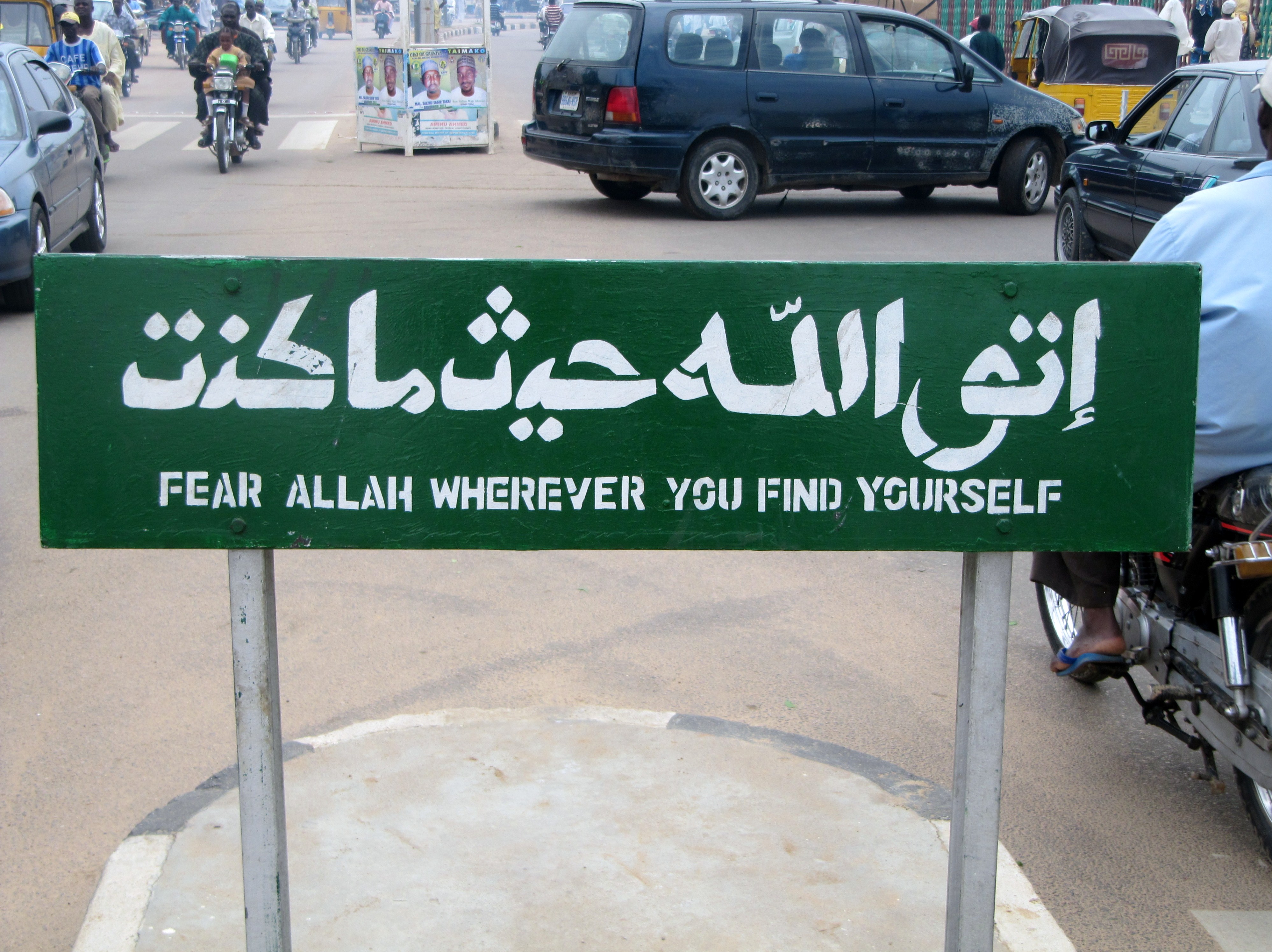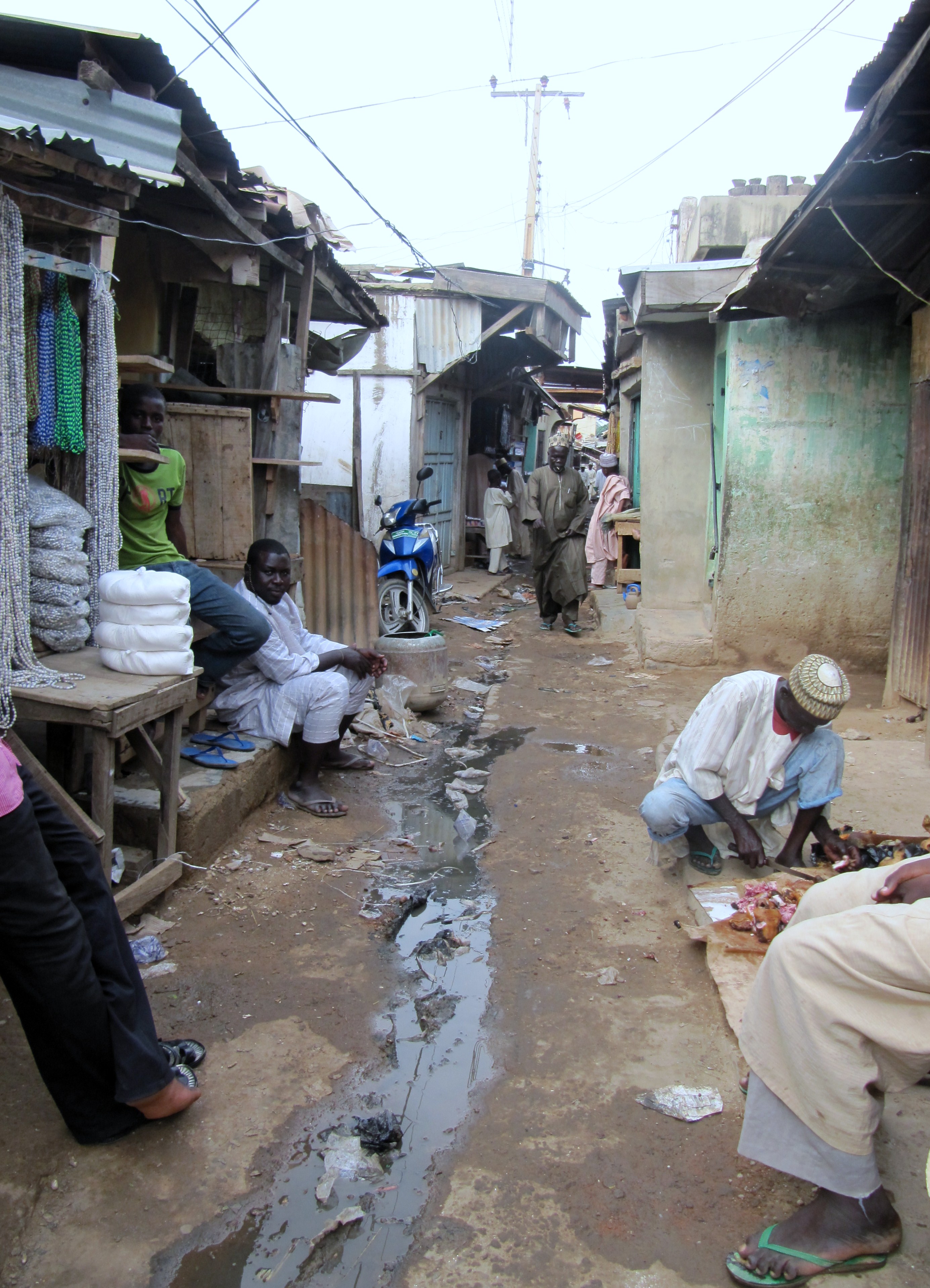
Photo Essay: Tradition and the Sahel

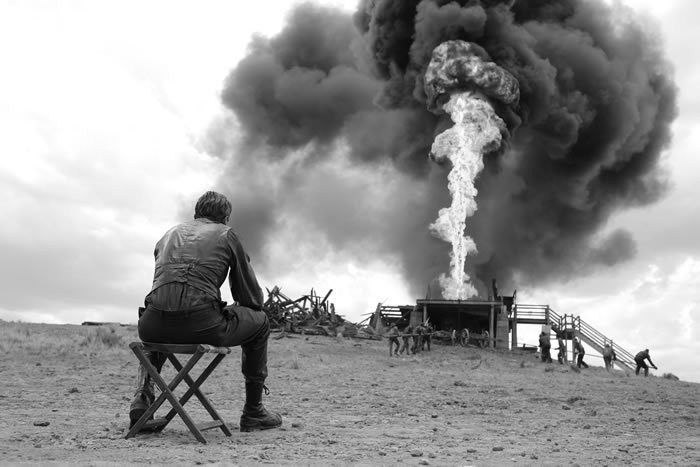
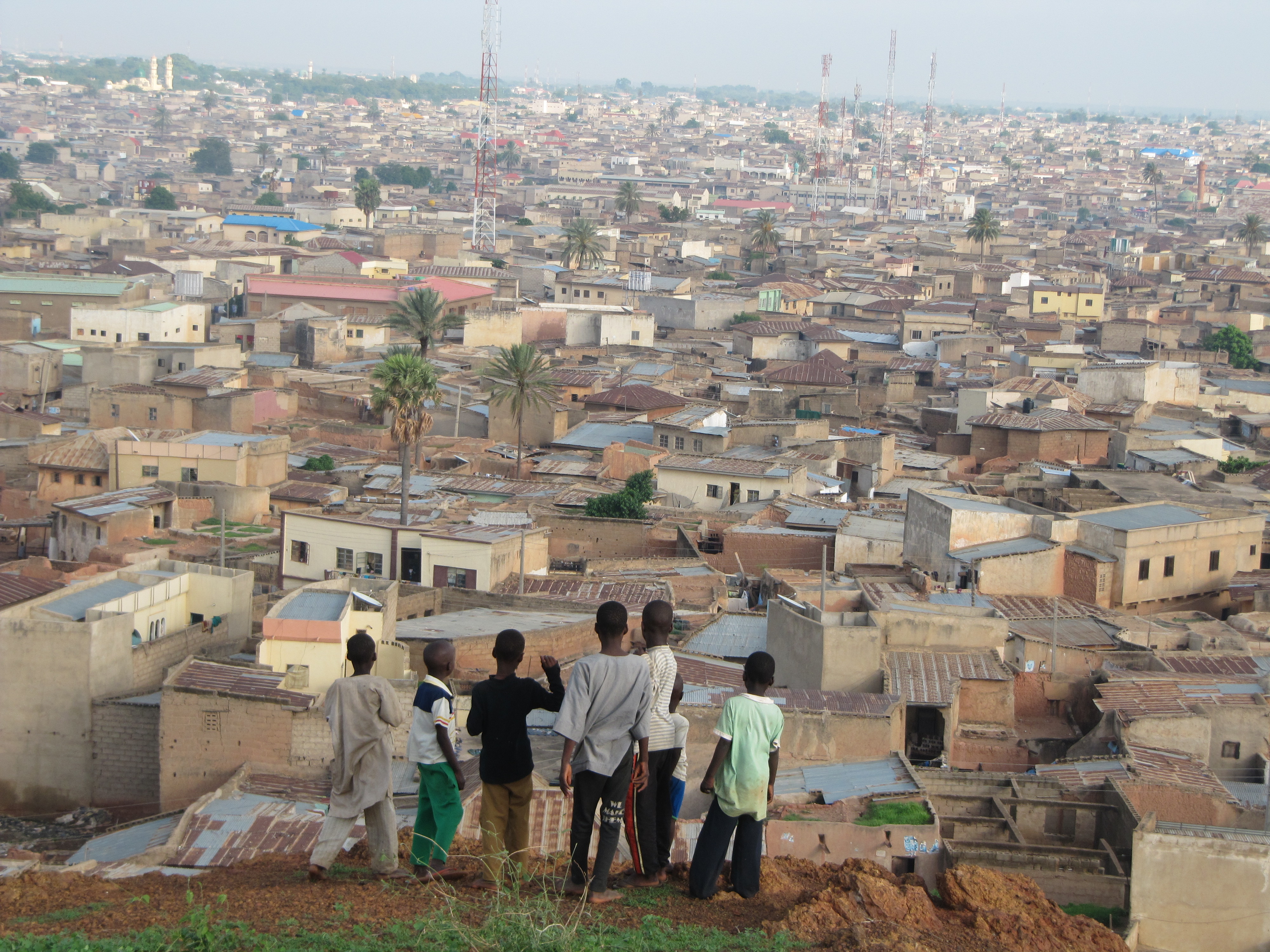
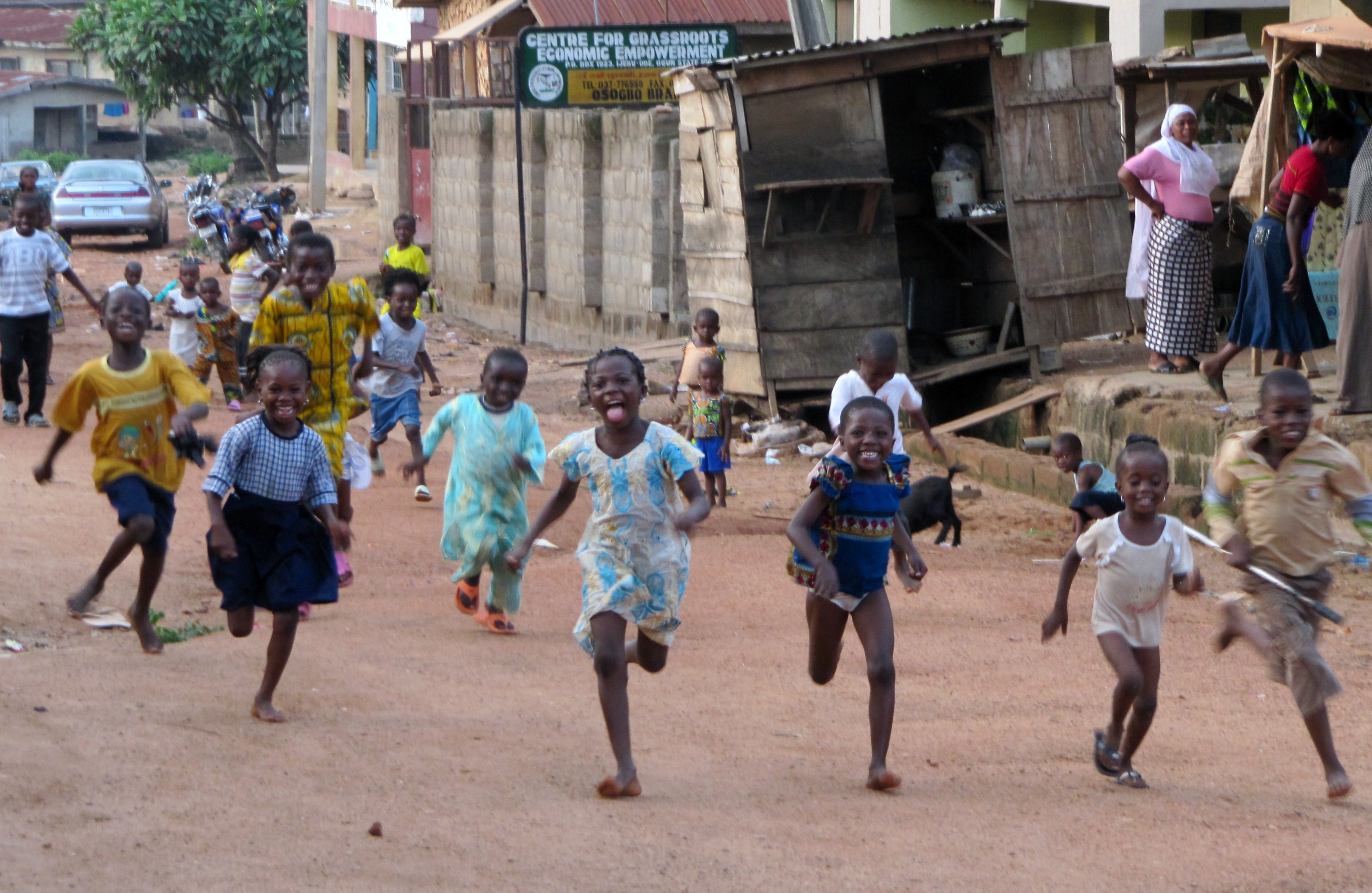
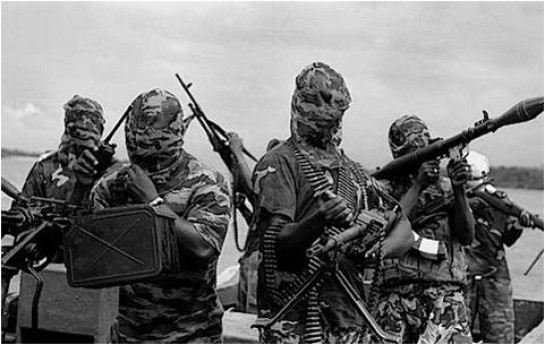
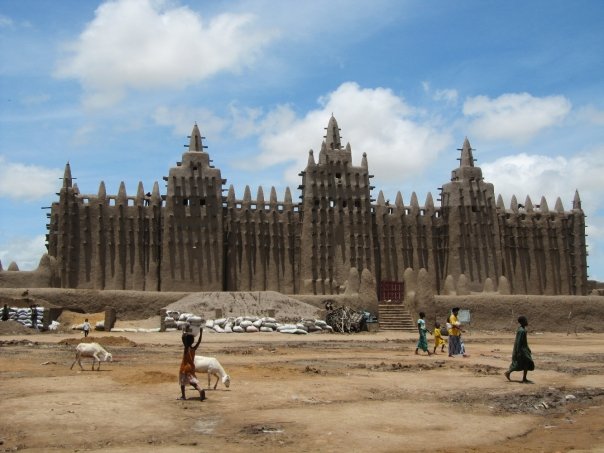
The Sahel is in the headlines.  As the death of US Ambassador Chris Stevens in Libya is linked to pan-Sahelian terrorist organisations and terrorism in Nigeria and Mali drifts further towards the front pages of western newspapers there is a need to look at some of the stories emerging from the region.  This collection of photos, taken by Jack Hamilton, looks at the changing nature of tradition in Mali, Nigeria and Senegal.

By Jack Hamilton, 4th October, 2012 Continue reading

Is Mali the ‘next Afghanistan’?

This article is a re-publication of a piece by Andrew Lebovich on his website, al-Wasat.  It analyses the popular attitudes on the security situation in northern Mali to look at the potential risks to international security and the risks that are, at present, overstated.

Mr. Lebovich is a contributor to the popular foreign policy blog The Washington Note, and his work has appeared at ForeignPolicy.com and The Atlantic Online. He also writes a formerly weekly, and now twice-weekly brief with Foreign Policy on legal issues in the struggle against terrorism, the Legal War on Terror (LWOT).


By Andrew Lebovich, 13th June, 2012.

The title of this post is a question I’m seeing more and more, and it reflects the growing concern in Washington, Paris, and African capitals that the security situation in northern Mali is spiraling out of control. In this kind of environment, bad news tends to echo loudly and quickly. The most recent example of this is the strong reaction in the international press to an interview Nigerien President Mahamadou Issoufou gave to France 24 this week, in which he said that Afghans and Pakistanis were in Mali training fighters, in addition to confirming that French hostages held for nearly a year and a half by AQIM were in “good health” and still alive. This news has garnered quite a bit of attention, especially in the Francophone media, though it should be noted that RFI reported the presence Pakistani trainers in Timbuktu and in Kidal a month ago, to considerably less attention. Still, this and other signs of the degradation in the security environment in northern Mali and the growth of AQIM have spurred speculation about whether or not northern Mali was becoming a “West African Afghanistan“, a new Somalia, or a jumping-off point for terrorist attacks elsewhere.

While I think some of this concern is warranted, I think some of this language and concern may be, for the moment, a bit overwrought, as I will explain in this piece. This post is my attempt to sort through some of the current popular attitudes about the security situation in northern Mali, the very real risks to regional and international security that may be looming in the north, and the equally real constraints on militant groups attempting to impose shari’ah in northern Mali or project force beyond Mali’s already porous (or nonexistent) borders.

Continue reading

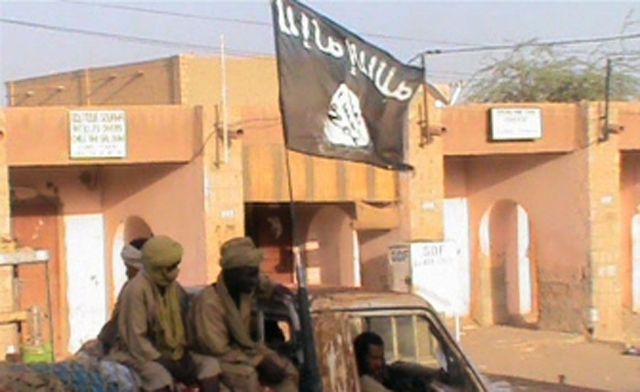
The Black Flag Flies in Mali

In this guest post from Andrew Lebovich, the recent events in Mali are dissected from the military coup to the future of the ‘newly liberated nation of Azawad’. Instability in the region is rife and Andrew posits that without a rapid response, the situation is liable to degenerate rapidly.


by Andrew Lebovich, 9 April, 2012

This post was originally published on Andrew’s website, al-Wasat.  The website seeks to compile perspectives on the Middle East, South Asia, CT and COIN. Their goal is to bring together some articulate, interesting, and occasionally funny individuals to write about radicalization, counterterrorism, terrorist ideology, Muslims in the West, and regional issues, all in one blog.

Less than two weeks after a group of Malian junior officers led a coup against the government of president Amadou Toumani Touré, Mali’s war in the north has fallen apart. In a three-day period that ended Monday, Tuareg rebels had seized the three major northern towns of Kidal, Gao, and Timbuktu, victories unparalleled in the past.

On Thursday, a spokesman for the Malian Tuareg rebel group the National Movement for the Liberation of the Azawad (known by its French acronym the MNLA) said that the group’s fighters had arrived “at the frontier of the Azawad” – a mostly scrub and desert territory the size of France that comprises a diverse ethnic population – and declared a halt to military operations. Later the same day, the group declared the unilateral independence of the region. In a dizzying flourish of events, the war that Tuareg rebels had fought since January 17, the fourth in a series of rebellions that began in 1963, appeared at first blush to be over. Instead, the real fight over the Azawad may have just begun.

The rush to capitalize on the dissolution of Mali’s army in the north has brought to the fore deep conflicts between the MNLA and the salafist-inspired Ansar Al-Din, and brought two terrorist groups who call northern Mali home – Al-Qaeda in the Islamic Maghreb (AQIM) and its “splinter” group the Movement for Unity and Jihad in West Africa (MUJWA) out of the woodwork.

The scant reporting and witness statements emerging from the north paint a confusing and complex picture of events there, one complicated by conflicting agendas and a sheer lack of information, credible or not. But with some reports depicting scenes of destruction, looting, and even rape in Gao and Timbuktu, the imposition of harsh tenets of sharia law in Kidal and Timbuktu, and a possible struggle for control in all three cities, events in northern Mali appear more than ever to be shrouded, to appropriate a phrase used by Tuareg expert Baz Lecocq, in a “haze of dust.”

Known unknowns

As Lecocq astutely pointed out when writing this week about the situation in the north, much of what we see now is based heavily on slim reporting, nearly impossible to confirm witness statements, and assumptions. But with those caveats aside, it is possible to trace at least the broad outlines of how we have arrived at this conflicted point, and where things may go from here.

According to a pro-MNLA writer Andy Morgan, at a meeting in October 2011 in the desert oasis of Zakak, a group of Tuareg leaders met to decide their future course of action in Mali. Comprised of local notables, past rebels, and commanders and fighters recently returned from Libya, this group would soon be known publicly as the MNLA. But at the meeting, Iyad Ag Ghali – the leader of Tuareg rebellions in the 90’s, and later a Malian diplomat in Saudi Arabia and interlocutor in hostage negotiations with AQIM  – purportedly presented himself to be head of the MNLA.

Iyad lost that attempt, as Bilal Ag Cherif was appointed the Secretary General of the MNLA. He also reportedly lost a subsequent attempt to lead the Ifoghas tribe, towhich he belongs. Alghabass Ag Intallah, the middle son of the current amenokal, or leader, of the Ifoghas was appointed the tribe’s “chief executive.” It should be noted that Morgan appears to be the sole available source for these particular claims, and the full story is likely far more complicated.

Once known for his love of wine, women and song, Iyad, who grew more religious over the years, went into seclusion after these defeats. In December news leaked that Iyad had created a new Salafist Tuareg group – Ansar Al-Din. Yet little was known or heard from or of Iyad until after the violence broke out in January. Following a siege of the military base at Aguelhoc at the end of January, photos and reports out of the city spoke of “summary executions” of nearly 100 Malian soldiers at Aguelhoc, and France and the Malian government suggested that extremist elements ranging from Iyad’s group to AQIM may have been involved.

Although rumors abounded about the presence of Iyad’s fighters and even those belonging to his cousin, AQIM sub-commander Hamada Ag Hama (Abdelkrim el-Targui), there was little hard proof of Iyad’s role in the north throughout February and early March, even as the MNLA advanced rapidly, picking off border towns with Algeria and Mauritania and harassing towns south of Timbuktu. The MNLA acknowledged quietly that Ansar Al-Din had fought with them at Aguelhoc and elsewhere, but categorically denied links to AQIM, even suggesting that Iyad had helped bring a number of Tuareg AQIM fighters back into the fold and away from jihadist militancy.

It was not until the strategic town of Tessalit was seized March 11 that cracks began to show. Soon after the MNLA claimed victory at Tessalit, Ansar Al-Din made its media debut on YouTube. The group’s 12-minute video showed images of Iyad leading his men at prayer juxtaposed with images of fighting at Aguelhoc and a message from another historical rebel figure, Cheikh Ag Aoussa, calling for the implementation of sharia not in an independent Azawad, but throughout Mali. A week later the group is said to have released a statement to journalists calling for the implementation of sharia in Mali by “armed combat” if necessary – far from the MNLA’s message of a secular, democratic Azawad. The move prompted the MNLA to distance itself from and then denounce Ansar Al-Din. Tension mounted as the latter claimed responsibility for a series of key victories in the north, which the MNLA and pro-MNLA sources denied vigorously.

Yet it appears that this outward animosity did not stop elements or commanders from these groups from working together, at least in some capacity. As Mali’s army dissolved from within following the March 22 coup d’état, MNLA and Ansar Al-Din forces surrounded Kidal, reportedly pushing into the city from opposite sides after negotiations for its surrender failed. Just a day later the key southern city of Gao fell with hardly a fight, again with reports that a group of fighters entered and seized parts of the city – the MNLA, Ansar Al-Din, and even the AQIM dissident group MUJWA, which according to some reports seized one of Gao’s two military camps, as the MNLA seized the other.

Just a day later Timbuktu, the last military bastion in the north, fell without a fight. While the MNLA had negotiated a peaceful transition with the local Bérabiche (Arab) militia protecting the town, Iyad soon swooped in, reportedly pushing MNLA forces to Timbuktu’s airport, and announcing first to the city’s religious and political leaders – and then on Wednesday, its people – his intention to implement sharia and fight those who oppose it.

Worse still are the reports that Iyad was acoompanied by several very important AQIM commanders: Mokhtar Belmokhtar, Abou Zeid, Yahya Abou al-Hammam, and close Belmokhtar aide Oumar Ould Amaha (spelled Oumar Ould Hama in some reports).

While the MNLA has forcefully denied being expelled from Timbuktu, Iyad’s statements and a number of eyewitness reports appear to confirm his takeover of the city and efforts to enforce the veiling of womenshutter shops and hotels selling alcohol, and even exact harsh punishment on looters and “vandals”. He is also said to have lowered and burned the MNLA’s flag, replacing it with a black “Islamist” flag.

Emerging from the shadows

One of the more startling elements of the reports out of Timbuktu is the aggressive emergence of AQIM on the scene. While AQIM and its predecessor groups, the Salafist Group for Preaching and Combat (GSPC) and the Armed Islamic Group (GIA) have long operated in the Sahara, and have attacked regional armed forces and other targets in Mauritania, Mali, and Algeria, AQIM is known much more for smuggling (drugs, cigarettes, weapons, and more) and the kidnapping of Westerners across the region, operations that may have netted the group tens of millions of dollars.

If true, reports of AQIM leaders appearing so openly in public – let alone this many of them, together – would be unprecedented. Yet it is extremely difficult even to assess these claims. While various accounts cite Timbuktu residents and participants at the Monday meeting identifying the AQIM leaders by sight, eyewitness accounts are notoriously unreliable. Moreover, it would be an extraordinary circumstance for so many key leaders to be in the same place, even if only for a short time. This is especially true given the reputed rivalry between Abou Zeid and Belmokhtar, though I have cast doubt on the extent of their supposed divisions in the past.

Nonetheless, it seems apparent that there is at the moment a sizeable AQIM presence in the city, operating openly alongside Ansar Al-Din and possibly searching for Westerners. Additionally, it makes at least anecdotal sense that AQIM would be both present in the city and useful in supporting Ansar Al-Din.

As I previously mentioned, many analysts believe blood ties exist between Iyad and the AQIM subcommander Abdelkrim el-Targui, who analysts believe is close to Abou Zeid and organized the kidnapping of two French men in the Malian town of Hombori last November. And the two groups share a broad worldview about the implementation of sharia and pursuit of jihad, though significantly less is known about Ansar Al-Din’s core ideology, having only given a small number of public statements.

More apparent, though, is the clear benefit AQIM brings Ansar Al-Din. On the one hand, AQIM can provide dedicated, hardened fighters, a significant factor if estimates that Ansar recently only possessed a few hundred men are correct. More importantly, AQIM may offer Ansar a bridge allowing the group to operate in Timbuktu; both Belmokhtar and al-Hammam have operated for several years in and around Timbuktu, and in particular to the north of the city. Just last month, Mauritanian aircraft struck a convoy they thought included al-Hammam less than 100 km north of the city. And Belmokhtar has, according to most accounts, married a Berabiche woman from a prominent family in or near Timbuktu. Given that Berabiche Arabs are predominant in the city, these longstanding transactional and personal ties – not to mention fear of the organization – could help the primarily Tuareg Ansar Al-Din avoid conflict and exert its influence in the city. It is too early to tell, however, if the tenuous calm in Timbuktu will hold for long.

Less easy to decipher are the gains to be reaped by AQIM or MUJWA from this arrangement. Reporting on the group since the Tuareg uprising has been scarce, though various unconfirmed reports placed Belmokhtar in Libya while others were believed to have fled into southern Algeria, perhaps to pursue business opportunities or simply wait until the instability settled and a clear winner emerged in the north.

The return of AQIM to the battlefield would indicate that they believe that a winner has emerged – though it is difficult to say if AQIM seeks a greater safe haven in which to operate, tighter control over smuggling routes in northern Mali, or simply the chance to spread its own version of Islamic practice. Still, this kind of active and open AQIM presence marks a serious break with past practice, and could herald a shift in AQIM’s behavior, goals, and operations.

This leaves us with MUJWA. The group announced that it had splintered from AQIM in December 2011, criticizing its predecessor organization’s lack of dedication to jihad and promising to spread its operations into West Africa. Interestingly, though, its only known leadership are from Mauritania and Mali, and the group’s only two operations before last week were in Algeria (the October 20 kidnapping of three aid workers from the Polisario-run Rabouni camp) and against an Algerian target (the suicide bombing of the gendarmerie headquarters in Tamanrasset).

The group’s self-proclaimed heavy involvement in the attack on Gao, like with AQIM in Timbuktu, represents a surprisingly overt involvement in the Mali conflict. Unlike AQIM, however, MUJWA has gone out of its way to show off its presence, even appearing before an Al Jazeera camera team in Gao.

We know significantly less about MUJWA, making it harder to discern their motives for playing such a purportedly important role in Gao. It is worth pointing out, however, that one of the group’s leaders, Sultan Ould Badi, is believed to be from north of Gao, which could again be a sign of MUJWA operating, like AQIM, where they have more local support or ties.

And we may get a better sense of MUJWA’s trajectory if allegations that the group was behind the ransacking of Algeria’s consulate in Gao, as well as the abduction of seven Algerian diplomats. Al Jazeera released a video Friday purporting to show MUJWA fighters taking the consul away, as well as shots of the group’s black flag flying over the consulate. This attack shows an unusual focus on Algeria for a group nominally committed to propagating jihad in West Africa, and might indicate that MUJWA remains close in important ways to AQIM.

Iyad and the MNLA

While the rapid expansion of Ansar Al-Din and other jihadist elements is a major concern to Western countries with a stake in the stability of the Sahel, they pose the most immediate threat to the MNLA’s efforts to secure an independent state in the Azawad.

Ansar’s growing public presence last month caused some to begin to doubt the control the organization said it possessed in the north, especially after a Red Cross convoy invited to Tessalit by the MNLA was turned back by armed men, widely believed to be Ansar Al-Din fighters. The MNLA’s failure to secure Kidal and Gao and the embarrassing loss of Timbuktu only reinforced for many this sense that the MNLA had perhaps exaggerated its fighting strength or leadership in the rebellion.

This fracturing of the Tuareg rebel movement has a few potential explanations. The first is simply that expert estimates of the size of the MNLA fighting force (perhaps as many as 3,000 men, according to Tuareg expert Pierre Boilley) were not accurate. The balance of forces also could have been impacted by the fact that Ansar Al-Din fighters have concentrated their forces on individual battles in Tessalit, Kidal, Gao, and now Timbuku, while MNLA fighters have ranged across northern Mali, from Ménaka in the east to Léré in the west, and from Tessalit in the north to Youwaru in the south.

Another possibility is that the MNLA, despite having a clear structure on paper and an impressive media organization centered primarily (but not exclusively) around Francophone Europe-based diaspora intellectuals, is not a truly coherent fighting organization on the ground. Unfortunately, there is not enough reporting to confirm or deny this theory, though it is telling that the MNLA has sought the help of Ansar Al-Din when engaging in most of its major battles or sieges since January. And in the face of clear affronts, the MNLA has thus far staunchly avoided any action that would lead to violence with Iyad.

In part, this is because taking on Iyad directly poses several potential problems for the MNLA. Setting aside questions about the relative strength of both groups (which we can’t answer at this time) attacking Iyad directly could further erode the MNLA’s cohesion. Despite having compromised with the Malian government after the 1990’s rebellions, Iyad remains an influential figure, owing both to his reputation as a former rebel leader and his position within the Ifoghas, the minority tribe that has nonetheless held sway in Kidal for several centuries (a fact aided by colonial France’s decision to maintain and entrench Ifoghas dominance). While the MNLA and its base of support is not just Ifoghas-based, an attack on such a prominent figure could undercut Ifoghas support.

However, I think the theses that privilege the MNLA’s apparent weaknesses ignore important mitigating factors that could help explain the group’s behavior.

For one thing, it is possible that the MNLA decided that it was better to finish its project of securing the borders of its new state, as it announced Thursday, before moving to solidify its internal position. While this is a risky proposition given the rapid and very public steps Iyad and his allies have taken, it may not be an entirely bad strategy; French Foreign Minister Alain Juppé on Thursday made a clear distinction between the MNLA and its erstwhile allies, calling for talks between Mali’s neighbors and Tuareg rebels combined with efforts to combat terrorism in Mali’s north. Reading between the lines, his remarks hold out the prospect of some sort of international recognition for the MNLA’s cause, especially when seen in the context of past vows by MNLA leaders to deal with AQIM if given an independent state.

Additionally, despite some very visible setbacks, the MNLA hasn’t actually left the field. Radio France Internationale reports, for instance, that the MNLA is quietly trying to restore order in Gao, and meeting with traditional and religious leaders in the city.  And despite being pushed out of central Timbuktu, the group still holds the airport, and is, according to some (admittedly pro-MNLA) reports, encircling the city. They have also entered Timbuktu since Ag Ghali’s takeover to spirit three Western expatriates to safety in Mauritania.

Time is running out

The situation in northern Mali remains fluid, and the MNLA may not have time for complicated machinations. Until today it had seemed increasingly possible that the Economic Community of West African States (ECOWAS) would send a peacekeeping detachment to Mali, though the contours and rules around an eventual deployment were never clear. Reports indicate that ECOWAS and the Malian junta reached a deal for Captain Amadou Sanogo to step aside in favor of an interim transitional government to be led by parliamentary speaker Diouncounda Traore. In return, ECOWAS will remove travel and trade sanctions put in place following the coup.

Regardless of what’s going on in the south, though, the north will likely remain unstable, and the MNLA must move quickly to reassert its position in northern Mali. If not, it may find itself shut out of the major power centers in the newly “liberated” Azawad, left to contend with an increasingly assertive and entrenched “desert fox.”
Hostage Crisis in Nigeria: Did the Terrorists Win?

In this article the author addresses the prevailing narrative that Boko Haram carried out the kidnapping and executions of two Europeans in northern Nigeria yesterday. By taking all of the evidence into account, the involvement of Boko Haram is one of several possibilities and to immediately place the blame on this group could be playing into the hands of the terrorists.


By Jack Hamilton, 9 March, 2012

In May 2011 two European construction workers were kidnapped in Kebbi, north-west Nigeria.  Yesterday both of these men were killed in a botched rescue mission in Sokoto, northern Nigeria.  Despite some bold assertions by the British and Nigerian governments, what exactly happened to the 28 year old Englishman, Christopher McManus and the 47 year old Italian engineer, Franco Lamolinara, and who they were taken by remains unclear.

First of all, regardless of who was responsible for the kidnapping and the rescue mission, the deaths of these two men is a tragedy.  The decision of the British Government to intervene in such a way must have had the primary objective of getting the hostages out alive.  Whether they were executed by the hostage takers or they were victims of crossfire in the ‘seven hour shootout’, their deaths represent a disastrous failure of British intelligence.

Now we must turn to the evidence of what happened to Mr. McManus and Mr. Lamolinara.  It is important that the narrative of ‘this was Boko Haram’ does not take hold as at this time it remains speculation.  As we will see, it is tenuous speculation.

In a statement today, a Boko Haram spokesperson announced: “We have never taken anyone hostage. We always claim responsibility for our acts”.  Boko Haram certainly have blood all over their hands but they also like to brag about it.  The fact that they have not done so in this case is revealing.

Sequence of Events Leading up to March 8

While kidnappings are common in the Niger Delta region of the country, they are not frequent in northern Nigeria and unheard of in the case of Boko Haram.  The kidnapping of the two Europeans was not accompanied by any ransom demand and the State Police Commissioner has reiterated that the terrorists never attempted to make contact with local security forces.

The kidnapping itself was amateurish for two reasons.  Firstly they allowed for some of their victims to escape and secondly they left a bag of money behind.

Nothing was heard from the kidnappers of their victims until a video was released in August of last year.  In this one-minute video the terrorists claim that they are members of al-Qaeda and show the hostages blindfolded and on their knees in front of their armed captors.

The video raises several possibilities.  Using such a technique is characteristic of al-Qaeda, as the group claim to be, and would provide the first evidence that the group is operating on Nigerian soil.  However, this does not mean that it was indeed al-Qaeda as there are several irregularities.

Firstly, the video did not come from the al-Qaeda in the Islamic Maghreb broadcasting centre, al-Andalus.  Seeing as the terrorists were so willing to prove that they are affiliated with al-Qaeda, it would make sense to go through the processes that the group tends to use.  Sending an amateurish video to AFP in Abidjan does not fall within this process.  AQIM tend to broadcast their kidnapping videos on jihadist websites with their al-Andalus watermark.

The second irregularity, pointed out by an expert on AQIM, Andrew Lebovich, is that they are not wearing the traditional attire of Salafis.  No Salafi organisation, with the exception of al-Qaeda in Iraq, dresses in the casual way the terrorists present themselves in the video.

This opens up the possibility that the organisation in question wishes to be seen as AQIM or Boko Haram to increase their bargaining stance.  Such a claim is pure speculation until the demands of the organisation are released but the lack of attention to detail is incongruous with the moniker they claim.  If they turn out to be pretenders, the media coverage reporting on the ‘Boko Haram’ kidnapping has fed directly into their hands.

What Happened on 8 March, 2012?

Location

The location of the hostages in Sokoto is highly significant.  If they had been taken to Kano or Maiduguri there would be little doubt that Boko Haram carried out the attacks.  Reporting from top news sources, including Sky News, is incorrect in implying that Sokoto is a Boko Haram base.

It is worth looking at Andrew Walker’s map of the instances of Boko Haram terrorism in comparison to the location of the Kebbi kidnapping and the shootout in Sokoto.  The operations of the organisation have not come anywhere near this part of Nigeria.

This is not to excuse Boko Haram.  There are two ominous possibilities.  Firstly, that Boko Haram has significantly expanded its geographical reach across Nigeria and has begun to undertake tactics that resemble those of al-Qaeda in the Islamic Maghreb.  Secondly, that there are now two of these groups in Nigeria.

What was the reason for the sudden raid? 

The Foreign Office has reported that they received intelligence saying that the hostages were about to be executed or moved.  This has been taken further by an article in The Guardian stating that the intelligence came following the arrest of a top Boko Haram official in Kaduna, northern Nigeria.  It also credits the British intelligence forces for training the Nigerian officials who were able to uncover this crucial information.  It remains unclear whether the arrest of these men in Kaduna was the trigger for the execution of the hostages.

For such a decision to have been taken it is clear that the lives of the men were in imminent danger.  A factor emphasised by David Cameron in his apologetic speech yesterday afternoon.

Cameron gave the go-ahead following meetings of the government emergency committee, Cobra.  The Italian Prime Minister, Mario Monti, was only made aware of the rescue operation after it had begun.  He was informed that “an unpredicted acceleration of events took place over the last hours. While fearing an imminent danger for the hostages, Nigerian authorities activated the rescue” by Cameron.

Various Italian MPs have demanded clarification for why Monti was not alerted earlier but this is not the big story.  It is clear that it was a rushed rescue operation conducted on a short time scale.  It is highly unlikely that the wisdom of the Italian Parliament, no matter how well versed they all were on the intricate security politics of north-western Nigeria, could have remedied this situation.

The events of the raid on the compound yesterday remain sketchy, hence the Italian demands for clarity on exactly what happened and why they were consulted so late in the day.

There are conflicting stories of how events unfolded.  The BBC states that “the British were the first at the door” while local sources, such as The World Today, state that the Nigerian state forces used a tank to break down the wall of the compound where the terrorists were holed up.  The lack of coherent information is most likely a result of journalists being kept one kilometre away from the shootout.

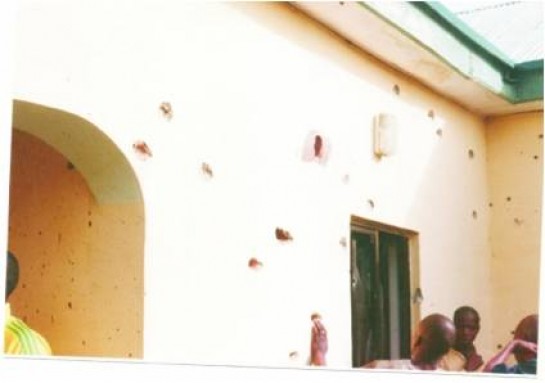
Sahara Reporters have released pictures of the compound after the attack.  WARNING: some of the pictures contain spatters of blood on the walls.  [pictures]

It is unclear how it came to be that the two hostages were killed but most sources agree that they were whisked deep inside of the compound as soon as the raid began and executed them immediately.  This would imply that the intervention had little chance of success to begin with if true.  It begs the question: why did foreign forces get involved?

The intervention of British forces on Nigerian soil seems now like a strange decision to have taken.  It is a clear sign that Britain did not trust the Nigerian forces, who they themselves had trained, to carry out the operation.  Instead it was led by the Special Boat Squadron (SBS) including Royal Marines in a mission which may have numbered twenty British personnel.

The Role of Nigerian State

Nigerian intelligence, according to President Goodluck Jonathan, has arrived at the definite conclusion that Boko Haram were behind the kidnappings and the attack.  This claim must be taken with a pinch of salt given the recent record of Nigerian intelligence, especially in dealing with Boko Haram.  It is in the interests of the Nigerian state to put forward a message that they are taking control of the deteriorating security situation in northern Nigeria.

If the narrative of the tragedy takes the form of ‘Nigerian forces kill eight members of Boko Haram following intelligence success’, it will reflect well.  If this was not Boko Haram, the intelligence reports from Kaduna must be looked at again to see if the tragedy was a result of a Nigerian intelligence failure.  For many in the north of Nigeria, the success and popularity of Boko Haram is down to the failings of the Nigerian State’s security.

Did the Terrorists Win?

The demands of the terrorists have not been stated.  If the intelligence reports from Kaduna are to be believed there must have been some hint at the ambitions of the organisation when these men were revealing the location of the hostages to the security services.  It has been reported that in the initial kidnapping, a large bag of money was left behind.  Perhaps the perpetrators believed that the ransom payout would be swift and bountiful.  Perhaps the kidnapping was for political rather than economic motivations.  To state a case for either based upon the bag of money would be pure speculation.  It is therefore more useful to look at the previous actions of Boko Haram to see if the terrorists were following a pattern.

The kidnapping of foreign nationals does not fit with the previous actions of Boko Haram.  Their demands have tended to be on religious institutions and local government with little violence reserved for international bodies (with the exception of the bombing of the UN in Abuja).  If the desire was, as with the UN, to gain international attention, the actions of British and Nigerian intelligence played straight into their hands by attempting what would be a futile rescue operation if it was carried out by Boko Haram.  The organisation could undoubtedly gain more attention from killing the hostages which begs the question: if British intelligence sources truly believe the aggressors to be Boko Haram, why did they play straight into their hands?

Below is my interview on Sky News as the news broke

What is Happening in Nigeria? Blood and Oil (Subsidies)

In this article the author looks at the current wave of political and economic turmoil sweeping Nigeria.  With a potential oil shutdown sending waves of panic across Brent Crude prices and terrorism forcing the closure of the borders the state is facing its largest crisis since its return to civilian rule in 1999.

_____________________________________________________________________________________________________________

by Jack Hamilton, 14 Jan, 2012

In 2010 the BBC released the controversial docudrama: ‘Blood and Oil’. It depicted a Nigeria crippled by corruption, protests and terrorism and was slammed for the tropes of endemic sleaze and violence. Executions, inhumane oil politics and the collusion of leading politicians in these atrocities were seen to reflect the Nigeria of the past. This is now the Nigeria of the present and it could be about to get a lot worse.

Occupy Nigeria

Naija Rising

This week the country closed its borders following counter-terrorism advice from the UN and a popular strike threatens to entirely shut down oil and gas production (accounting for over 90% of the export market) on Tuesday if demands are not met. There have been two crucial ultimatums:

1. Boko Haram has threatened to kill all Southerners (read: Christians) in the north if their demands of religious reform are not met. The attacks have already begun.

2. Occupy Nigeria has threatened to grind Nigeria’s export economy to a halt if their demands to maintain the fuel subsidy are not met. The deadline has been extended until Tuesday.

Facing a potential civil war and economic collapse, the Federal Government of Nigeria must act decisively.  There is no quick-fix.

There Might Be Blood – Subsidy Strikes

Who is Drinking Nigeria's Milkshake?

Nigerian oil and gas workers have threatened to shut down the Nigerian oil market, deepening the strikes against the withdrawal of petrol subsidies.  The government and unions are locked in talks which have been extended by two days as of today.  This leaves the government until Tuesday to find a solution or face economic meltdown.

The Petroleum and Natural Gas Senior Staff Association of Nigeria (Pengassan) have put all production platforms on red alert in anticipation of a shutdown. This demonstrates the lack of optimism in resolution being reached in time.

The crisis in Africa’s largest oil exporter has already had an international impact. Oil prices have already risen in anticipation of the shutdown and Nigeria’s export reserves would only last for six weeks.

Brent Crude prices have risen by $1 per barrel in a single day and in a global crude market already shaken by conflict in the Middle East and North Africa, a shutdown in Nigeria could have expansive ramifications. In an election year the last thing a US incumbent would like to see is a pinch at the pumps.

While the true international impact of the crisis is yet to be fully realised, it has already had a devastating impact domestically. The price of fuel has already more than doubled and the prices of other goods, including food, are skyrocketing. People are struggling to get to work, to put food on the table and to run their electricity generators. If the strike turns violent it is these people who will suffer.

Subsidies are seen to be the only benefit most Nigerians receive from the vast oil riches of the country. The argument for their removal is that they cost the state $8 billion per year in funds that could be better used on infrastructure and development. In a country in which government corruption is rife and the trust in the state is dangerously low it is clear that the people would like to see the money conferred through subsidies rather than pilfered by the ‘1%’.

The subsidy involved a huge amount of corruption but its removal does not equate to the removal of the corruption. It is merely a relocation.

Spreading Terror

The north of Nigeria is ‘sliding towards a full-blown guerrilla war’ according to The Economist. Boko Haram bombing campaigns have intensified since the Christmas Day attacks and acts of retribution have been carried out in the Christian south. The burning of a mosque in Benin City, southern Nigeria, demonstrates the dangerous roadmap the northern insurgency could instigate.

Fears abound over the potential links between Boko Haram, a small cult whose primary objective is the removal of secular education, and al Qaeda in the Islamic Maghreb.  Assertions of a broader terrorist network were originally purported by sources in the American military (AFRICOM) and the Algerian Government but on Tuesday this fear was also echoed by the United Nations.

Secretary-General Ban Ki-Moon has stated that ‘concerns will increase’ as the popularity of Boko Haram grows. The alleged sophistication of the attacks, especially the bombing of the UN in Abuja, has provided some substance for these assertions but the most recent activities reflect burgeoning brutality, not capability.

Goodluck Jonathan has responded to the fears of a vast terrorist network by closing the borders of the country. Nigeria’s international borders are now operating on high alert as the latest measures demonstrate the degree of force the Federal Government is willing to use to achieve peace and stability across the country.

Elevated force does not necessarily provide a solution for the state.  They are fighting a guerrilla organisation, galvanised by support from those who fear the encroachment of an over-zealous central government.  Memories of egregious state violence mean that heavy state mobilisation is likely to increase rather than diminish the allure of the Boko Haram message to those who feel alienated from the state.

Will Things Fall Apart?

The Occupy Nigeria protests and Boko Haram attacks are entirely separate movements with the common theme of opposing the Federal Government of the country. With opposition to government threatening the security and the economy of the nation questions abound over the future of Nigeria.

Jonathan has announced palliative measures the mass production of buses to ease the transport issues in the country as well as reducing government salaries by a quarter (although they remain obscenely high in such an impoverished nation).

The most recent response to Boko Haram has been a change in language. Jonathan has acknowledged that the support base may be more than purely criminal. In his speech on Monday he admitted that there may even be members of his government that identify with the organisation.

Talks with Occupy Nigeria have been extended by two days but there is a general lack of optimism for a rapid resolution. Boko Haram are intensifying their attacks and flickers of retribution have begun in the south. At present neither crisis shows signs of abating and the Federal Government is floundering.

Nigeria is being plunged into a future which looks ominously similar to its past. In this scenario ‘Blood and Oil’ appears rosy.

______________________________________________________________________________________________________________

For more on the recent crises in Nigeria and terrorism across West Africa see these articles on InPEC:

The State of Terrorism in Nigeria: The Rising Threat of Boko Haram

Photo Essay: 6 Reasons Terrorism is Gaining Momentum in Northern Nigeria

Securing Emptiness: The Sahara Desert and the Global War on Terror

Securing Emptiness: The Sahara Desert and the Global War on Terror

“So Geographers in Afric-maps With Savage-Pictures fill their Gaps” – Jonathan Swift

This article is the introduction to a series of pieces on the Sahara Desert. In this piece the author assesses the idea of emptiness and how this has come to be seen as a threat in international politics. In the words of Jonathan Swift, “So Geographers in Afric-maps With Savage-Pictures fill their Gaps”

______________________________________________________________________________________________________________________

By Jack Hamilton, 23 Dec, 2011

Emptiness is both romanticised and feared.  In this sense deserts serve as a geographical blank canvas upon which cultural and political views can be painted.  It is this fear of the unknown that ebbs into contemporary political and cultural tropes on the Sahara Desert.

Grazing from Mauritania in the West through the hinterlands of Mali, Algeria and Niger, to the Tibesti mountains of Chad towards the northern states of Nigeria, this is the land which has been described as the ‘swamp of terror’: the Sahara-Sahel.  The narrative of this terrain has drifted from romantic imaginings of nomadic caravans and peaceful Sufism towards depictions of drug smuggling routes and sandy bastions of violent Islamism threatening the West.  When did the ‘nomads’ become ‘terrorists’?

Security for the Insecure

The increased militarisation of the region makes it important to question how this shift in language has come about since the relatively brief introduction of the Global War on Terror (GWoT) to the area and the reasons as to why this occurred.  The current rhetoric used to describe the threat of Al-Qaeda in the Islamic Maghreb (AQIM) is predicated upon previous linguistic constructions of the Sahara as well as the more recent tropes of the GWoT to create a threat far surpassing the capabilities of the small group in the desert.

That is not to say that AQIM does not exist and is not a threat.  It is instead the assertion that the Sahara should be viewed as a diverse region in itself and not merely lumped into the cartography of insecurity put forward under the GWoT.

The Blank Canvas of the Desert

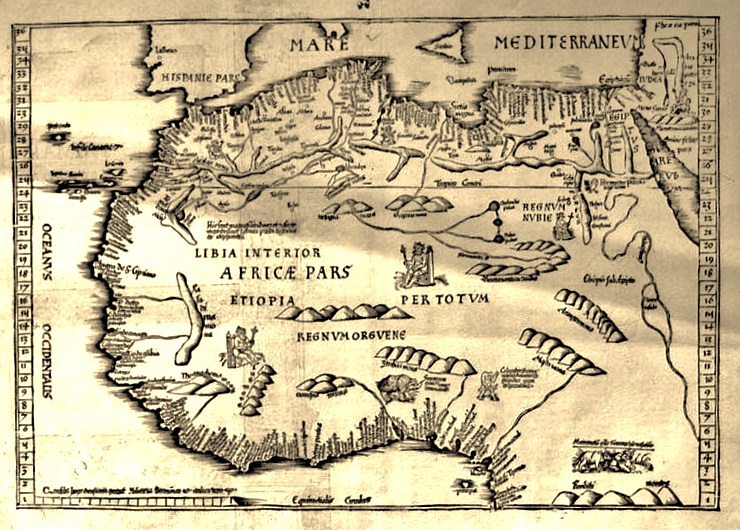
For centuries the unknown hinterlands of the Sahara have been imagined with colourful representations of nomads riding exotic beasts and African kings holding up the famed golden wealth of Africa in their hands.[i]

Defined by its emptiness, religion, wealth and potential threat, the lands to the south of the Mediterranean existed not as a discrete entity but an ebbing shore (or in Arabic, a Sahel) to other civilisations.  Such images have faded but the narratives remain.  The ‘shore’ now borders a ‘swamp of terror’[ii] that is perceived to traverse the globe, sustained by religion and poverty, to create the cartography of insecurity.

The decision to undertake a war in the Sahara may have been inherently political but the success of the messages of the Global War on Terror have relied on pre-existing tropes synonymous with Africa and the Sahara in particular.  The historian, E. Ann McDougall claims that ‘the Sahara has served the West as a canvas on which to paint its greed, fears and ambitions’[iii].  It is upon this cartographic canvas that a small group in the Sahara-Sahel has been constructed as a direct threat to the West.

Geographical Emptiness

Depictions of the Sahara centre on the notion of emptiness.  Maps show a land derelict of flora and fauna that isn’t delineated as being ‘North Africa’ nor can it be ‘Sub-Saharan Africa’ by definition.  It exists in the margins as it is seen as a margin in itself: a geographical ‘other’.  This drought of definitions has been extended into the narratives surrounding the Sahara-Sahel in the GWoT.

Deprived of distinguishing characteristics it has come to be defined by associations, geographical and rhetorical, to explain a region that is simultaneously devoid of life but teeming with insecurity.  It is therefore necessary to locate the Sahara-Sahel within the narratives of the GWoT to see where they interact with the ‘Savage-pictures’ to fill this geographical and rhetorical gap.

In this series the ‘emptiness’ of the Sahara will be evaluated by assessing the threat of al-Qaeda in the Islamic Maghreb in comparison to the forces being deployed to fight against them.  The next article will assess the position of the Sahara in the Global War on Terror and place the region within the global cartography of insecurity.

_________________________________________________________________________________________________________________


[i] This most famous of these pictures is in the Catalan Atlas published in 1356, drawn by Abraham Cresques.  The original is in the Bibliotheque Nationale, Paris and can be also found on the internet at: http://www.georgeglazer.com/maps/world/catalanenane.html. accessed on 28 August 2011.

[ii] Powell, ‘Swamp of Terror in the Sahara’.

[iii] E. Ann McDougall, ‘Constructing Emptiness: Islam, Violence and Terror in the Historical Making of the Sahara’, Journal of Contemporary African Studies, 25 (1: 2007), p. 17.

Photo Essay: 6 Reasons Why Terror is Gaining Momentum in Northern Nigeria

Looking for a Future

The state of Nigeria is facing its largest crisis in over a decade.  As the ferocity and popularity of the Islamist terrorist group Boko Haram rises, the very unity of the state is being challenged. This collection of photos assesses the reasons why the group is becoming increasingly attractive to the disaffected population in the north despite their gruesome tactics.

For more on Boko Haram see ‘The State of Terrorism in Nigeria’


By Jack Hamilton, 14 Dec 2011

1. The Lost Generation

The 'Lost' Generation

Northern Nigeria is a youthful place. Having maintained a high birth rate for decades, over half of the population is now under the age of 30. The average fertility rate in Nigeria is 5.7. In the northern states it is 7.3. This demographic shift has arrived at a time in which unemployment is rife and the perception of victimisation by the federal government is strengthening. There is now a generation of young, unemployed northern Nigerians who feel alienated from the central government and see flagrant displays of wealth in Nollywood films depicting the southern cities of Lagos and Port Harcourt. This sentiment of marginalisation has been utilised effectively in the propaganda of Boko Haram.


2. Religion

A Sign of the Times

The use of religion as a political tool goes back to the pre-colonial era of Nigerian history.  Now a democratic state, in theory one religion should not take precedence over another (a notion enshrined in the Nigerian Constitution).  Despite this, religious disputes consume much of Nigeria  in an ongoing conflict which has claimed thousands of lives.  Politics, especially in electoral cycles, so often comes down to religion.

Boko Haram is a religious actor whose primary goal is to implement Sharia law across the entire state of Nigeria.  They claim that the 50.5% population of Muslims is underrepresented at a Federal level and advocate extreme violence to achieve their objectives.  It is clear that the vast majority of Muslims in Nigeria do not support the religious stance of the group but the popularity of Sharia law since its institution in the twelve northern states shows the strength of faith in the region.

The complexity of the ethno-religious conflicts engulfing the Middle Belt and the north of Nigeria is difficult to summarise here.  While the attacks of Boko Haram are frequently framed as solely religious actions the reality is a more complex conflagration of ethnicity, alienation, fear and insecurity.


3. Urban Planning

Street Politics

Islamic design resonates in the street networks of Kano. To ensure privacy and the seclusion of women the city does not have a regularized street network and instead seeks to avoid long lines of sight and open vantage points. A consequence of this urban planning has been that non-Muslim migrants to the city have been taken up residence in the non-Muslim enclave, ‘Sabon Gari’ (colloquially: ‘Sabo’). This has meant that the cities of the north have grown from having a single core to being polynucleated with conflicting parties living side by side but not together. When conflict erupts in urban areas, it can be explosive. Boko Haram attacks frequently target the ‘Sabo’ districts.


4. Mistrust

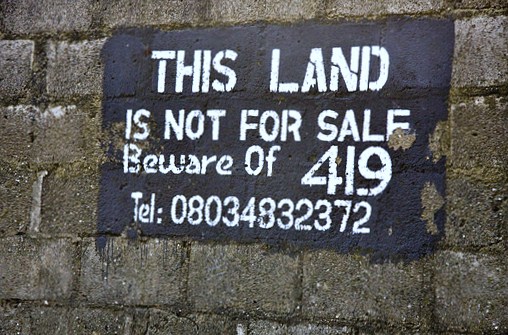
Beware 419

The mere mention of Nigeria often conjures the phrase ‘419’. While popularly known as an internet scam, the number is derived from the property laws in Nigeria in which Law 419 outlines property ownership. The phrase ‘Beware 419’ litters walls across the country to alert ‘potential buyers’ that the house is in fact inhabited and not for sale. After asking for a deposit up front the criminal will flee the scene leaving the ‘new owners’ to confront the current occupants. Mutual distrust is rife.


5. The Security Vacuum

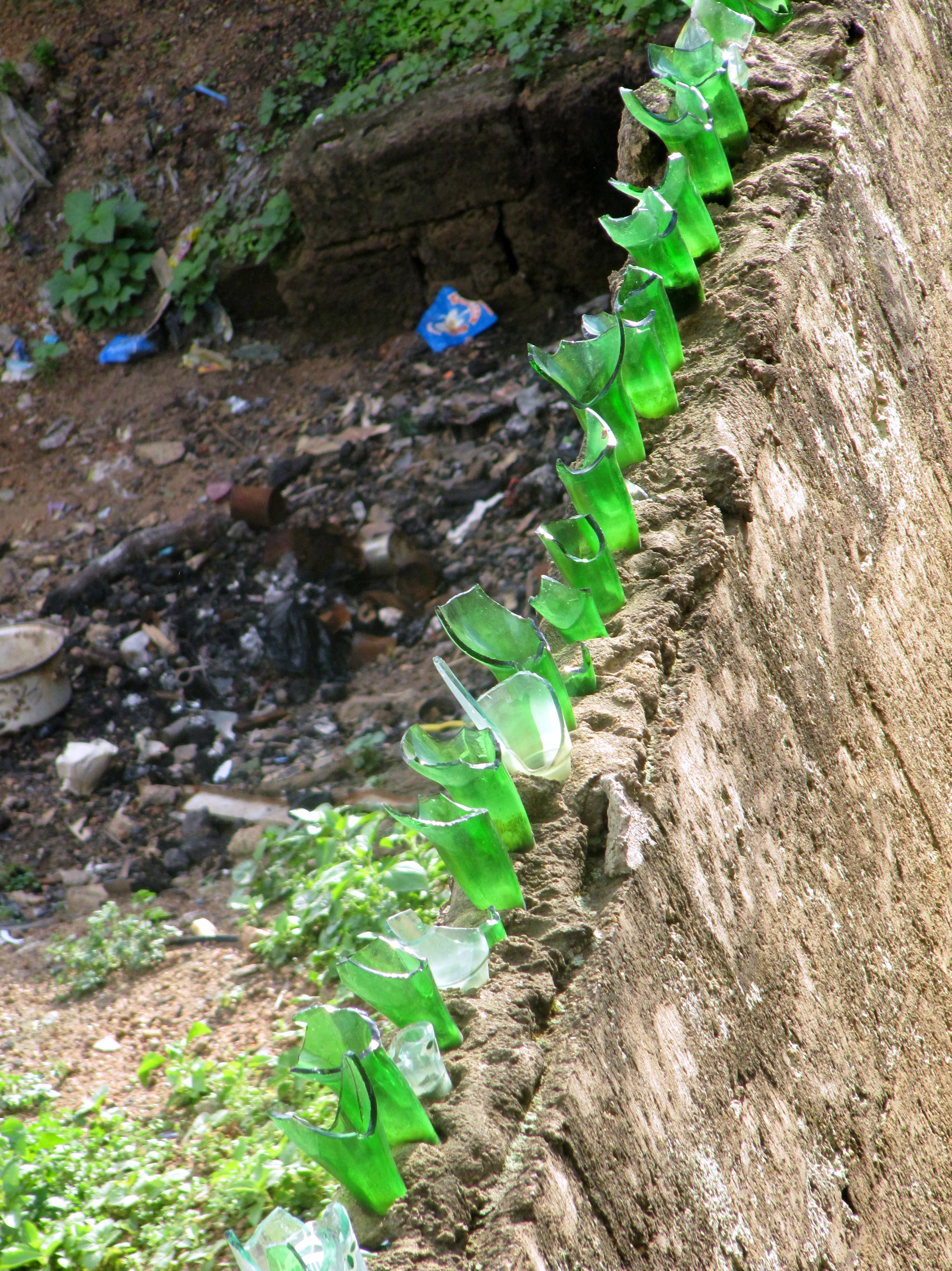
And if one green bottle should accidently fall...

Personal security takes primacy in the north of Nigeria. A lack of trust in the central authority of the state manifests itself in personal security measures. This picture shows the rows of broken glass bottles cemented into the top of a wall to deter intruders. Such walls surround houses in both high and low income areas as violent crime and theft is endemic. Disdain towards the Nigerian security forces have meant that the horrific bomb attacks of Boko Haram on police stations and international organisations have helped to garner support for the terrorist group.


6. Health

Testing Times

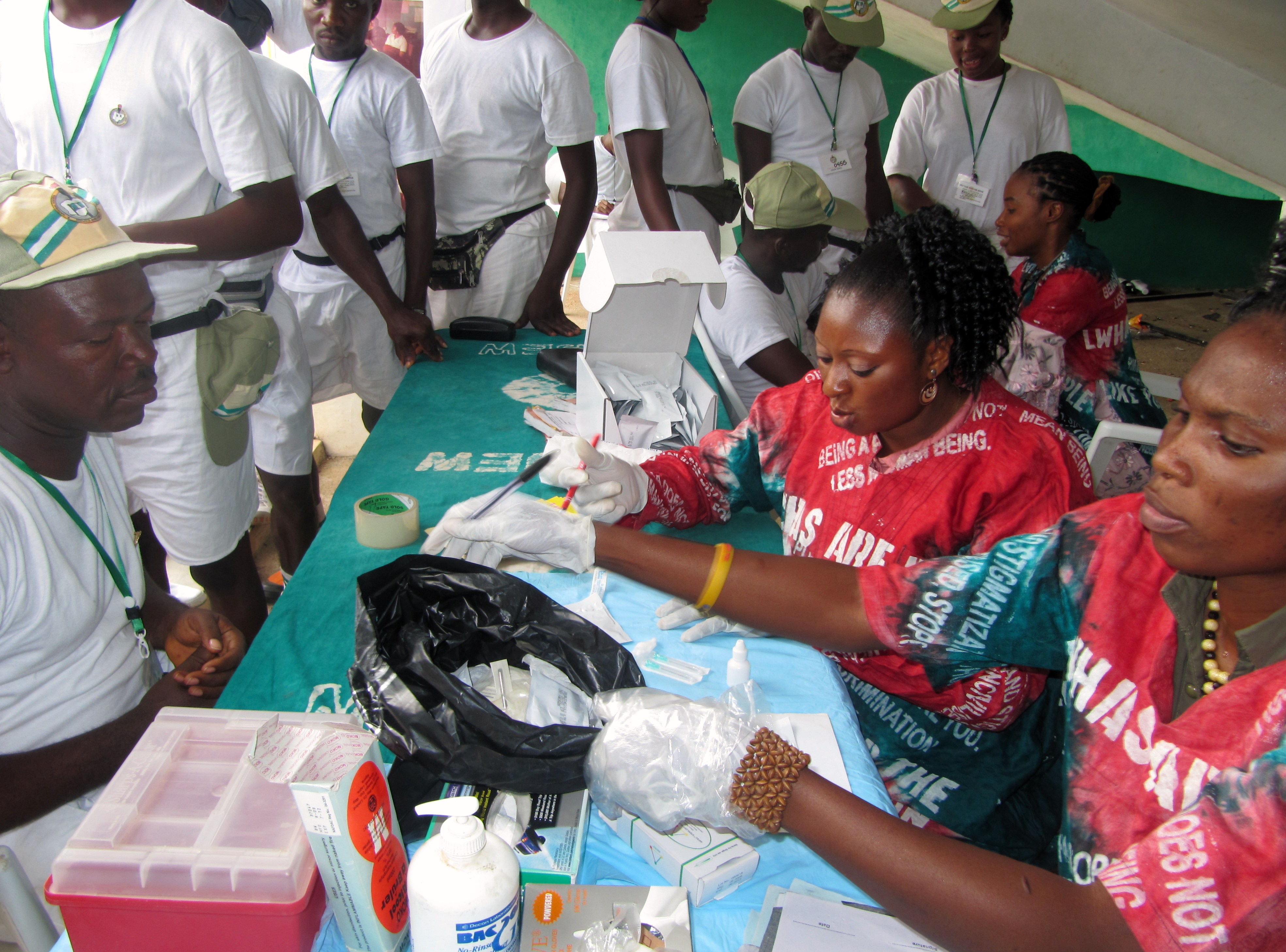
Northern Nigeria continuously faces a shortage of doctors known as a ‘brain drain’: doctors migrate to higher paying positions in the south of the country or further afield in Europe and North America. The issues of malnutrition and water shortages are taking their toll as the climate of the arid northern regions becomes increasingly inhospitable. Medicinal supplies are insufficient at current levels as malaria and HIV/AIDS remain at constant levels and when aid does arrive it has on occasion been mismanaged. In 2009 alone 84 children in the northern states died after ingesting a batch of contaminated teething medication.

The State of Terrorism in Nigeria: The Rising Threat of Boko Haram

In this article the author assesses the rising threat of the Nigerian terrorist organisation, Boko Haram.  The most recent spate of bombings and executions has raised questions over the unity of the Nigerian state and the future of security on the continent.  It is therefore necessary to understand why Boko Haram is increasing in popularity as their attacks become increasingly barbaric.


By Jack Hamilton, 14 Nov, 2011

Unchecked Massacre

Brutal attacks in Nigeria over the past week have left over 100 people dead.  A single small religious group has transmogrified into a dynamic terrorist organisation capable of rapidly changing tactics and targets in a pattern of violence responsible for over 1000 deaths in northern Nigeria since 2009.

Last week the gunmen wandered around the northern town of Damaturu killing any Christian who could not recite the Islamic creed on the spot.  Nigeria’s Defence Minister Bello Halliru Mohammed has stated that the security forces once again have control and that there is nothing to fear but his words have assured few.

The fact remains that there is still no coherent strategy to combat Boko Haram.


Rising Intensity

The nature of recent events has shocked many, even in regions where Boko Haram attacks are frequent.  Residents expressed rage at the ease with which gunmen were able to take over the city and leave bodies littering the streets.  Police stations, mosques and churches were reduced to rubble before the security forces mobilised a response.  At that point members of the group engaged in gun battles across the city that lasted for hours.

The situation in northern Nigeria is degenerating rapidly.  International observers fear that Boko Haram may already have links to al-Qaeda and al-Shabab and that the campaign of terror shows no signs of abating.

In order to understand Boko Haram it is first necessary to look at who they are, what they want and how they believe they can achieve it.

Who

Boko Haram colloquially translates as “Western education is forbidden”.  It is a claim to reject all things Western from the theory of evolution to Western-style banking.  This has manifested itself in different tactics since the emergence of the group in 2002.  Before 2009 there were no signs that the group desired the overthrow of the state and rather preached to withdraw from the institutions of the non-Sharia Nigerian nation.  It was a law banning the riding of motorbikes without helmets that would prove to be the catalyst for violence.

In July 2009 the central government sought to enforce the law on helmets.  Boko Haram flouted the legislation and was subjected to police brutality which in turn set off an armed uprising in Bauchi, later spreading to Kano, Borno and Yobe.  By the time the army had suppressed the situation over 800 people were dead across the north of the country.

Since 2009 the group has spread rapidly.  The majority of the attacks have taken place in Borno state but Boko Haram have also expanded to the northern states of Adamawa, Bauchi, Gombe, Kaduna, Katsina and Sokoto as well as the attacks on Abuja and threats against Lagos.  In addition to the geographical spread there has been a change in tactics from the localised skirmishes to strategic suicide bombing campaigns and massacres directed not only at Nigerian security forces but also international targets such as the UN.

Tactics

Boko Haram have changed their tactics over the years.  Under their previous leader, Mohammed Yusuf, the group staged mass uprisings against the police and suffered hundreds of casualties.  After Yusuf’s death at the hands of security forces in 2009 they began using tactics more in line with jihadist terrorism including the first suicide bombings in Nigeria’s history.

The attack on the UN may have been an attempt to pressure the international community or perhaps it was simply to embarrass the Nigerian state but it succeeded in drawing global attention to a burgeoning problem.  Boko Haram may be diffuse but it is expanding geographically with increasing tactical sophistication.

Composition

As Boko Haram expands the questions over their composition complicate.  According to Paul Lubeck, an expert on northern Nigeria, Boko Haram is not a single group but a collection of splinters banded under one name by the Federal Government.  One section appears willing to negotiate while others remain determined to intensify the bombing campaign.

Some statements reflect a strict adherence to Islamic law while others cite a determination for a smaller Nigerian state as their raison d’être.  If the group is as amorphous as Lubeck claims it will make it very difficult to negotiate with let alone combat.

Grievances

Economic

The structural issues of northern Nigeria have allowed Boko Haram to thrive in recent years.  In addition to acute poverty the region has a high birth rate and 50% of the population are below the age of 30.

Inequality, unemployment and industrial stagnation have exacerbated the perception that the north has been marginalised by the liberalisation of the Nigerian economy.  The question of who owns the land has not been answered since independence and the Federal State seems too far away and blighted by corruption to deal with such issues.

Political

Grievances in the north were compounded by the election of a southerner, Goodluck Jonathan, as President earlier this year.  Jonathan assumed the office following the death of the northern Muslim President Umaru Yar’Adua and many northerners believe Jonathan should have stepped aside to allow another northerner to take Yar’Adua’s place.  This would have been in line with the ‘gentleman’s agreement’ that the Presidency should rotate between the north, the south-west and the south-east every two terms.

Security

The administration is treating Boko Haram as a security issue rather than tackling the divisive subject of poverty in the north.  Abuja’s response has been to flood the north with heavy-handed military and police forces that now stand accused of human rights violations against civilians.

Politicians in the north have begged for the numbers of security forces to be reduced as police corruption has become rife.  For many in the north the police are the face of the central government.  The people feel alienated from a force they perceive to be corrupt.

Responding to Boko Haram

For many the heavy military presence in the north is the single most important hindrance in securing any negotiated peace.  The failed attempt to destroy the group in 2009 was the greatest recruitment drive Boko Haram could have hoped for, especially the controversial extra-judicial killing of the leader Mohammed Yusuf.

The current strength of Boko Haram is largely a result of such poor foresight by the Nigerian state.  As a result there is now a security vacuum in the most heavily militarised region of the country.

Flagrant myopia has created martyrs and swelled the ranks of the guerrillas.  The legal response to the killing of Yusuf is a good first step but it does little to combat the issues of poverty and corruption that are integral to Boko Haram’s recruitment.

Opposition leaders in the north claim that the government has failed to understand the amount of support Boko Haram has amongst the population.  By stating their opposition to central government and corruption the group has grown far beyond their initial religious doctrine and the government will need to find a response to the structural inequalities in Nigeria if the terrorists are to lose their supporters.  It does not appear as if this is going to happen any time soon.  It is possible that Boko Haram may actually be growing beyond the borders of Nigeria.

The Anti-Social Network?

Many experts have questioned whether the increased tactical sophistication of Boko Haram is evidence of the group branching out to international terrorist organisations, especially al-Qaeda in the Islamic Maghreb (AQIM).  A change in tack to target international organisations with large high-tech bombs has caused concern.  General Ham, head of US Africa Command, believes that the worst case scenario already exists and that Boko Haram are working in tandem with AQIM and al-Shabab in a “loose” partnership.

Hard evidence for any such link is still to be produced.  The geographical distance between AQIM, Boko Haram and al-Shabab make such a partnership unlikely and the possibility remains that the increased military technology may have come from within Nigeria itself.  Alex Thurston, an expert on terrorism in the region, has posited that it is more likely the sophistication came from disaffected Nigerian soldiers than any international training.

The Future State of Nigeria

The failure of the government reactions have meant that Boko Haram has been successful in achieving one of their primary goals: the weakening of the legitimacy of the state.  Attacks on international organisations have created increased pressure on Jonathan to find a solution to the problem.  The short-term solution of heavy military deployment may eventually yield similar successes to those against the militant groups in the Niger Delta but it would also undermine the cohesion of Nigeria.  This would also act to provide momentum for Boko Haram.

The failure to develop a clear strategy to combat the small Islamic group in 2009 has forced the Nigerian state to face up to the larger structural issues concerning the north.  A solely military solution is no longer feasible.

The Lighthouse in the Desert


By Jack Hamilton, 9 Oct, 2011

Folklore spills across time creating and undoing history as it ebbs. Whole identities can be constructed and deconstructed in these stories but it is rare in these ages that entire maps can be reimagined due to a single small tree. The old addage “so geographers in Afric maps, with savage pictures fill their gaps” has long since faded but this is a story about one such ‘gap’, the one piece of life within it and the price of life that goes with it.

The Sahara Desert is awash with a sandstorm of whispers and this particular spec is the lonely Tree of Ténéré. It is a story which entails trust amidst gossip as well as the dangers of blind trust in a terrain in which one can see for miles. Upon first hearing the story I didn’t believe that such a tree could ever have existed. In recent weeks a terrorist cell linked to al-Qaeda was undone by their belief that the tree still existed. However, I must start by describing the story of the tree.

There was once a solitary tree standing in the centre of the Sahara Desert. Between the Baobabs of Senegal and the Olive Trees of Tunisia remained one sole survivor of a bygone era. Millenia ago the tree had been part of a great forest which had gradually died off as the Sahara became the inhospitable mother she is today. One tree remained to guide all those who dared to traverse the barren lands. It was a beacon: the lighthouse in the desert.

The nomads of the desert alone knew of this tree and used it as a tracking mechanism when traversing the most desolate depths of enduring beige. When these Tuareg would encounter the Fulani in north east Mali they would recount their tracks in order to let the Fulani know of their passage, including the waypoint of the tree in the middle of the desert. Having listened politely to the detailed directions the Fulani would thank the Tuareg and see them on their way providing that no disagreements had been reached.

At this stage the Fulani would all agree never to follow the route of the Tuareg. These men had seemingly been driven dangerously insane by the desert. Of course, there is no chance for a tree to exist in such a place. There are no trees for hundreds of miles in the Sahel (the shoreline of the desert), let alone the Sahara. If this route had a proclivity for perverting the minds of the fearsome Tuareg, it was no place for men.

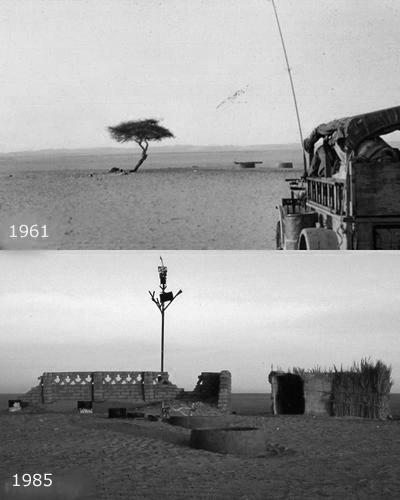
This story circulated until the times when modern technology made it possible for mere mortals to take the route. Safe inside the machinery that would be used to fight the Second World War, Europeans were able to cross the desert here in hopes of cutting off a rival. It was at this time that they too believed themselves to have gone insane too as in the horizon the withered spectre of an acacia tree loomed. They had not been in the desert long enough to have reached the Libyan coast and had not crossed the Italian lines that would have inevitably preceded the water. It could not be Algeria as there had been no sign of the southern Air mountains. The story was true. They had discovered the Tree of Ténéré. The most isolated life on Earth.

It is here that a part of the mystery ends. Confused and in search of the truth the Europeans (a French division) decided to dig underneath the tree and discovered a well 35 metres down. While the fairytale of the tree was slightly depleted the beacon took on a new significance as not only being the only life but suddenly becoming a redeemer of life in the harsh conditions of the Sahara. The tree was not a mirage but the literal symbol of water in the desert.

However, as with all of these stories of the desert, it ends in tragedy. In the 1970s a Libyan truck driver somehow careered into the tree, allegedly drunk. Upon hearing this part of the story I was always interested to hear how the driver could explain this to his boss. He had somehow managed to hit the only tree in a 400km radius.

The reason I was reminded of this story was due to reading intelligence reports from the security forces tracking al-Qaeda in the Islamic Maghreb (the Saharan branch of the terrorist organisation). One of the Algerian trackers claimed that they had an intimate knowledge of the desert and in the pursuit they had passed the Tree of Ténéré. Today in the place of the tree stands a simple metal sculpture representing the optimism of the tree. Unfortunately the tracker described in great detail the tree as it looked before the 1970s, exactly the description that was recounted to me. It was clear that the ‘trackers’ did not know the desert and had possibly never crossed into Niger where the tree used to stand. They were found out immediately.

The idea of the Tree of Ténéré had always seemed to me like one of the lies which whispers around the desert. It brought a smile to my face that the myth was actually the truth and it was this fact that unveiled the fiction.


Jack Hamilton can be followed on Twitter @jmhamilton