A Pocket Guide – The 1942 US Army Booklet on Northern Ireland – Part 2

This is the second in a series of articles compiling the US Army guide to Northern Ireland during World War Two. Following the bombing of Pearl Harbor the US agreed to take over the defence of the region to free up British troops to fight in North Africa and the Middle East. It also gave the US the time to complete invaluable military training before entering the war in Europe. This was the manual given to the first officers to arrive in Belfast on 23 January, 1942.

The first article outlined the differences between the North and South of Ireland as well as the two key rules for any visitor:

(1) Don’t argue religion
(2) Don’t argue politics

This excerpt describes the country: the geography, climate and feel of living in Northern Ireland.

_______________________________________________________________________________________________________

The Country
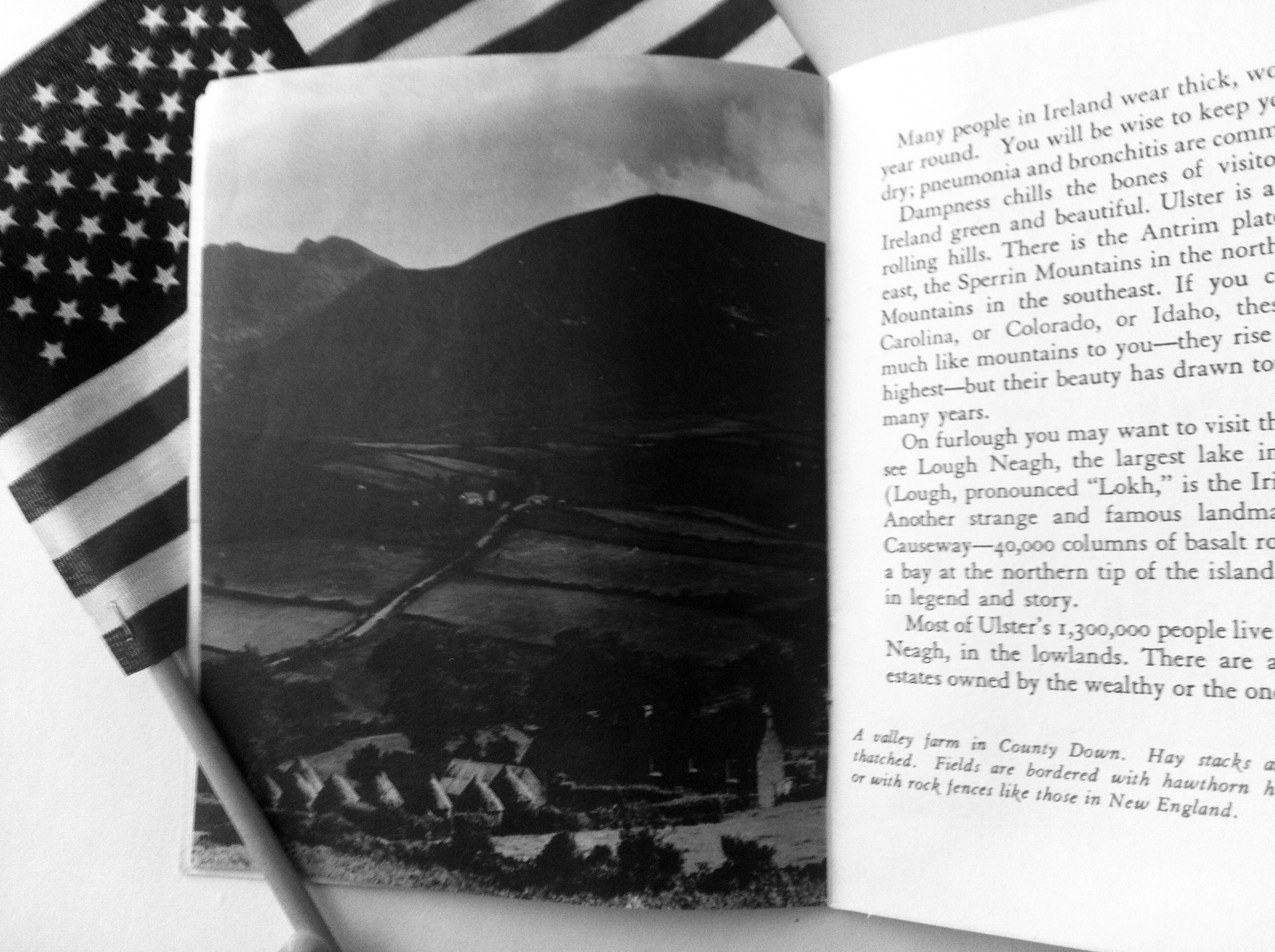
A valley farm in County Down. Hay stacks are neatly thatched. Fields are bordered with hawthorn hedgerows or with rock fences like those in New England

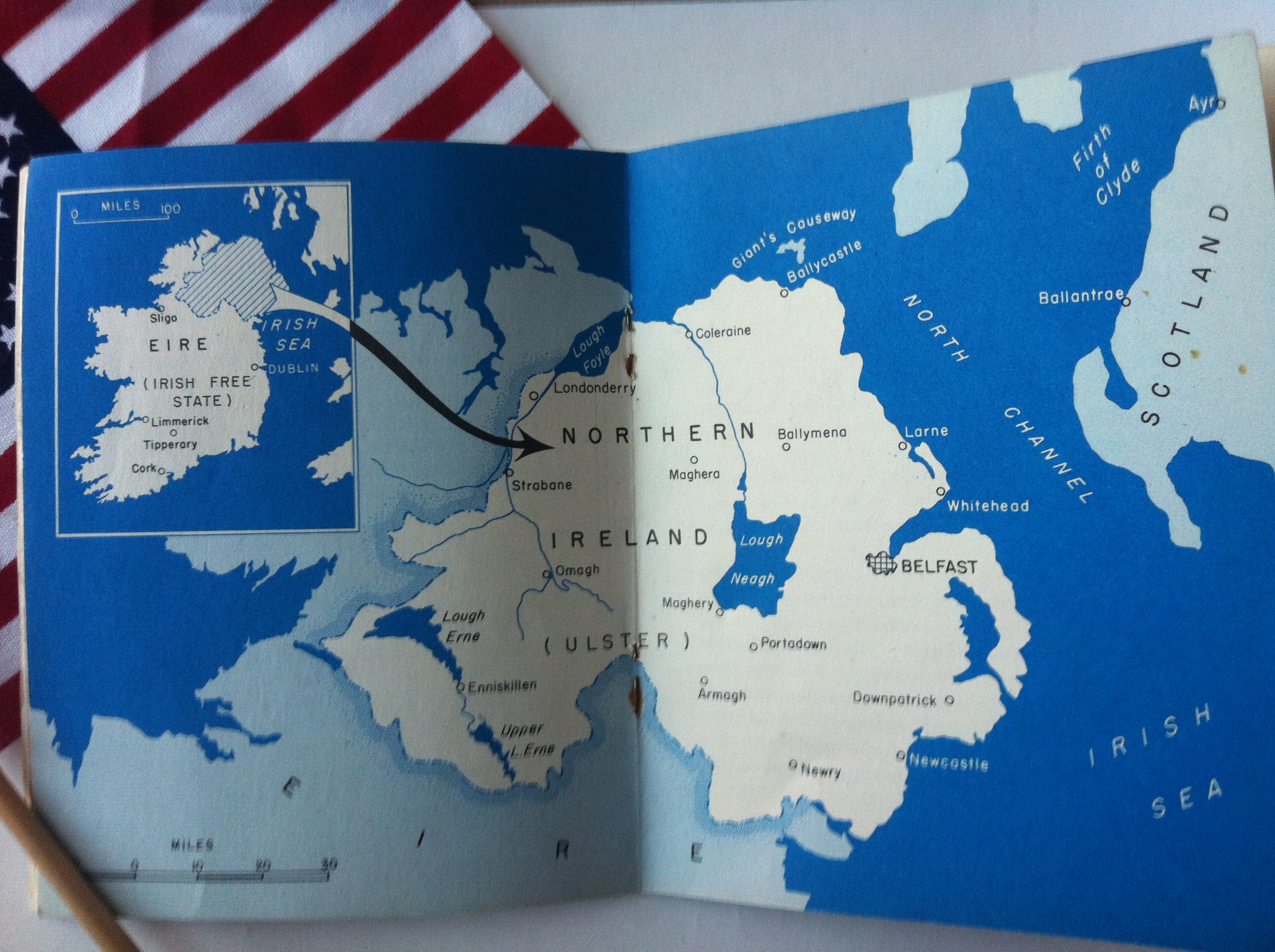
NORTHERN Ireland – usually called Ulster – is a small country, only slightly larger than the State of Connecticut. It is made up of the six counties in the northeastern corner of the island: Antrim, Armagh, Down, Londonderry, Fermanagh, and Tyrone. Some 1,300,000 people – not quite so many as Los Angeles – live there.

First off you may not like the Irish climate. It is damp, chilly, rainy. If you are from the Southwest or from California you may find yourself homesick for sunshine. The sun is only an occasional visitor in Ireland; there are about 200 rainy days a year. The rains, however, come usually as gentle drizzles, not as thundershowers.

It may be news to you that Ireland is farther north than the United States. For this reason the day is very short in winter and long in summer. In late June and July there is little darkness and you will be able to read a newspaper at 9 o’clock at night. In late December daylight lasts less than 7 hours, and darkness closes by midafternoon.
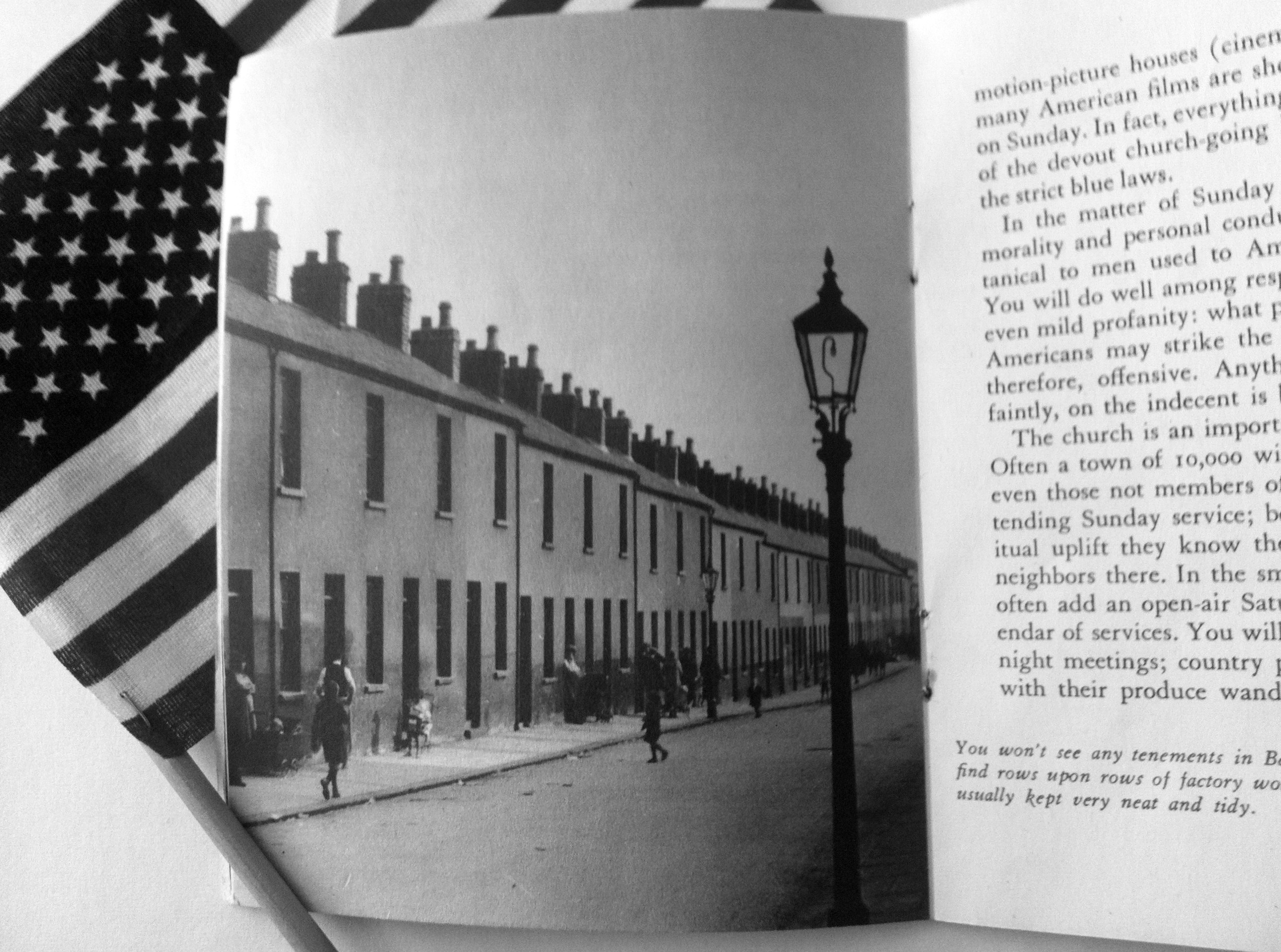
You won't see any tenements in Belfast. Instead, you will find rows upon rows of factory workers' homes like these, usually kept very neat and tidy

Despite Ireland’s northliness – it lies about exactly opposite Labrador – extremes of heat and cold are rare. In the summer a temperature of 80 degrees is the peak of a heat wave, and in winter freezing weather is the exception rather than the rule. It is the always-present dampness which make the cool summers and mild winters seem colder than they are.

Many people in Ireland will wear thick, woollen clothing the year round. You will be wise to keep yourself warm and dry; pneumonia and bronchitis are common.

Dampness chills the bones of visitors, but it makes Ireland green and beautiful. Ulster is a saucer circles by rolling hills. There is the Antrim plateau in the north-east, the Sperrin Mountains in the northwest, the Mourne Mountains in the southeast. If you come from North Carolina, or Colorado, or Idaho, these may not seem much like mountains to you – they rise 3,000 feet at their highest – but their beauty has drawn tourists to Ulster for many years.

On furlough you may want to visit the mountains, or to see Lough Neagh, the largest lake in the British Isles. (Lough, pronounced ‘Lokh’, is the Irish word for lake.) Another strange and famous landmark is the Giant’s Causeway – 40,000 columns of basalt rock which rise from a bay at the northern tip of the island. This is celebrated in legend and story.

The shipbuilding yards of Belfast are among the very largest in the world. Before the war, when this picture was taken, giant liners, including the ill-fated Titanic, were launched here. Now the yards are busy day and night building ships of war

Most of Ulster’s 1,300,000 people live northeast of Lough Neagh, in the lowlands. There are a good many large estates owned by the wealthy or the once-wealthy, and you will find ancient turreted castles scattered among the hills and the glens, but most of the Irish farmers manage to make their livings on plots of land which Americans, used to tractors and far horizons, would think hardly larger than ample vegetable gardens.

This scale of farming will seem almost absurdly small to you who come from the Middle West or the Far West. There are 90,000 farms in Ulster with tiny fields and small, whitewashed, thatched-roof cottages. A 5-acre place is really substantial and anyone who owns more than 40 acres is considered to be engaged in large-scale farming. Fine cattle graze on the pasture land, and hay, potatoes, turnips, and wheat are grown.

Belfast is the most important industrial center in Ireland, and one of the key points of the British war effort. It has a population of 438,000 – one-third of the people in all Ulster live there – and is slightly larger than Kansas City, Missouri. Belfast was badly bombed by the Germans in 1940. Londonderry (called Derry by the Irish), the second city of Ulster, is located on the North Coast, and had a population of 43,000 before the war.

Belfast today resembles many American cities where the weapons of war are being forged as fast as industrial wheels will turn. The production of linen in peacetime is a great industry; Irish linens are known all over the world. Today much of the linen industry has been converted to the manufacture of cotton goods – cloth for British Army uniforms.

Farewell to Nuclear Weapons or the Failure of Civilisation

In this article, the author praises Mikhail Gorbachev for his renewed call for nuclear disarmament and discusses some of the myths surrounding nuclear weapons and nuclear deterrence. Drawing on psychology and psychoanalysis he concludes that denial is making us accomplices of the greatest atrocity known to civilisation.


By David J. Franco, 20 Oct, 2011

This morning I read Mikhail Gorbachev’s renewed call for nuclear disarmament. In his article A Farewell to the Nuclear Sword of Damocles former USSR President and artifice of the Perestroika warns that ‘by failing to propose a compelling plan for nuclear disarmament, the US, Russia, and the remaining nuclear powers are promoting through inaction a future in which nuclear weapons will inevitably be used’. As much as I was happy to read that Gorbachev is determined to continue the job he started as a man of power, I experienced a mixture of unhappiness and distaste upon reading the following commentary left by one of the readers:

‘The genie is out of the bottle, and cannot be put back inside.

Nuclear weapons ended WWII and kept the world from WWIII. So long as nations have these weapons, there will not be another World War. The presence of these arms has saved millions of lives. For example, they maintain the relative peace between India and Pakistan – because neither one wants to be bombed. I hope, really hope, that they will never be used, and that there will come a time when they are not needed or present.

As long as humankind insists on not living together in peace, these weapons are needed. I see little hope of changing human nature in the near term.’

Unhappiness and distaste, indeed, for the above analysis is misguiding at its best. Arguing that nuclear weapons are the sole reason for which the world has not lived a third world war is misleading and lacks scientific rigor. The great powers went through their longest period of peace between 1815 and 1914 (with the permission of the Crimean War and the Franco-Prussian exchange) when neither nuclear weapons nor United Nations existed as yet. Lessons from the past and, more plausibly, utilitarian calculations may be more at the core of why the world has not known a third world war. Further, the presence of these weapons, and their only use to this day, caused thousands of instant deaths in Hiroshima and Nagasaki. The Japanese army had been defeated by the time those weapons were dropped which means that the decision responded more to the need to announce the world who the new boss was. Hence, rather than saving millions of lives nuclear weapons have the honour to have caused the largest number of deaths at once in the history of human warfare. They also hold the record for bringing the greatest level of suffering to a non-combatant population during and after (many years after) the dropping of the bombs – you may want to read statements of survivorsor watch the acclaimed BBC film Threads.

Nuclear weapons and nuclear deterrence are said to be the reason for the relative peace between India and Pakistan, or the US and the USSR for the same matter. To demonstrate the contrary is an impossible task for it is impossible to prove something in the negative. However, if anything the existence of nuclear weapons in South Asia increases the security dilemma and exposes the region and the world to greater risk. But of course our commentator knows better and even delights us with his wishful thinking: ‘I hope, really hope, that they will never be used’. Well, for what it matters I do hope that they will never be used and for that reason I do hope that they are eliminated.

One of the greatest obstacles in the quest to eliminate nuclear weapons is said to be what in psychological or psychoanalytical terms is known as denial. Denial to accept the inner destructiveness of human beings in general and, more specifically, denial to see that destructiveness in ourselves as much as we can see it in our enemies. For in each of us, individually and collectively, there is as much good as there is evil. There may be multiple interrelated causes for war, amongst which I count political, economic, ethnic, religious, etc. But it is also a fact that human beings are naturally aggressive (of course some are more violent than others but all may become equally violent under certain circumstances). In short, regardless of whether life and death instincts clash with one another permanently, or whether necrophilious instincts take over only when love for life fails, the fact is that each of us, with no exception, is capable of the best and of the worst. The Russians weren’t worse than the Americans, and the Americans weren’t better than the Russians. For there is only one human race, not two –the good and the bad–, as many want us believe.

Nuclear deterrence policies are said to be rational and to fail only when dealing with irrational leaders or terrorists. Two things need be said in relation to this. First, there is nothing rational when a nation is defended with the most (self)destructive weapons ever created by man. Not even Tilly’s theory of war makes states, assuming such theory is valid, holds sway when all that is left after a nuclear explosion is a pile of debris and millions of dead in an inhospitable land. State leaders and terrorists seem equally irrational in light of this –plus so far only leaders have dropped a nuclear bomb. Second, nuclear deterrence policies can only make sense in the event that mankind’s inner destructiveness is denied or disregarded. Man has fought wars since the start and it will likely continue to fight wars until the end. International cooperation and norms can tame behavior and arguably, only arguably, change state interests. A change in the superstructure may also arguably help outlaw human competition. But as long as men have nuclear weapons at hand ready to be launched civilisation will continue to see the word failure each time it looks at itself in the mirror. For we do not need another nuclear explosion to confirm that we have failed. Civilization is already failing.

In a sense I am relieved that the author of the above commentary leaves denial aside to acknowledge mankind’s inner (self)destructiveness. What on the contrary puzzles me is that despite this, or because of this, he/she is led to conclude that nuclear weapons are necessary in order to maintain peace. The answer to this problem, he/she argues, is not to eradicate nuclear weapons but to eradicate war from the face of the earth. But because man is violent and will always be, war will always prevail and nuclear weapons will always be needed to maintain peace in the absence of better means. Against the argument that man will always fight wars because of its inner violence one may say that social conclusions cannot always be derived from biological conditions. Those who argue that may indeed have a point. But that is not the point. The key question here is: should we continue to allow the existence of nuclear weapons ad eternum? Even if we were to assume that it has worked in the past, are we fully certain that nuclear deterrence will always work in the future? If not, are the effects of a nuclear exchange something the world can afford? My view is that none of these questions can be answered in the positive. Nuclear deterrence will not always work and the effects of a nuclear exchange (there cannot exist such a thing as limited nuclear exchange) are not something civilisation can afford.

I am too young to have lived the nuclear anxiety of the Cold War years, but I am old enough to observe that such anxiety, although not particularly manifest in the West these days, can make a comeback any second. It only takes a renewed crisis or a change in the international order to revert the current situation. Note that I do not discuss here the possibility of a nuclear explosion caused by miscalculation or accidental use because this short article addresses mainly the contents of the commentary noted above. But miscalculation and/ or accidental use, too, can take place any minute and the effects of that happening will be as equally devastating as a nuclear exchange. Because, believe me, just as it is a matter of time before a state or terrorist cell uses a nuclear bomb, it is also a matter of time before one is dropped accidentally. The great powers have a duty to lead and to fulfill their obligations in accordance to international law including their obligation to disarm as per article VI of the Non-Proliferation Treaty. As long as they do not work together towards that goal, leaving aside irrational notions of power and prestige, the world will continue to see the emergence of new wanna-be proliferators. In a purely Orwellian fashion, history gets rewritten and those who are friends today can easily become enemies tomorrow. Memory too gets erased easily and it seems that not many today in the West remember what it was like to live under the threat of a nuclear exchange. I do not blame them for not remembering but I do blame them for not wanting to remember. When something has not been sorted it cannot be left ignored as if the problem did not exist in the first instance. Denial is the most dangerous of all self-defence mechanisms. Whether we like it or not, it is automatically making us accomplice of the worst atrocity facing civilization: its own failure.