Are transnational socioeconomic trends trumping Zionist ideology in the Occupied Palestinian Territories?

In this essay, the author explores how globalization of Israeli capital has undermined the ideological thrust of Zionism in constructing policies towards Occupied Palestinian Territories. 


By Kanchi Gupta, 27th August, 2012

This essay demonstrates that while Zionist ideology is predicated on the expansion and territorial integrity of ‘Eretz Israel’, the nature of its administrative regime was steered by Israel’s internal socioeconomic dynamics. Israel’s sui generis ‘instrumentalization’ for the ingathering of global Jewish diaspora and resulting ethnic make-up, as well as social democratic, secular and religio-national ideological preferences are inclusive of Israeli political structure. However, as Israel’s economy opened to global capital, neoliberal capital interests spilled across borders and determined the construction of Israel’s policies in Occupied Palestinian Territories. Therefore, the essay determines that Israeli policy outlined below must not be viewed solely through the lens of ideologically driven military conflict. Rather, Israel’s military policy is an amalgamation of its economic and political strategies, which have further created transnational neoliberal economic imperatives. Continue reading

Should the ‘new wars’ be seen as a continuation of economics by other means?

In this essay the author attacks the idea that modern conflicts are more driven by economic motivations than those in the past. Romantic ideals of gentlemanly European conflicts have masked the harsh realities of war. Even in the most egregious cases of greed and ‘warlording’, the political motivations can never be fully amputated from the criminal behaviour.

If modern conflict is to be understood the language of ‘new wars’ must be avoided. In the case of the Lomé Peace Agreement, the concept of economic determinism was taken to the extreme and led to the subsequent collapse of the peace. Future peacemakers must keep this simple message in mind: money is not the only form of power.


By Jack Hamilton, 4th May, 2012

In 2007 the Former U.S. Treasury Secretary Lawrence Summers described the links between economics and politics in conflict regions as ‘something out of Dickens: you talk to international relations experts and it’s the worst of times. Then you talk to potential investors and it’s one of the best of all times’ . This idea that modern warfare has evolved into a new era in which economic motivations have overtaken political ambitions has become popularised in the post-Cold War era. The notion has led Carl von Clausewitz’s aphorism to be rephrased to claim that ‘war has increasingly become the continuation of economics by other means’ . This substitution of ‘politics’ in favour of ‘economics’ poses the question: have economic incentives created a situation in which there is now more to war than winning?

Continue reading

Oil and the Arabian Peninsula: Blessing or Curse?

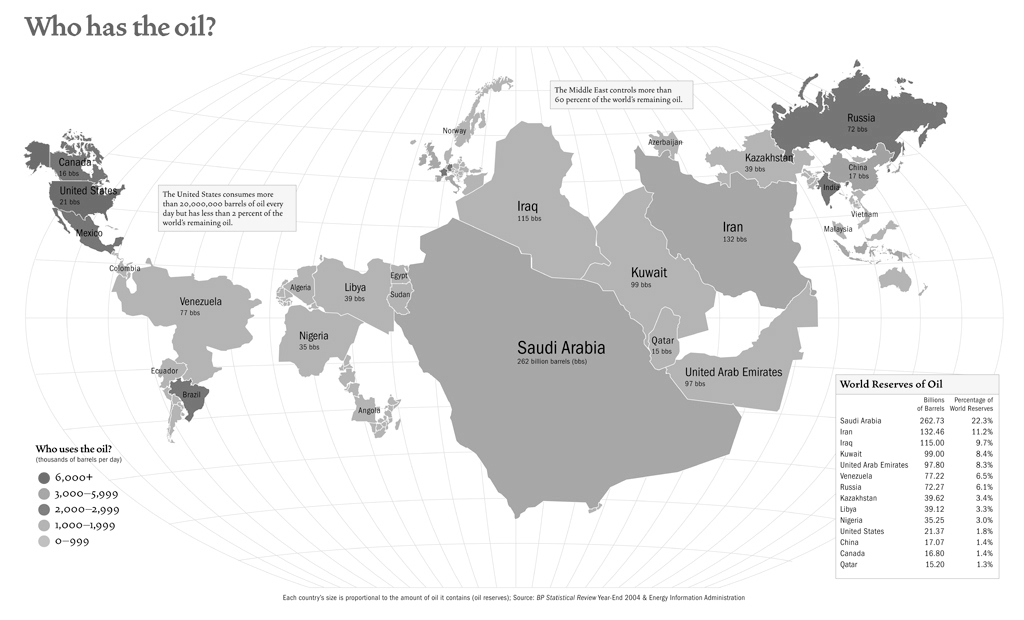
In this article, the author assesses the success rate of how oil-rich countries in the Arabian peninsula and beyond have tackled the challenge of increased oil revenues and how they have handled their newly established wealth. For many, oil has been a curse in disguise, with mismanagement of oil revenues, unequal distribution of wealth and the Machiavellian power of the rentier state – which in the case of Libya proved to be fatal.


By Matthias Pauwels, 26 Oct, 2011

Roughly a century ago, nobody would have imagined that a complex mixture of hydrocarbons of various molecular weights and other liquid organic compounds would become the most contested, sought-after commodity in the world. Oil-rich countries in the Middle East have been the scene of epic battlegrounds to gain control over the black gold. As a crafty tool to conduct psychological warfare, petrodiplomacy has become an important diplomatic weapon to the Arab nations against the West and, in particular, Israel. When crude oil found its way to the international market during World War II, the world became increasingly dependent on Arab oil. For over half a century, the oil industry of the world outside North America and the Soviet Union had been dominated by seven great international oil companies, exercising control over output and off-take prices. However, the tide was turning. By the 1960s-1970s control over Middle Eastern oil was rapidly passing into the hands of governments in the area and out of the hands of the heretofore dominant Western companies. International oil companies, once the beneficiaries of lucrative concessions and tax arrangements, slowly lost the control they traditionally exercised over Middle East oil production and pricing and had to accept policies determined unilaterally by the producing nations.

Consequently, a sudden increase in the rate of revenue flows to the Middle East simultaneously presented the economic planners of the region with an unprecedented opportunity and challenge. Over the past decades, very large increases in the revenues accruing to the oil-exporting countries have given rise to extravagant hopes of a swift acceleration in their economic development.

At the dawn of the twenty-first century, we are able to assess the success rate of how these countries have tackled the challenge of increased oil revenues and how they have handled their newly established wealth. Here I am arguing that for countries of the Arabian peninsula, oil, paradoxically, is a curse in disguise. Although the possibilities of oil revenue flows appeared unbridled, these governments have largely crumbled under the huge pressure to properly utilise this wealth.

Firstly, the mismanagement of large proportions of oil revenues is embedded in the asymmetry of economic, political, and cultural perspectives. Practices such as unwise spending policies and loose budgetary controls have produced the caricature – so popular in the West – of the rich Arab with dark glasses and his Rolls Royce. Secondly, unequal leaps of development in the Middle East, often based on oil revenues, have accentuated multilateral social and economic inequalities. As a result, Pan-Arabism has declined. Thirdly, the sole concentration on oil revenues has proved to be a slippery slope: declining oil revenues in an undiversified economy leave young people with reduced changes and disappointment, creating a breeding ground for Islamism to firmly nestle itself in the consciousness of the common Arab youth. And finally, the most desirable course for relations between consumers and producers of oil remains the issue of heated argument. Over the past decades, the world has witnessed several oil crises, the establishment of OPEC and severe fluctuations in oil prices, directly affecting the world economy. Rather than moderating with time, the debate of optimising the relationship between consumers and producers of oil remains volatile.

1.      The paradox of oil: a financial curse in disguise

The actual utilisation of oil as a strategic commodity of great political potency as well as developmental power has left the Middle East faced with numerous challenges. When Saudi Arabia imposed the first income tax on oil companies in 1950, the law was specifically designed to capture fifty percent of the profits attributed to crude oil. As a result of these arrangements, the revenues of oil-producing countries of the Arabian peninsula soared, and their governments seemed satisfied. As time moved on, a final transfer of power of petroleum from companies to governments in the 1973-1974 period created the opportunity to fully gain control over oil revenues. Although there was a realisation that oil resources of the region would ultimately be depletable and the development of more diversified domestic economies, capable of generating their own funds for investment, should be made a “first priority goal”, the Middle East has received considerable criticism for the way they have handled their new wealth. In this context, authors such as Sayigh allude to the misdirection of an inordinately large proportion of oil revenues into the private accounts of rulers, continuing wastefulness, loose budgetary controls and unwise spending policies which permitted overconsumption and the formation of private “princely fortunes” in Saudi Arabia, Kuwait, and the Gulf sheikhdoms.
 (Click to enlarge image)

It is certainly true that the construction of superhighways and the building of stadiums that will only be filled sporadically fully testify to the folly of oil revenue investments. The real estate investment bubble of Dubai has burst, a process which was accelerated by the financial crisis of 2008. Additionally, Qatar has recently invested an unprecedented oil revenue budget in bringing the World Championship Football to the small Arab emirate in 2022.

Although many do not deny the existence of the concept of “conspicuous investment”, one can argue that the comic, Orientalist figure of the wealthy oil sheikh, with his thousand-and-one night palaces and lavish cars, has disappeared. In this context, Sayigh notes that after a few years of wasteful confusion in the oil countries, careful procedures were developed for assigning revenues to capital and current expenditures. Huge infrastructural projects have been undertaken in transport, communications, power, irrigation, land reclamation, housing, urban facilities, education and health – all of which have helped to consolidate the economic base.

While I do not contest that attempts have been made to create more diversified domestic economies in the realisation that oil resources may ultimately be depletable and to cope with the changing panorama of energy sources, Sayigh’s observation should by no means be generalised. Although efforts have been made by governments to sensibly manage the impressive flow of oil revenues, problems of misspending, overspending and overconsumption are not a manifestation of the past. True, Kuwait has been blazing a trail for sensible domestic oil revenue investment through the Kuwait Fund for Arab Economic Development (KFAED). During the past three decades, the country has more or less found a balance in allocating equal portions of its income to three areas: domestic development, regional development and foreign investment. Dubai, on the other hand, has played the role of the golden child of the Emirates for the past two decades, massively investing in urban development, the expansion of industry, infrastructure, and the modernisation of transportation. The government’s decision to diversify from a trade-based, oil-reliant economy to one that is service and tourism-orientated has made property more valuable. A longer-term assessment of Dubai’s property market, however, showed depreciation. Some properties lost as much as 64% of their value from 2001 to November 2008.

Dubai’s property market experienced a major downturn in 2008 and 2009 as a result of the slowing economic climate and when by early 2009 the situation had worsened due to the global economic crisis, the emirate was faced with an $80 billion debt due to overspending, and was forced to seek financial help from other emirates. Although Dubai’s intentions are noble to invest in creating a diversified economy, not solely reliant on oil, unwise spending policies are not a manifestation of the past.

2.      Political consequences of the oil effect

Aside from the financial challenges oil extraction has brought countries of the Arabian peninsula, one can put this in the perspective of two extremes: on one hand, the Arab oil states have enjoyed stability, continuity and wealth to a degree unknown since the 1950s. On the other hand, the glaringly uneven distribution of resources among the various sectors of the population has provoked anger and frustration. Furthermore the rising social status and self-awareness of the middle class and its low political status, combined with unemployment, has created a breeding ground for Islamism, although there is by no means an exclusive link between oil exports and the rise of militant Islam.

The one significant political development noticeable during the oil decade is the decline of the ideal of Arab unity and Pan-Arab solidarity. Since the 1950s, Pan-Arabism is on the decline, with the occasional flicker of revival during the Arab-Israeli conflict. In general, revenues from oil have exacerbated the differences in the economic conditions of the Arab states, particularly between the sparsely inhabited oil states of the Arabian peninsula and the densely populated countries of the Nile Valley.

By the late 1970s, a deepening economic gap had opened between the populations on either side of the Red Sea – that of the Nile Valley and that of the Arabian Peninsula. Its impact was considerable, and meant among other things a weakening of the forces calling for Arab unity while it favoured the territorial Arab nation-states. In addition, the failure of Nasserism and its view on Pan-Arabism weakened Egypt’s ideological opposition to the existence of separate Arab states. Unwillingly, Egypt was forced to turn to Arab oil producers for aid.

However, the decline of Pan-Arabism is no exclusive international phenomenon. Even domestically it can be disruptive to a harmonious feeling of unity. Despite the United Arab Emirates’ increased sharing of the oil wealth with the poorer, non-oil sheikhdoms through the confederation government, the contrasts in wealth have continued to underscore the urgent hope of the have-not rulers of Ajman, Fujayrah, Ra’s al-Khaymah, and Umm al-Qaywayn that it would be only a matter of time before they, too, became oil producers. Alledgedly these contrasts have been the root of many political differences between the rulers. In this light, the hope that an oil discovery on its territory was imminent was the main reason for Ra’s al-Khaymah to delay joining the U.A.E. until February 1972. And so, oil and the hope of prospective oil wealth became an obstacle for Pan-Arabism, both internationally and domestically.

3.      Oil and Islam: a breeding ground for political polarisation?

Islamism today is a universal phenomenon in the Muslim world. Therefore the mere hypothesis of a strict connection between oil and Islamism is too far-fetched. It is by no means an exclusive phenomenon of oil exporting countries. Even the study of potential links between oil exports and the rise of Islam remains empirically difficult.

When we do shine a light on Islamist movements in oil exporting countries, it becomes clear that they represent both a social revolt as well as an assertion of cultural and national identity in the wake of an unsuccessful or incomplete modernisation based on oil. Rapid population growth, immature and unstructured political systems where ageing leaders stay in power without accountability to the public, and the autocratic nature of these political systems have been known to create social and generational tensions. Many Muslim countries have old rulers, who control the government and have a firm grip on the economic surplus. Often they also tend to represent Western ideas and lifestyles to a considerable extent. Opposition to them is a frustrated middle generation and especially an impoverished, unemployed youth – no surprise there in context of the recent Arab Spring. They want influence, prosperity and to assert cultural traditions against Western influence. Such a stereotype may be particularly relevant to the oil exporting Muslim countries. After the 9/11 terrorist attacks on the United States, the United Arab Emirates was identified as a major financial center used by al-Qaeda in transferring money to the hijackers. Moreover, two of the 9/11 hijackers who were part of the group that crashed United Flight 175 into the South Tower of the World Trade Center, were UAE citizens.

Unequal leaps of development in the Middle East, often based on oil revenues, have accentuated social and economic inequalities, as I have mentioned earlier. The issue here can be described as being three-fold: it is social, concerning the distribution of income, wealth and power; cultural and national, concerning political and personal identity; and generational, affecting conflicts of power between age groups with different experiences and expectations.

However, oil exports appear to be neither a necessary nor a sufficient condition for the rise of Islamism. If they were a necessary condition, Islamism would not have been present in non-exporting oil countries such as Sudan, Lebanon or Palestine. If they were a sufficient condition, oil exports alone would have provoked a strong surge of Islamism in, for instance, Kuwait. When it comes to the 9/11 hijackers, it probably was a mere coincidence that both men had the UAE nationality, although al-Qaeda has been known to frown upon the “ emerati wastefulness” and splurging lifestyle. But a direct causal link between oil exports and Islamism would be indirect and highly complex. As an alternative, authors such as Noreng suggest three sensible reasons for possible links between oil and Islamism. First of all, when oil revenues decline, the public sector suffers from diminishing resources and a frustrated private sector emerges. Secondly, declining oil revenues in an undiversified economy leave young people with reduced changes and disappointment. And thirdly, there is a ripple effect from the oil exporters to the non-oil exporters. When oil revenues rise, the rich oil exporters employ labour from the non-oil exporting countries of the region. They in turn remit money home and increase the GNP of their home country. When oil revenues decline, foreign workers lose jobs, go home and remittances diminish. This way, religion creates an escape and an outlet for frustrations. It is however important to mention that the sole combination of misery and mosques does not by itself produce Islamist movements. Islam’s social promise has to be elaborated, interpreted and presented by a conscious elite able to influence the masses and propagate Islamism to the people.

The social task of Islam focuses precisely on an equal distribution of wealth through the zakat, the wealth tax, which has become an imperative duty for devout Muslims. The specific purpose of the wealth tax is to prevent the rise of any rentier class in the economic system. The specific problem of oil is that it creates an influx of rentier income. Oil provides much money without much effort. In a Middle Eastern context, oil seems to have produced a special political system, based on the centralisation of petroleum revenues within the state. Here, the state is the distributor of economic rent and favours instead of being a tax collector and redistributor. Rulers tend to hand out selective privileges, financed by oil revenues, against loyalty and support from a large private sector. This way, political loyalty is exchanged for economic favours. This is the basis of a classic rentier state. Islamic economic principles can be used to fight or prevent the rise of a rentier class within a state. The problem with oil revenues for Islam is that they differ qualitatively from productive income, because they have their origin in the extraction of a finite resource, not in human labour and productivity: it is “easy” money. When wasteful consumption above reasonable needs goes hand in hand with mismanagement of income distribution and wealth, Islamism may once again find a breeding ground in these rentier states, drawing back upon Islamic economic principles, such as the zakat.

 4.      What role has oil played in the Libyan crisis?

Libya’s petroleum sector has been critical in shaping its political economy. Although Libya ranks 17th among global oil exporters, its 46.4 billion proven oil reserves are the largest in Africa – practically the size of Nigeria and Algeria combined. Over the decades this sector has provided significant resource inflows for Gaddafi. Oil revenues laid the foundation for the establishment of the Libyan rentier state, where rents from natural resources rather than domestic productivity were the backbone for economic growth. The rentier state in Libya was responsible for mass unemployment and poverty since the vast majority of Libyans without access to oil rents hardly benefitted from the country’s wealth, while Gaddafi and his cronies distributed oil wealth via a highly exclusive patronage network and the “republic of the people” effectively eviscerated opposition politicians.
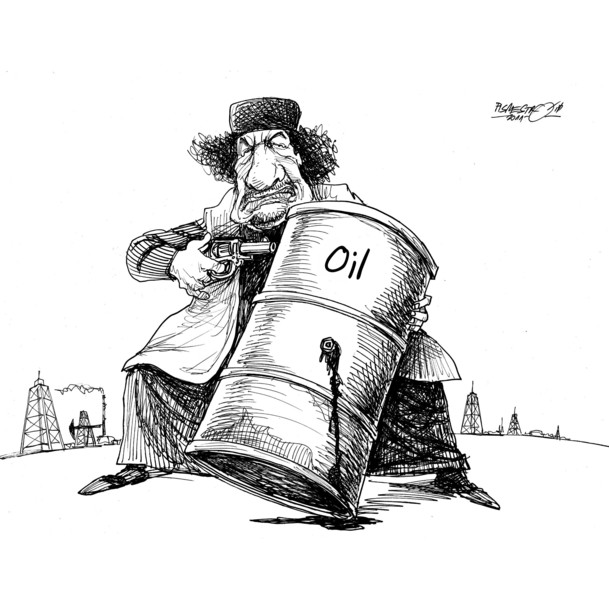
As the dominoes started falling across North Africa, it was only a matter of time before unrest spilled over in Libya. However, Libya was different from Tunisia and Egypt. Without a history of opposition activity, the rebellion has been poorly coordinated and clear leaders were hard to identify. The patronage system appeared to be strong and those benefitting from Gaddafi’s largesse were quick to rally to his side in the initial stages. Moreover, Libya’s patronage system was highly liquid, as evidenced by the more than $60 billion government deposits in local banks – an astounding 99% of Libya’s GDP. By comparison, lending to the private sector only accounted for 11% of its GDP, underlying the rentier characteristics of Libya’s political economy.

5.      Arab petrodiplomacy: a double-edged weapon

The concept of oil as a diplomatic weapon and means for psychological warfare is as old as the Arab-Israeli conflict itself. Especially during the 1967 six-day Arab-Israeli war, Middle East oil became even more important as a diplomatic weapon to the oil-exporting Arab nations due to the fact that oil had almost entirely replaced the use of coal since 1965. However, the use of oil as a diplomatic weapon by the Arab nations against the West has its pitfalls. Applying diplomatic pressure through oil embargoes has mainly missed its primary target, since the United States has remained virtually unaffected by them.  Before the oil weapon could cause irreparable damage to the American economy in the 1973 oil crisis, the oil embargo was quickly eased. The early lifting of the embargo was driven by economic impulses that a major recession in America would affect the entire world adversely. Moreover, the oil embargo of 1973 has paradoxically strengthened the American position in the Middle East, especially in Saudi Arabia. American oil companies, such as Aramco, are still making high profits and continue to operate in the region.

6.      Conclusion

Whether we are discussing the pitfalls of Arab petrodiplomacy,  the intricate task of sensibly managing oil revenues, the dangers of becoming a breeding ground for Islamist groups or the rise of the rentier state, oil-rich nations of the Arabian peninsula and beyond have been confronted with numerous challenges. Although the possibilities oil and its revenues can provide seem endless, they are nothing but a curse in disguise. There are still huge challenges to face when it comes to creating sensible spending policies, managing budgetary controls, keeping overconsumption in check but above all, an equal distribution of wealth. Still too often oil revenues are used solely to aggrandise private fortunes. More efforts should be made to create diversified economies, expand the private sector and ensure that oil revenues are reinvested in domestic development programmes. Development, to mean anything at all, must include the development of the productive capacities of the people themselves, and this is only partly promoted by the provision of transport facilities, factories, buildings and other infrastructure. The receipt of foreign revenues – money – does not in itself improve the capacities of people, a common mistake which oil-rich Middle Eastern countries have often made. This is what we can call absorptive capacity: beyond a certain level, no increase in the availability of capital or other direct inputs can influence the rate of development if a country lacks the social, institutional, and political capacities to utilise increased capital, labour, and natural resources.


References

  • Ali, Sheikh R., 1987. Oil and Power: Political Dynamics in the Middle East. London: Pinter Publishers
  • Anthony, John Duke, 1975. The Impact of Oil on Political and Socioeconomic Change in the United Arab Emirates. In J.D. Anthony, ed. 1975. The Middle East: Oil, Politics and Development. Washington: American Enterprise Institute for Policy Research, Ch. 4.
  • Armitstead, Louise, 2008. Dubai’s Palm Jumeirah sees prices fall as crunch moves in. London: The Daily Telegraph (20 November 2008).
  • Gilbar, Gad G., 1997. The Middle East Oil Decade and Beyond: Essays in Political Economy. London: Frank Cass & Co LTD.
  • Licklider, Roy, 1988. The Oil Weapon in Theoretical Context. In R. Licklider, ed. 1988. Political Power and the Arab Oil Weapon. London: University of California Press, Ch. 1
  • Licklider, Roy, 1988. The “Lessons” of the Oil Weapon for Theory and Policy. In R. Licklider, ed. 1988. Political Power and the Arab Oil Weapon. London: University of California Press, Ch. 7
  • Loutfi, Muhammed, 1975. Prospects for Development and Investment For Oil Producing Countries. In J.D. Anthony, ed. 1975. The Middle East: Oil, Politics and Development. Washington: American Enterprise Institute for Policy Research, Ch. 4.
  •  Noreng, Øystein, 1997. Oil and Islam: Social and Economic Issues. Chichester, West Sussex (UK): John Wiley & Sons LTD
  • Penrose, Edith, 1975. International Oil Companies and Governments in the Middle East. In J.D. Anthony, ed. 1975. The Middle East: Oil, Politics and Development. Washington: American Enterprise Institute for Policy Research, Ch. 1.
  • Said Zahlan, Rosemarie, 1999. The Making of Modern Gulf States: Kuwait, Bahrain, Qatar, the United Arab Emirates and Oman. New York: Ithaca Press
  • Sayigh, Yusif A., 1975. Oil in Arab Developmental and Political Strategy: an Arab View. In J.D. Anthony, ed. 1975. The Middle East: Oil, Politics and Development. Washington: American Enterprise Institute for Policy Research, Ch. 2.
  •  Stocking, George W., 1970. The Economics of Middle East Oil Pricing: Costs, Prices, Profits and Revenues. In G.W. Stocking, 1970. Middle East Oil. Tennessee: Kingsport Press, Inc., Ch. 21
  • Tempest, Paul, 1993. The Politics of Middle East Oil. London: Graham & Trotman Limited
 

Special Economic Zones in India: The law and the experience

In this paper, the author analyses the motivation, framework and the socio-economic impact of India’s Special Economic Zones (SEZ) Act of 2005.


By Siddharth Singh, 16 Oct, 2011

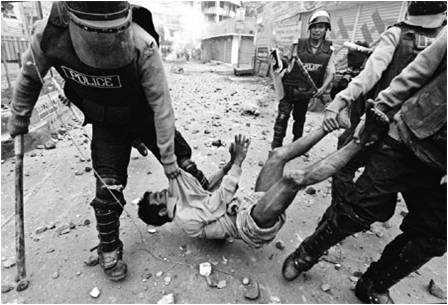
Special Economic Zones (SEZs) have been touted to be magic pills for nations to kick-start exports, develop infrastructure, and increase employment by adhering to the principles of free markets and minimum distortions caused by effective administration and low or no taxes (Tantri, 2010, p26). Owing to the success of China and other countries, India took up the development SEZs with much enthusiasm, but the outcome has not entirely been as desired. On the one hand, the Ministry of Commerce and Industry reports impressive figures to show how SEZs have “worked” (discussed below), but on the other hand, there are cases such as that of Nandigram, West Bengal (The Telegraph, 2007) where 14 people died in March, 2007 while protesting against the establishment of a chemicals hub SEZ by an Indonesian developer (Manoj, 2009, p355 and Dohrmann, 2008, p75).

In an attempt to understand India’s experience with SEZs, this essay will first look into the motivations of setting up SEZs. It will then assess the framework the SEZ Act of 2005, and finally, move on to scrutinise the social and economic impact of this policy.

The Rationale of the SEZ

An SEZ is a geographically delimited area administered by a single body, offering a certain incentive regime to businesses which physically locate within the zone (The World Bank Group, 2008, p2). An Export Processing Zone (EPZ) is a type of SEZ which is legally defined as a “policy enclave” within the host state territory, to which distinct regime of custom and trade regulations apply (Muchlinski, 2007, p226). These policy enclaves are instruments to realise micro and macro-economic, and political objectives. Microeconomic issues include employment generation, while political objectives include implementing regional economic development strategies (Guangwen, 2003, p20).

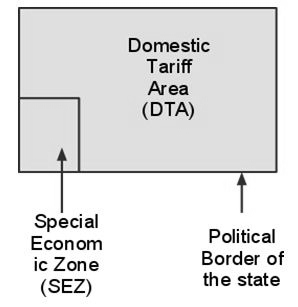
The SEZ is a subset within the geographical boundaries of the state. The rest of the host state is legally referred to as the Domestic Tariff Area or the DTA (Muchlinski, 2007, p229). Effectively, the SEZ is “outside” the territory of the host state with respect to trade and investment. Figure 1 below explains this relationship.

 Figure 1

The host states can expect inter alia to earn increased export earnings, benefit from increased employment opportunities, improved training and skills, and transfer of modern technology (Muchlinski, 2007, p227). In return, foreign investors are offered incentives such as tax exemptions, duty free imports, exemptions from import quotas, capital mobility to remit profits, export allowances and subsidised interest rates within the SEZ. A significant incentive offered by the host state involves the legal control of labour relations. Specifically, the right to establish trade unions or take industrial action may be limited within the SEZ (Muchlinski, 2007, p229).

Political and economic stability, reliable infrastructure, inexpensive labour, market access, and efficient bureaucracy are factors that determine not only how attractive investors will find the SEZ, but are factors that eventually determine the success of the SEZ (UNIDO, n.d., p27).

Keeping in mind these objectives and demands, India embarked on a journey to use SEZs as engines of economic growth. India set up Asia’s first EPZ set up in Kandla in 1965. The government announced the SEZ policy in April 2000, claiming to “to overcome the shortcomings experienced on account of the multiplicity of controls and clearances; absence of world-class infrastructure, and an unstable fiscal regime and with a view to attract larger foreign investments in India” (SEZ India, 2011a, Introduction). The Foreign Trade Policy provisions governed SEZs in India prior to the implementation of the SEZ Act, 2005 in February, 2006 (Chandrasekhar and Ghosh, 2007).

Salient Features of the SEZ Act (2005)

‘The Special Economic Zones Act, 2005’ was passed on the 23rd June, 2005, in an attempt to give a framework to the implementation of SEZs in India. It includes several regulatory and investment fostering mechanisms.

i. Creation of SEZs and general administration:

The Act explicitly mentions a few guiding principles for the Central Government regarding the creation of SEZs. The objectives of the government, as stated by the Act, must be to generate additional economic activity, promote exports of goods and services, create employment opportunities, and develop infrastructure, all while maintaining the “sovereignty and integrity” of India

(SEZ Act, 2005, p8). Thus, SEZs have thus come to be justified as an engine of growth and employment generation, and not in terms of exports expansion alone (Sharma, 2009, p18).

The Act calls for the creation of the “Board of Approval”, which, as the name suggests, looks into applications to set up SEZs and gives approval to them if they meet the required criteria. This acts as a single-stop-shop for investors (called ‘developers’) to get the required regulatory permission to set up an SEZ. SEZs may be established under this Act either jointly or severally by the Central Government, State Government of any legal person. The Central Government, however, can suo moto set up SEZs, and can prescribe other requirements at a later stage (SEZ Act, 2005, p1-6).

The position of a Development Commissioner is established (p14), and this position is responsible for the general overview of the SEZ, from presiding over the Approval Committee (p17-18) to running the SEZ Authority, which is in charge of provision of infrastructure, promoting exports. reviewing the functioning and performance of the SEZ, and other such functions (p28-29).

ii. Tax Exemptions, Finance and Banking

By definition, SEZs are so-called “tax havens”. The Act specifies all those taxes and duties that the developers would be exempted from in the SEZs. There is exemption from Custom Tariff Act, 1975, Central Excise Act, 1944, Central Excise Tariff Act, 1985 and other similar laws (p24). 100% Income Tax exemption on export income for the first 5 years, and 50% for the next 5 years is offered (SEZ India, 2011a, Facilities and Incentives).

Attention is also given to the trade between the SEZ and the DTA. The Act (SEZ Act, 2005, p8) prescribes the exemption from the payment of duties, taxes or cess under all enactments of the First Schedule for trade between DTA to SEZ. However, any goods moved from the SEZ to the DTA would be subject to safeguarding duties, anti-dumping regulations and other instruments (p26).

The Act also specifies the financial governance structure of the SEZ. Bank branches in SEZs, for example, are defined as ‘Offshore Banking Units’ (SEZ Act, 2005, p3-4), and can be set up after the approval of the Reserve Bank of India (RBI), which is India’s central bank (p20). Other financial activities in the SEZ would be monitored by the relevant regulatory authorities in the DTA (p21).

iii. Law Enforcement

Were illegal activities to take place, the Act states that the Development Commissioner would have the cases investigated, and the cases would be heard at the court(s) appointed by the State Government and the Chief Justice of the state High Court (SEZ Act, 2005, p22). The Act also explicitly states that in case there is any inconsistency of this law with other laws, than this Act would have an overriding effect over others (p34).

iv. Amendments

Over the years, several amendments have been made to the Act. They have primarily revolved around specifying the provision of infrastructure and requirements for establishment of SEZs. The minimum area requirements vary across industries and regions. As an example, a multi-product SEZ has to be between 1000 and 5000 hectares, and at least 50% of the area needs to be earmarked for developing the processing area (SEZ India, 2010, ch II sec. 5, sub-sec 2 a).

Amendments also allow for the generation, transmission and distribution of power within an SEZ (sec. 5, sub-sec 5 c). Importantly, in the case of an information technology related SEZ, 24 hours of uninterrupted power supply is to be provided, apart from reliable connectivity (sec. 5, sub-sec 5A).

Importantly, a stated objective is the generation of positive net foreign exchange earnings, as it is specified that a unit would achieve positive net foreign exchange, calculated cumulatively for a period of five years from production (ch VI sec 53).

The Act is clear in specifying the framework regarding the implementation of an SEZ promotion strategy. The Act however, remains conspicuous in its silence on land acquisition and labour laws, which has become the bone of contention on the implementation of the policy.

A Brief Overview of SEZs in India

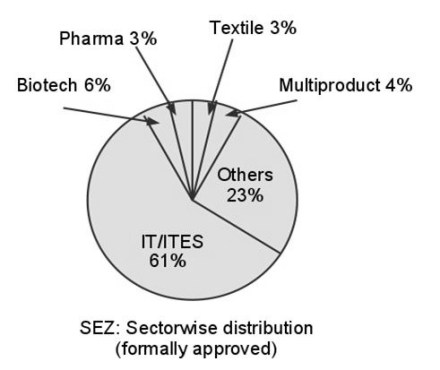
Prior to the enactment of the SEZ Act, 2005, there were 19 SEZs across India. The government has now approved 581 SEZs (SEZ India, 2011b) with a further 154 with in-principle approvals (SEZ India, 2011c). 130 of these SEZs are operational today. 283 of the 581 approved SEZs are in the three states if Andhra Pradesh, Maharashtra and Tamil Nadu (SEZ India, 2011d). Of the sectors, the Information Technology and IT enabled services sector has a 61% share of SEZs, while the biotech, pharma, textile sector and multi-product SEZs have less than 10% share each. Apart from these, there are three airport based multi-product, and eight port-based multi-product SEZs (SEZ India, 2011e).

Source: SEZ India, 2011e

The Indian experience in the implementation of SEZs has brought to light major areas of concern in the economic and social spheres. In the economic sphere, these are related to fiscal costs, net employment generation and exports. The social experience of SEZs has brought up issues of worker rights, and those of land transfer, dispossession and displacement. The next two sections of the paper will look into these briefly.

The Economic Experience

i Fiscal issues and investment:

Tax holidays in the SEZ are generous, and provide 100% exemption for Income Tax on profits for the first 5 years of production and 50% for the next five years, apart from the tax breaks discussed above. In addition to this, land is given by the government to developers at low rates (Dutta, 2009, p23). Estimates by the Finance Ministry show that the losses to the state exchequer in terms of forgone revenue would be £24billion for an investment of £50billion (Chandrasekhar and Ghosh, 2007).

Owing to the perceived lost revenue, the Finance Ministry announced a Minimum Alternate Tax on the book profits of developers and units operating in SEZs in the 2011-12 Budget. The Commerce Ministry, however, wants to see a roll back of this tax and sees SEZs as “engines of growth” (Pannu, 2011). This points to differences between the Finance Ministry and the Commerce Ministry on the issue of SEZs.

In fact, Arunachalam (2010, p25) shows that the investment as of 2009 in approved SEZs stood at £416million, and not the figures cited by the Finance Ministry. He argues (2010, p20) that Indian SEZs failed to attract FDI as it would have liked because firstly, India has not used SEZ policies to test reforms which would later be adopted nationwide; secondly, Indian SEZs are small in size (especially when compared to their Chinese equivalents), and finally, because of the lack of labour market flexibility.

ii. Exports:

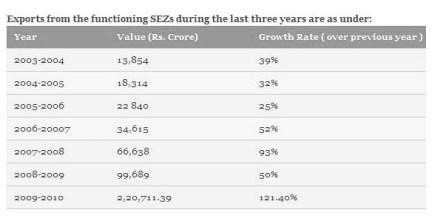
The Ministry of Commerce and Industry claimed that the value of exports from functioning SEZs increased from £1.9billion in 2003-04 to £30.6billion in 2009-10 (exchange rate £1 = INR72 as of 16th March, 2011). The growth rate of exports over the previous years increased from 25% before the SEZ Act, 2005 to 52% after its implementation, and it stands at 121.40% in 2009-2010 (SEZ India, 2011a, Export Performances). Note that these figures are inconsistent with the estimates of
losses by the Finance Ministry.

An example of a successful SEZ in this regard would be the Mundra SEZ. This SEZ houses India’s largest private port, has been most successful in seeing an increase in exports. It is expected to handle 100m tonnes of exports by 2013, with a growth rate of 40% in these years (Thakkar, 2008).

However, the Comptroller and Auditor General of India has pointed out that most of the SEZs sell goods within the country as “deemed exports” rather than actually exporting them overseas. This seems plausible as the exponential rise of exports from SEZs corresponds with stagnant national exports. The Finance Ministry speculates that some units have merely shifted to these zones from the DTA to avail tax benefits (Pannu, 2011).

Source: SEZ India, 2011a, Export Performances

iii. Employment generation (or the lack thereof):

Proponents of SEZs have claimed that SEZs lead to employment generation, in addition to exports. While the total employment by all types of SEZs across India as of 2008 was about 370,000 (Reddy, Prasad and Kumar, 2010, p87), Mahanta (2010, p199) shows that acquisition of agricultural land by SEZs lead to a fall in food-grain output and agricultural employment. Importantly, he shows that this fall in agricultural employment is not offset by the increase in employment in SEZs.

Another point to note is that compared to countries around the world, Indian SEZs have not seen a high proportion of female workers. In 2003, only 37% of the workforce was female (Varma, Prasad and Krishna, 2010, p320-322). The claims of benefits of the generation of employment by SEZs are hence called into question.

The Social Experience

i. Land acquisition and displacement

Land acquisition is the ‘hot topic’ of India’s SEZ policy. The SEZ Act, 2005 makes no mention of it. The out-dated Land Acquisition Act, 1894, is applicable in this regard. Even the Land Acquisition (Amendment) Bill, 1998 has come under fire from for several shortcomings. For instance, land losers could have their land acquired even if a stated compensation isn’t paid (Asif, 1999, p1564).

Land acquisition is especially contentious and problematic when the land being acquired is populated with people living off the land, which is often the case with agricultural land, as was the case in Nandigram, West Bengal. In addition to this, Chandrasekhar and Ghosh (2007) argue that real-estate developers can engage in major land grab in the guise of setting up SEZs as the SEZ rules require only 25 per cent of the land to be used for industrial processing purposes.

While approved SEZs are to consume 95,000 hectares of land, (Balasubramanian, 2010, p53), the Ministry of Commerce stated that as of 2008, the land allocated to SEZs was about 0.070% of the total land area and 0.128% of the total agricultural area of the country (Reddy, Prasad and Kumar, 2010, p87). While this may seem low, it is has proven to be problematic because of the high population density in some of these areas.

An illustration of the flawed acquisition mechanism by the government would be the case of the state of Andhra Pradesh, where land is being acquired from the poorest people who had been earlier allocated land by the government in “land-for-the-poor schemes”. Legally, this land belongs to the government, so the government takes it back often without compensation on the behalf of SEZ developers (Oskarrsson, 2010, p368).

On the other hand, the Commerce Ministry has cited examples of how rise in land rates in barren, unproductive land has brought wealth to the poor and SEZs have brought infrastructure to the hinterland, as is the case with Mundra in the state of Gujarat (Bhatt, 2007). The wastelands in the coastal regions of Gujarat are mostly owned by the government, hence leaving out land acquisition out of the picture. Moreover, states like Tamil Nadu have seen the rural population welcome SEZs, because several years of social upliftment by the government has made the populace less dependent on agriculture for their livelihood (Murugesan and Bandgar, 2010).

ii. Labour relations

While the SEZ Act, 2005 makes no mention of changes in labour law, Tanwar (2010, p231) writes that changes to the prevailing pattern of application of labour laws have been made in SEZs. All units operating in SEZs are categorised as “Public Utility Service”, meaning that many labour laws become irrelevant. A Public Utility Service is defined to be a service that is of great value to the society, and the lack of provision of which can affect the life of everyone. In this case, employees have to give a 14 day notice before going on strike. Additionally, employees in SEZs don’t have protection in the form of a notice period or compensation against retrenchment. It follows that employees will be reluctant to raise a voice against their employers when the need arises. Moreover, employers in SEZs have the right to change the terms and conditions of service at any point of time. Mahanta (2010, p200) raises concern regarding the lack of labour unions, stating that the possibility of fall in real wages is high, although experience shows that SEZ wages are at par with non-zone wages (Varma, Prasad and Krishna, 2010, p326).

Conclusion

This essay has dealt briefly into a few contentious issues that arise with the establishment of SEZs in India. With significant employment not being generated, and with no real rise in national exports has taken place, the rationale of this establishment is called into question. The issue remains volatile, as was seen in the case of Nandigram, where the conflict continued to simmer after the scrapped its plans to establish the SEZ there (Dohrmann, 2008, p76).

However, governments are unlikely to give up on establishing SEZs, and it is imperative that laws are amended in order to make trade and investment flourish without disempowering the people who are displaced or the workforce in SEZs. The Land Acquisition Act of 1894 need to be looked into, and a transparent rehabilitation law needs to be put in place (Dohrmann, 2008, p79). In fact, the people need to be made stakeholders in the progress of the nation. Failure to do so may further prove former Indian Prime Minister VP Singh correct in his assessment of the SEZ policy of India, when he said (Dohrmann, 2008, p1), “the current promotion of SEZs is unjust”, and that it acts as a “trigger for massive social unrest, which may even take the form of armed struggle.”

__________________________________________________________________________________

References

  • Arunachalam, P., 2010. “Special Economic Zones and Foriegn Direct Investment in India and China”. In: Arunachalam, ed. Special Economic Zones in India. Serials Publications, New Delhi. ISBN 978-81-8387-336-9
  • Asif, M., 1999. “Land Acquisition Act: Need for an Alternative Paradigm”. Economic and Political Weekly June 19, 1999 Balasubramaniyan, R., 2010. “An Econometric Analysis of Special Economic Zones in India”. In: Arunachalam, ed. Special Economic Zones in India. Serials Publications, New Delhi. ISBN 978-81-8387-336-9
  • Bhatt, S., 2007. “Rivalry Between Business Houses has blown up the SEZ issue”. Rediff News 21st Feb, 2007. [online] Available at: http://www.rediff.com/money/2007/feb/21sez.htm [accessed 18th March, 2011]
  • Chandrasekhar, C.P., and Ghosh, J., 2007. “SEZs in India: The Record So Far”. Business Line, 27th November, 2007. [online] Available at http://www.thehindubusinessline.in/2007/1/27/stories/2007112750070900.htm [accessed 15th March, 2011]
  • Dohrmann, J. A., 2008. “Special Economic Zones in India – An Introduction”. ASIEN 106 (January, 2008) p60-80 [online] Available at http://www.asienkunde.de/articles/a106_asien_aktuell_dohrmann.pdf [Accessed 16th March, 2011]
  • Dutta, M., 2009. “Nokia SEZ: Public Price of Success”. The Economic and Political Weekly, 3rd October, 2009. Vol XLIV no. 40
  • Guangwen, M., 2003. The Theory and Practice of Free Economic Zones: A Case Study of Tinajin/People’s Republic of China. Peter Lang ISBN 0-8204-6508-9
  • Mahanta, A., 2010. “Special Economic Zones and its Impact on Agriculture and Employment in India”. In: Arunachalam, ed. Special Economic Zones in India. Serials Publications, New Delhi. ISBN 978-81-8387-336-9
  • Manoj, P. K., 2009. Special Economic Zones in India: Financial Inclusion: Challenges and Opportunities. Serials Publications, New Delhi. ISBN 978-81-8387-275-1
  • Muchlinski, P., 2007. Multinational Enterprises and the Law 2nd Ed. Oxford University Press
  • Murugesan, P., and Bandgar, P. K., 2010. “Land Acquisition for SEZs in India: Theoretical Perspective”. Southern Economist, 1st August, 2010 [online] Available at:  http://www.vesasc.org/Economics_-_Murugeshan_Sir.pdf [Accessed 19th March, 2011]
  • Nagayya, D., and Rao, T. V., 2010. “Special Economic Zones For Raid Insutrlization and Regional Development: Progress and Concerns”. In: Arunachalam, ed. Special Economic Zones in India. Serials Publications, New Delhi. ISBN 978-81-8387-336-9
  • Oskarsson, P., 2010. “Zoning Andhra Pradesh: Land for SEZs via tha Land for the Poor Program”. In: Arunachalam, ed. Special Economic Zones in India. Serials Publications, New Delhi. ISBN 978-81-8387-336-9
  • Pannu, S.P.S, 2011. “Ministries in a tug of war over tax on SEZs”. Business Today, 14th March, 2011 [online] Available at: http://businesstoday.intoday.in/bt/story/ministriesfightovertaxonspecialeconomiczones-(sezs)/1/13883.html [accessed 14th March, 2011]
  • Reddy, P., Prasad, A., and Kumar, P., 2010. “Generation of employment by Special Economic Zones in India”. In: Arunachalam, ed. Special Economic Zones in India. Serials Publications, New Delhi. ISBN 978-81-8387-336-9
  • Sharma, N. K., 2009. “Special Economic Zones: Socio-Economic Implications.” Economic and Political Weekly 16th, May, 2009 vol. XLIV no. 20
  • SEZ India, 2010, “SEZ Rules incorporating amendments upto July, 2010”. Ministry of Commerce and Industry (Department of Commerce), Government of India  [online] Available at: http://sezindia.nic.in/goipoliciessra.asp [Accessed 14th March, 2011]
  • SEZ India, 2011a. Special Economic Zones in India, Ministry of Commerce & Industry (Department of Commerce) [online] Available at http://sezindia.nic.in/ [Accessed 15th March, 2011]
  • SEZ India, 2011b. “ListofFormalApprovalsgrantedundertheSEZAct,2005, 2011”. Ministry of Commerce and Industry (Department of Commerce), Government of India  [online] Available at: http://sezindia.nic.in/writereaddata/pdf/ListofFormalapprovals.pdf [Accessed 14th March, 2011]
  • SEZ India, 2011c. “In Principle approvals granted under the SEZ Act, 2005”. Ministry of Commerce and Industry (Department of Commerce), Government of India [online] Available at: http://sezindia.nic.in/writereaddata/pdf/Listofinprincipleapprovals.pdf [Accessed 14th March, 2011]
  • SEZ India, 2011d. “SEZ: Statewise Distribution”. Ministry of Commerce and Industry (Department of Commerce), Government of India  [online] Available at: http://sezindia.nic.in/writereaddata/pdf/StatewiseDistributionSEZ.pdf [Accessed 14th March, 2011]
  • SEZ India, 2011e. “SEZ: Sectorwise Distribution”. Ministry of Commerce and Industry (Department of Commerce), Government of India  [online] Available at: http://sezindia.nic.in/writereaddata/pdf/Sectorwise%20distributionSEZ.pdf [Accessed 14th March, 2011]
  • Tanwar, S., 2010. “Relevance of Labour Laws in Special Economic Zones”. In: Arunachalam, ed. Special Economic Zones in India. Serials Publications, New Delhi. ISBN 978-81-8387-336-9
  • Thakkar, M., 2008. “Mundra Port: Anchored to Success”. The Economic Times 12th Nov, 2008 [online] Available at: http://articles.economictimes.indiatimes.com/2008-11-12/news/28448158_1_mundraportsezadanisbiggestport [Accessed 19th March, 2011]
  • Tantri, M. L., 2010. “Import Dependency of Special Economic Zones”. The Economic and Political Weekly 4th September, 2010 Vol. XLV no. 36
  • The Telegraph, 2007. “Red-hand Buddha 14 killed in Nandigram re-entry bid”. The Telegraph, 15th March, 2007 [online] Available at http://www.telegraphindia.com/1070315/asp/frontpage/story_7519166.asp [accessed 14th March, 2011]
  • The World Bank Group, 2008. “Special Economic Zones: Performance, Lessons Learned, and Implications for Zone Development”. The World Bank Group, April, 2008 [online] Available at: http://www.ifc.org/ifcext/fias.nsf/AttachmentsByTitle/SEZpaperdiscussion/$FILE/SEZs+report_April2008.pdf [accessed 14th March, 2011]
  • The Land Acquisition Act, 1894. Ministry of Law and Justice, Government of India, 1st Spetember, 1895 [online] Available at: http://dolr.nic.in/hyperlink/acq.htm [accessed 16th March, 2011]
  • The Special Economic Zones (SEZ) Act, 2005. Ministry of Law and Justice, Government of India. 23rd June 2005 [online] Available at http://sezindia.nic.in/goipolicies.asp [Accessed 13th March, 2011]
  • UNIDO, n.d. “Export Processing Zones: Principles and Practice”, United Nations Industrial Development Organisation. [accessed from the British Library of Political and Economic Science, LSE]
  • Varma, A. V. N., Prasad, J. C., and Krishna Y. R., 2010. “Special Economic Zones – The Socio Economic Dimensions and Challenges.” In: Arunachalam, ed. Special Economic Zones in India.
    Serials Publications, New Delhi. ISBN 978-81-8387-336-9