
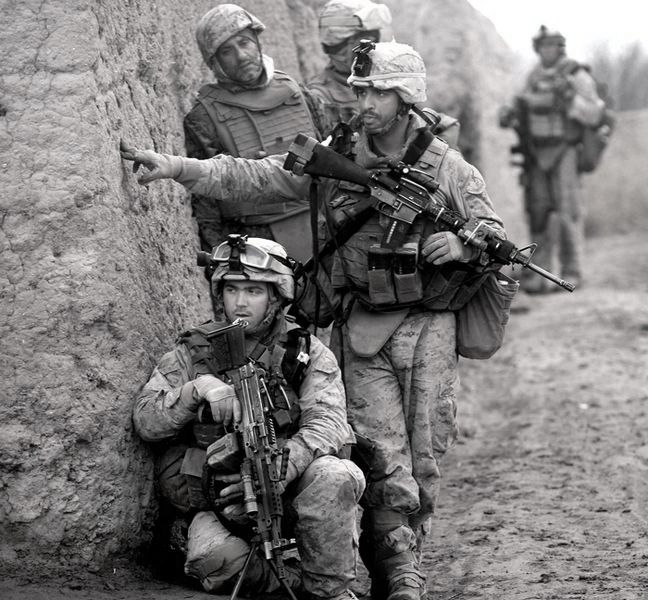
In this article the author assesses the view that democracies can never be successful in fighting a counterinsurgency. Taking the case studies of Afghanistan and Northern Ireland it is clear that the power of the propaganda war inhibits the capacities of democracies to act freely and that every military leader must understand that their actions will be perceived as an act of political warfare.
By Jack Hamilton, 16 Nov, 2011
General Sir Gerald Templer claimed of counterinsurgency that “the shooting side of this business is only twenty five percent of the trouble”[i]. Due to the nature of democracies and modern warfare, counterinsurgency may well now be one hundred percent political.
The political vulnerability of accountable democratic leaders, omniscient media presence and the potential propaganda exploitation of all combat actions mean that military officials at every level now need to understand that their every action can be construed as an act of political warfare in which political outcomes are more important than battlefield success. This issue creates huge problems for democracies when engaging in counterinsurgencies but can also open up opportunities.
This essay will posit that the inherent challenges that democracies face when engaging in counterinsurgencies can be turned into opportunities by using the democratic nature of the state, the local population and the open media to their advantage. However, these practices have their limits and the overemphasis on any one of these factors has the potential to seriously undermine the counterinsurgency effort.
Counter-Insurgency On the Fly
The notion of counterinsurgency is logically contingent on the concept of insurgency. If counterinsurgency includes all of the measures used to put down an insurgency it must be a pragmatic position that is not fixed but shifting in response to the changes in the insurgency. An insurgency is an attempt to control a contested political space. This means that changes in the state, its functions or the international system change the nature of the insurgency.
The constantly changing nature of insurgency means that no single doctrine is able to explain counterinsurgency, despite the popularity of the US COIN Manual. The British Manual reflects this ethos: “Reflection suggests that, where particular organisations or methods have been exported to other theatres, their success lies in the extent to which they are adapted to local conditions’[ii].
The specific nature of counterinsurgency means that drawing broad conclusions may not be the most useful analytical technique. Instead, this essay will use case studies of Afghanistan and Northern Ireland to outline some of the challenges and opportunities that democracies face when engaging in counterinsurgency both internally and externally.
Democracies and War: Conventional Success and Unconventional Failure?
Counterinsurgency has enjoyed a recent level of academic attention unseen since the U.S. campaign in Vietnam[iii]. The assumption that small wars were irrelevant to politics has been dismissed due to the increasingly influential role that asymmetrical conflicts take on the world stage[iv]. Since the end of the Second World War insurgents appear to have been relatively successful in these small wars, especially when fighting against a democracy. This is despite the fact that the democratic protagonists were among the most experienced, successful and resilient states to have been fighting in conventional wars at the time.
The question must therefore be asked, why do democracies seem to be successful in conventional forms of warfare but unsuccessful in carrying out counterinsurgencies?
Are Democracies Losers?
The notion that democracies are systematically more prone to defeat when engaging in counterinsurgency is predicated upon three claims according to Gil Merom[v]. First, the importance of accountability in leaders makes it difficult for a democracy to engage in a sustained campaign. Second, democracies are restricted from using overt forms of coercion by international and domestic public opinion. The concerns over human rights abuses and the desire to maintain a good reputation curtail the use of force when fighting insurgencies. The US COIN Manual begins with the overt statement that insurgents “will try to exhaust U.S. national will, aiming to win by undermining and outlasting public opinion”[vi]. It also warns against excessive violence (“the more force you use, the less effective it is”) since the images of such for can be presented in the media to erode public support at home and prolong the war[vii]. The third factor that can undermine the effectiveness of counterinsurgency efforts by democracies is the freedom of the media which is seen to relay certain images of war, such as the overuse of force, to the domestic and international audience and helps to shape popular opinion.
These same features that appear to restrict the effectiveness of democracies engaging in counterinsurgencies seem to be responsible for their success in conventional forms of warfare. Democracies have succeeded in ninety three percent of the interstate wars they have initiated since 1815 largely as a consequence of democratic leaders participating in wars where the chances of victory were high[viii].
Are Democracies Winners?
There are several reasons as to why democracies have been successful in conventional forms of warfare. The first explanation for this stems from the combination of the openness of democratic governance and the political vulnerability of democratic leaders. This process of freer decision making and the high risk of failure make democracies less prone to start wars they cannot win. Democracies are more selective in choosing their battles therefore explaining the higher winning percentage.
The second explanation claims that democracies fight more effectively in wars. This can be due to high levels of cohesion allowing the force to overwhelm the opposition with sheer numbers or due to the advantage of democratic decision making when deciding strategy.
A third reason is that democracies tend to treat their captives more leniently meaning that enemies are more likely to surrender rather than fighting to the last bullet[ix]. The challenges and opportunities for democracies in warfare can be seen as interchangeable depending on the context and the ability of the democracy to frame the conflict to project itself in the best light on the world stage. A good example of a democracy fostering a favourable narrative in a counterinsurgency was the experience of the British Army in Northern Ireland.
Internal Counterinsurgency – The British Army in Northern Ireland
According to the British Army report on the counterinsurgency effort in Northern Ireland, the intervention was ‘one of the very few ever brought to a successful conclusion by the armed forces of a developed nation against an irregular force’[x]. The Army were perceived to have removed the sting from the violence in the province and allow for a peace process to take shape. Whether or not this was reality was not the most important factor as the perception of the effort was more significant than the military activities. This is made explicit in the report following the conflict which frames the conflict as a ‘propaganda war’ in which ‘information is the currency, not firepower’[xi].
When the British Army[xii] was deployed onto the streets of Northern Ireland it sought to draw on the model of counterinsurgency which had been developed for the withdrawal from the Empire[xiii]. This entailed overcoming three of the challenges of counterinsurgency:
- The demonstration of ‘political will’ to defeat the insurgents
- The battle for ‘hearts and minds’
- ‘Police primacy’ in defeating insurgents[xiv]
1. Political Will
The importance of political will was especially prescient in the case of Northern Ireland following the disunity in the US over the Vietnam conflict. The British solution to this was for the political parties to graft a bipartisan approach to promote a consistent policy towards the Northern Irish situation[xv]. This undermined the attempts of the insurgents to divide British politics and meant that one party would not offer more favourable terms to one of the parties within Northern Ireland. It also helped to minimise the public debate over the bigger questions within Great Britain as an inter-party conflict had the potential to stimulate debate over not only the question of withdrawal but over the ‘Irish Question’ in general[xvi].
The apparent fractured nature of democracies was therefore overcome by this act of bipartisanship. While the inherent threat of fracturing remained the two leading parties used the democratic system to cooperate and thus remove a potential advantage for the insurgents.
2. ‘Hearts and Minds’
The battle for ‘hearts and minds’ is always crucial to any counterinsurgency effort. In the case of Northern Ireland this battle would be fought using the weapons of minimal force and psychological operations. The use of minimal force has been disputed in Northern Ireland due to the ambiguities of counterinsurgency theory. While the early activities of the Army in Northern Ireland may not have used overt force, small scale efforts such as the Falls Road Curfew meant that the Army was no longer seen as the protector of both the Catholic and the Protestant community.
By isolating only the Catholic community in the use of curfews and internment, those in communities more closely tied to the insurgent efforts felt that the security forces were no longer there to protect them. It is no coincidence that during the period of curfews and internment in the early years of the 1970s recruitment to the IRA accelerated[xvii]. Large swathes of the Catholic population that were not involved with the IRA were treated as if they were, and this caused widespread resentment of the security forces that were purportedly there to protect them.
Minimal force was also necessary due to the increased role of the media during the conflict. The internal nature of the conflict meant that the mainstream news in Britain was also being transmitted directly to those engaged in the conflict subjecting the British army to dual scrutiny. British counterinsurgency therefore had the problem of simultaneously winning the hearts and minds of both the ‘local’ and the ‘domestic’ public. The British Army manual on counterinsurgency correctly ascertained that the press, if handled well, is ‘one of the Government’s strongest weapons’. This was backed up by the claim from the British Army press representative in 1972: ‘Northern Ireland is basically a propaganda battle…It’s a propaganda battle backed up by military action’[xviii].
Opinion polls in Great Britain show that the general public was not behind the counterinsurgency campaign in Northern Ireland. In September 1971 a Daily Mail poll showed that 59 percent of British public opinion favoured withdrawal[xix]. This negative attitude to the conflict was consistent throughout but failed to have an impact on the activities of the counterinsurgency project. Public opinion in Britain supported more extreme uses of force such as internment and during the punitive years of the Army presence in the province only 7 percent of respondents to a Gallup poll said that the army were being ‘too tough’. In fact, 90 percent thought that the plans to deal with the IRA were ‘not tough enough’ and 88 percent supported the reintroduction of the death penalty in Britain to combat the insurgency[xx].
Merom assumes that democracies will be restricted by public opinion that will call for less force to be used in counterinsurgency. In the case of the internal conflict in Northern Ireland the opposite was true due to the perceived costs of the engagement in both human and financial terms. The response of the British Army was to conduct a propaganda war through the use of ‘black propaganda’ through which they attempted to control the information that was available to the media[xxi]. This permitted the Army to circumvent many of the challenges of the free media and public opinion by removing the fundamental issues such as the ‘Irish Question’ from the debate[xxii].
3. Police Primacy
The ‘police primacy’ entailed a more expansive role for the local police and a more restricted role for the British Army. The reason for this was the advantage of the local police in gathering regional intelligence and the increased likelihood that they would be sensitive to local opinions[xxiii]. It would also decrease the costs to the British Army both in terms of the financial and human cost of fighting the insurgents. The reasoning behind this logic was the success of the policy in Malaya[xxiv] but this failed to take into account the idiosyncrasies of the internal counterinsurgency effort.
The discrediting of the local police force, the RUC, following violent crackdowns on civil rights marches had isolated them from the nationalist community meaning that they would not be able to capture the ‘hearts and minds’ of those most likely to join the insurgency. Republican paramilitaries also targeted Catholic members of the security forces and reinforced a pre-existing bias in recruitment (under 4 percent Catholic by 1973)[xxv].
The democratic nature of the British state helped to re-establish the trust in the local security forces. The reformation of the police from the distrusted RUC into the slightly more popular PSNI was part of the peace process that helped to take the sting out of the violence in Northern Ireland. This process was made possible by providing political concessions to the insurgents.
Entry Concession
The counterinsurgency effort in Northern Ireland put huge amounts of pressure on the democracy of the United Kingdom. Public opinion and large swathes of the media supported a more coercive approach to counterinsurgency that would have had a hugely detrimental impact on the attempts to win hearts and minds. Despite this, the use of bipartisanship meant that political unity was maintained despite calls for repression from Great Britain and Unionists within Northern Ireland. The solution to this potential fracturing was facilitated by the internal nature of the conflict plus the democratic state. The British government accepted that it could not defeat the IRA in a military battle and accepted that the goal of a united Ireland was legitimate provided that it was pursued through the existing democratic process.
In a study of 267 cases of opposition to state authority Stephan and Chenoweth found that regimes become more democratic as they are more likely to offer concessions to the campaigns that challenge their authority[xxvi]. This was to be the case in Northern Ireland. The operations in the province can be seen as a success as the counterinsurgency effort helped to take the sting out of the political violence. In the words of the Banner Report, the reflection of the British Army on the effort in Northern Ireland, the counterinsurgency was a success as it was able to ‘suppress the level of violence to a level which the population could live with, and with which the RUC and later the PSNI could cope’[xxvii]. The statement summarises the success of the British effort to demonstrate a political will to capture the hearts and minds of the population and promote policy primacy.
Installing Democracy from Outside: External Counterinsurgency in Afghanistan
Stable democracies are much less likely to face the challenge of internal war than other regimes types[xxviii]. The consequence of this is that democracies are more likely to be engaging in counterinsurgencies on foreign territory as external occupiers.
The opportunities that exist for counterinsurgency campaigns internally do not necessarily translate to the same form of combat outside of the state. The most important difference is that achieving a political solution is much more complicated when it is outside the political system, especially in an area of weak governance. Secondly, the intelligence gathering that was so crucial to the ‘police primacy’ effort in Northern Ireland is more difficult externally as the ‘locals’ are likely to speak a different language. Third, the ability to use the media to frame the conflict is much more difficult in an external counterinsurgency as the sources are more diffuse. It is therefore important to assess the different challenges that democracies face when fighting a counterinsurgency abroad. These can be broken down into four categories:
- Weak governance
- No ‘buy-in’
- The need to maintain momentum
- Law and Order
In the example of Northern Ireland the counterinsurgent effort was an attempt to maintain the political status quo in the nation whereas in Afghanistan international forces attempted to change it. The opportunity for the democracies was to frame the conflict in such a way that their humanitarian objectives would be the key issue and thus help in garnering the support of the local population and the media. However, the four issues outlined above provided challenges to this narrative of the conflict. It is therefore necessary to elaborate on these factors to explain how the opportunities for the democracies became challenges.
Weak Governance
Weak central governments made insurgencies more feasible and therefore more of a challenge to democracies attempting to engage in counterinsurgencies abroad. The need to establish functioning governance presents a further challenge. Governance includes the ability to establish law and order, manage resources and implement policies[xxix]. This poses a significant problem for a democracy as it is forced to provide the enforcement of justice and policing from outside the state which means that it is enforcing its own doctrine upon a foreign political body.
‘Top Down’ Democracy
Since the invasion of Afghanistan the state has become an experiment in installing democracy from the outside and from the ‘top down’. This is a complete diversification from the status quo in the country as it is an attempt to implement a new set of institutions which are not rooted in the traditional institutions of Afghanistan. Not only are Afghans not the driving force behind the democratic push but the lack of economic development since the process began may have actually contributed to the insurgency and undermined the counterinsurgent efforts[xxx].
The gap between the vision of democracy and the domestic realities in Afghanistan are constantly widening as evidenced by the spike in insurgent attacks in 2010[xxxi] and development figures show that basic indicators such as life expectancy and adult literacy have also fallen in recent years[xxxii]. All of these factors play into the hands of the insurgents who wish to prevent ‘Western’ democracy taking root in Afghanistan.
Inclusivity?
Inclusivity was a vital goal in the attempt to develop a national debate and the election of former warlords and Taliban members to parliamentary seats gave hope to this process[xxxiii]. This inclusivity has inevitably been a key factor in the disunity of the government as the executive and the legislative have repeatedly clashed. The executive was deemed to be dominated by Western-back ‘liberals’ while the National Assembly became the stronghold of dissent without the ability to raise questions about sovereignty[xxxiv]. Such a lack of coherence meant that the governance that was so crucial to the ambitions of security and counterinsurgency could not be achieved. The inherent threat of the new institutions becoming negatively associated with the counterinsurgent force was realised in the perceptions of the Karzai administration.
Legitimacy?
Poor governance also causes problems for security as a lack of legitimacy undermines the ability to provide law and order. This problem is at its most acute when the security problem is spread over a vast geographical expanse such as Afghanistan. In the words of Robert Rotberg, ‘failed states cannot control their peripheral regions. Especially those regions occupied by out-groups. They lose authority over large sections of territory’[xxxv]. Insurgency itself is a form of state-building as the insurgents seek to provide the same security to the population. In an area of weak governance insurgents can then assume state-like functions and set up administrative structures. In the rural areas of Afghanistan the beneficiaries of the Karzai government were seen to benefit only the ‘urban elite’ which caused widespread resentment[xxxvi]. Such grievances accompanied by the inability of the U.S. government to build competent Afghan security forces meant that there was no monopoly of the legitimate use of force within the state. As noted by President Karzai, ‘The Taliban are not strong…It is not them that causes the trouble. It is our weakness that is causing trouble”[xxxvii]
Bottoms Up?
The alternative to democracy emerging from in a top-down manner is attempting to foster it ‘bottom-up’. This however contains the inherent challenge of making the imported democracy something worth fighting pursuing for the Afghan people. The Bonn Agreement placed too much emphasis on the process and not enough on the substance of the transfer to a democratic state in Afghanistan. It failed to take account of the daily realities for the Afghan people who were suffering in a sea of underdevelopment, corruption and insecurity. The counterinsurgency needs to maintain the initiative at all times, including in the development field. If it is perceived that limited improvements have been made it may lead to the local population questioning whether the costs of democratization are a price worth paying. In Afghanistan the lack of tangible development in the everyday lives of Afghans at a time when it was public knowledge that the international community was spending vast sums of money there fuelled mistrust. The cumulative impact of corruption was that forty percent of the aid to Afghanistan in 2008 flowed back out of the country[xxxviii]. The essentials for social functioning such as school systems, courts and welfare systems were crippled by this[xxxix]. Corruption disproportionately burdens the most vulnerable section of society, undermines the rule of law and damages government legitimacy. All of these factors benefit the insurgents and provide a challenge for the intervening democracy.
Peace is not the Absence of War
When engaging in an external counterinsurgency it is a misguided assumption that peace is merely an absence of war. The democratization process that follows needs to ensure that the anti-democratic forces are deprived of political authority that they had maintained through the use of strategic violence. In an external case it is not as simple as merely removing the sting from the political violence to allow for political concessions to slowly take shape, as it was in Northern Ireland. Public opinion at home will be less permissive of using human and financial capital in a foreign country than in an internal insurgency crisis.
In Afghanistan the new political institutions were put in place at a time when the Taliban had not been pacified causing the military campaign in the country to metamorphose into a counterinsurgency. The growing dissatisfaction of Afghans with the democratization process and the tactics used in the military side of counterinsurgency has led some theorists to claim that violence and insecurity in the nation are now a direct result of the international intervention[xl]. If this is the case then the international forces are stuck in a vicious cycle in which the harder they try, the worse the situation will get.
Counterinsurgency by democracies abroad always carries the political dimension of the exportation of democracy for the purposes of international security. The attempt to implement this system, itself the result of a specific historical evolution in a specific context, into a new environment ignores the socio-political and cultural circumstances that are vital to the security of the people. Democratization from outside therefore carries the threat of isolating those hearts and minds which the counterinsurgency seeks to protect. So far in Afghanistan the democratic project lacks the ‘buy-in’ that it needs to succeed. The legitimacy of the governing organisation must come from the population rather than a timetable such as the Bonn Agreement.
Democracies and Counterinsurgencies: The Challenge of Opportunism
There are huge challenges to fighting a counterinsurgency both internally and externally but it is dangerous to generalise the issues. Counterinsurgency must always be a pragmatic and rapid response to events on the ground. To use a set theory contains several key flaws when attempting to conduct a counterinsurgency. Firstly, the rejection of a purely military solution and the emphasis on the role of the government does not draw attention to the tensions that can arise from the relationship between the military and the political elites. Secondly, the aims of counterinsurgency are seen to be so ambiguous that they are open to hugely divergent interpretations, particularly on the use of force. Third, the attempt to apply the lessons of previous counterinsurgency efforts ignores the complex political environment and creates a problem when ‘lessons’ from previous campaigns are applied out of context.
Internal Success?
The apparent success of the counterinsurgency effort in Northern Ireland was a consequence of the democratic system and the internal nature of the conflict. Following a failed initial ‘surge’ in the early years of the Troubles, the British Army assumed a more withdrawn role that was designed to bolster the local security forces and attempt to repair relationships with those communities which were more inclined to support the insurgency campaigns.
Bipartisanship and successful propaganda campaigns permitted for the potential weaknesses of the democratic state to be overcome as a verisimilitude of unity was fostered until a time when security was able to be devolved and the ‘hearts and minds’ of the majority of the population bought in to the idea of a legitimate democratic solution.
External Failure?
Engaging in an external counterinsurgency poses further challenges for a democracy which cannot be overcome in the same way. The case of Afghanistan demonstrates the problem of attempting to achieve a ‘buy in’ while trying to implement democracy from the outside. The failure to make democracy seem like a desirable alternative to the status quo means that the effort fails to win the ‘hearts and minds’ of the local population while the inevitable drawing out of the conflict leads to the same result at home due to the burgeoning costs.
The solution cannot be the use of the political system as in Northern Ireland if the local population do not accept the authority of the institutions and instead place priority on their security. Security is the one element that the Taliban could provide the Afghan population with.
The opportunities of counterinsurgency have been demonstrated by the activities of the British Army in Northern Ireland while the limitations can be seen in the ongoing efforts of international forces in Afghanistan. These statements should not be taken to be absolute but rather a reflection of the fluid nature of counterinsurgency and how challenges can rapidly become opportunities and vice versa as every element of conflict is politicised.
Every Individual Counts: The Lesson of Lynndie England
Stalin famously remarked that ‘the death of one man is a tragedy, the death of millions is a statistic’. In the case of counter-insurgency every individual counts. Even Privates can now take on a political and strategic role as a result of the saturation of media in warzones. The photographs of Lynndie England in a smiling pose besides abused detainees at Abu Ghraib made her the face of the scandal[xli]. The actions of any individual soldier can alter the narrative and the effectiveness of the campaign more than any public information operation. The opportunities available to a counterinsurgency campaign are therefore contingent on their ability to dictate the popular narrative of the war to both the population at home and to the local people.
[i] Quoted in Simon Smith, ‘General Templer and Counterinsurgency in Malaya: Hearts and Minds, Intelligence and Propaganda’, Intelligence and National Security, 16 (3:2001), p. 65.
[ii] British Army, Operation Banner, Army Code 71842, An Analysis of Military Operations in Northern Ireland, Accessed at http://www.vilaweb.cat/media/attach/vwedts/docs/op_banner_analysis_released.pdf, on 26/2/2011 at 13:44, p. 85.
[iii] David Kilcullen, ‘Counterinsurgency Redux’, Small Wars Journal, accessible at: http://smallwarsjournal.com/documents/kilcullen1.pdf, Accessed on 26/02/2011 at 13:41, p. 1.
[iv] Kenneth Waltz, Theory of International Politics, Addison-Wesley Publishing (Reading, MA: 1979), pp. 190-191.
[v] Gil Merom, How Democracies Lose Small Wars, Cambridge University Press (Cambridge: 2003), p. 15.
[vi] U.S. Army, Field Manual No. 3-24, University of Chicago Press (Chicago: 2007), p. ix.
[vii] U.S. Army, p. 252.
[viii] Dan Reiter and Allan C. Stam, Democracies at War, Princeton University Press (Princeton, New Jersey: 2002), p. 29.
[ix] Stephen Biddle and Stephen Long, ‘Democracy and Military Effectiveness: A Deeper Look’, The Journal of Conflict Resolution, 48 (4: 2004), p. 531.
[x] British Army, Operation Banner, p. 83.
[xi] Ibid., p. 85.
[xii] I am using the term ‘British’ to refer to those people living in Great Britain and it should not be taken to assume that there are not British people living in Northern Ireland.
[xiii] T.R. Mockaitis, British Counter-Insurgency, 1919-1960, Macmillan (London:1990).
[xiv] Paul Dixon, ‘Hearts and Minds? British Counterinsurgency Strategy in Northern Ireland’, Journal of Strategic Studies, 32 (3: 2009), p. 446.
[xv] Paul Dixon, ‘A House Divided Cannot Stand: Britain, Bipartisanship and Northern Ireland’, Contemporary Record, 9 (1: 1995), pp. 147-87.
[xvi] Paul Dixon, ‘Britain’s Vietnam Syndrome? Public Opinion and British Military Intervention from Palestine to Yugoslavia’, Review of International Studies, 26 (1: 2000), pp. 99-121.
[xvii] Sunday Times Insight Team, Ulster, Penguin (Harmondsworth: 1972), p. 221.
[xviii] Dixon, ‘Hearts and Minds?’, p. 461.
[xix] Ibid., p. 462.
[xx] Ibid., p. 463.
[xxi] Paul Foot, ‘Colin Wallace and the Propaganda War’, in Bill Rolston and David Miller (Eds.), War and Words. The Northern Ireland Media Reader, Beyond the Pale Publications (Belfast: 1996).
[xxii]Simon Hoggart, ‘The Army PR Men of Northern Ireland’ in Bill Rolston and David Miller (Eds.), War and Words. The Northern Ireland Media Reader, Beyond the Pale Publications (Belfast: 1996).
[xxiii] Brian A. Jackson, ‘Counterinsurgency Intelligence in a Long War. The British Experience in Northern Ireland’, Military Review, January-February (2007), p. 75.
[xxiv] Robert Thompson, Defeating Communist Insurgency, Chatto and Windus (London: 1967), p. 103.
[xxv] D. Anderson and D. Killingray, Policing and Decolonisation: Nationalism, Politics and the Police, 1917-1975, Manchester (Manchester: 1992), p. 6.
[xxvi] Maria Stephan and Erica Chenoweth, ‘Why Civil Resistance Works: The Strategic Logic of Nonviolent Conflict’, International Security, 33 (1:2008), p. 23.
[xxvii] British Army, Operation Banner, p. 94.
[xxviii] James D. Fearon and David D. Laitin, ‘Ethnicity, Insurgency and Civil War’, American Political Science Review, 97 (1: 2003), p. 84.
[xxix] World Bank, Governance Matters, 2006: Worldwide Governance Indicators, World Bank (Washington DC: 2006), p. 2.
[xxx] Shahrbanou Tadjbakhsh and Michael Schoiswohl, ‘Playing with Fire? The International Community’s Democratization Experiment in Afghanistan’, International Peacekeeping, 15 (2:2008), p. 252.
[xxxi] ‘One More Please Sir’, The Economist, 26 February 2011.
[xxxii] Tadjbakhsh and Schoiswohl, ‘Playing with Fire?’, p. 253.
[xxxiii] Antonio Giustozzi, ‘War and Peace Economies of Afghanistan’s Strongmen’, International Security, 14 (1:2007), pp. 75-89.
[xxxiv] Tadjbakhsh and Schoiswohl, ‘Playing with Fire?’, p. 257.
[xxxv] Robert Rotberg, ‘The Failure and Collapse of Nation-States: Breakdown, Prevention, and Repair’ in Robert Rotberg (ed.), When States Fail: Causes and Consequences, Princeton University Press (Princeton, NJ: 2004), p. 6.
[xxxvi] World Bank, Afghanistan: State Building, Sustaining Growth, and Reducing Poverty, Report No. 29551-AF, World Bank (Washington DC: 2005), p. xxvi.
[xxxvii] C.J. Chivers, ‘Karzai Cites Taliban Shift to Terror Attacks’, New York Times, June 20, 2007.
[xxxviii] Oxfam, ‘Afghanistan: Development and Humanitarian Priorities’, Jan. 2008, accessed at www.oxfam.org.uk/resources/policy/conflict-disasters/downloads/afghanistan_priorities.pdf , 09:15 on 26 February 2011.
[xxxix] Ann Hironaka, Neverending Wars: The International Community, Weak States, and the Perpetuation of Civil War, Harvard University Press (Cambridge, Mass.: 2005), pp. 42-46.
[xl] Tadjbakhsh and Schoiswohl, ‘Playing with Fire?’, p. 263.
[xli] ‘Lynndie English Convicted in Abu Ghraib Trial’, USA Today, 26 September 2005.
 InPEC Magazine