The North-East in India’s Look East Policy

India’s Look East Policy seems to offer huge potential and developmental scope for India’s North Eastern Region. However, there is an absence of sincere dialogue between the northeastern states and the center, resulting in an obvious gap between policy and implementation.

Editorial Note: While this paper was originally written in 2010, it brings about important perspectives on the developments of India’s internal and foreign relations. For this reason, we found merit in publishing this previously unpublished paper, even though it does not account for developments post 2010.


By Sabina Yasmin Rahman, 15th May 2013 

In the year 1991-92, under the then Prime Minister, P.V. Narasimha Rao, India launched its “Look East” Policy (LEP), an active economic policy of engagement with Southeast Asia to be implemented as an official initiative in achieving two objectives: the encouragement of trade links with individual partners and to provide foreign employment for India’s own expanding work force. This paper is an attempt to critically analyze the various underpinnings of this policy and study the impact it has been able to make so far with special reference to the context of the North-east of India.

Backdrop of the Policy:

With the collapse of the Soviet Union at the end of the Cold War and the onset of the era of globalization and economic liberalization, the need to secure international trade and encourage foreign investments was felt strongly by nations all over the world. The 1990s was a period seeing rapid economic development and growth of Asian countries, especially in Southeast Asia. Southeast Asia came to be recognized a region with vast economic potential and the Indian sub-continent was fast emerging as an economic and political force to be reckoned with. This is when the Indian leadership came up with the concept of “Look East”. India sought to create and expand regional markets for trade, investments and industrial development. It also began strategic and military cooperation with nations concerned by the expansion of China’s economic and strategic influence. Thus, from the very start, India’s strategy has focused on forging close economic and commercial ties, increasing strategic and security cooperation with emphasis on historic cultural and ideological links.

Continue reading

Can Money Solve India’s Education Woes?

In this essay, Rithika Nair looks at the under-performing education sector in India. She exaplains that sheer finance alone will be unable to rectify the structural problems of the system and that development will need to play a larger role in the future of India if it is to become a true world power for decades to come.


By Rithika Nair, 5th October, 2012

“Can an increase in allocation in the education budget, guarantee better quality of education?”

India is under-performing in education.  Earlier this year, when the then Finance Minister, Pranab Mukherjee (who is now India’s President) declared the budget for the year 2012-2013, there rose a tumultuous wave of applause, and with that a tirade of  criticism, as he allocated a budget of $11.9 billion (Rs. 61,407 crore) to education – an increase of 18% when compared to last year’s budget.1 The better part of the budget was in favour of primary education, with a relatively meagre amount of $2.9 billion (Rs. 15,438 crore) for the benefit of higher education.

Continue reading

Special Economic Zones in India: The law and the experience

In this paper, the author analyses the motivation, framework and the socio-economic impact of India’s Special Economic Zones (SEZ) Act of 2005.


By Siddharth Singh, 16 Oct, 2011

Special Economic Zones (SEZs) have been touted to be magic pills for nations to kick-start exports, develop infrastructure, and increase employment by adhering to the principles of free markets and minimum distortions caused by effective administration and low or no taxes (Tantri, 2010, p26). Owing to the success of China and other countries, India took up the development SEZs with much enthusiasm, but the outcome has not entirely been as desired. On the one hand, the Ministry of Commerce and Industry reports impressive figures to show how SEZs have “worked” (discussed below), but on the other hand, there are cases such as that of Nandigram, West Bengal (The Telegraph, 2007) where 14 people died in March, 2007 while protesting against the establishment of a chemicals hub SEZ by an Indonesian developer (Manoj, 2009, p355 and Dohrmann, 2008, p75).

In an attempt to understand India’s experience with SEZs, this essay will first look into the motivations of setting up SEZs. It will then assess the framework the SEZ Act of 2005, and finally, move on to scrutinise the social and economic impact of this policy.

The Rationale of the SEZ

An SEZ is a geographically delimited area administered by a single body, offering a certain incentive regime to businesses which physically locate within the zone (The World Bank Group, 2008, p2). An Export Processing Zone (EPZ) is a type of SEZ which is legally defined as a “policy enclave” within the host state territory, to which distinct regime of custom and trade regulations apply (Muchlinski, 2007, p226). These policy enclaves are instruments to realise micro and macro-economic, and political objectives. Microeconomic issues include employment generation, while political objectives include implementing regional economic development strategies (Guangwen, 2003, p20).

The SEZ is a subset within the geographical boundaries of the state. The rest of the host state is legally referred to as the Domestic Tariff Area or the DTA (Muchlinski, 2007, p229). Effectively, the SEZ is “outside” the territory of the host state with respect to trade and investment. Figure 1 below explains this relationship.
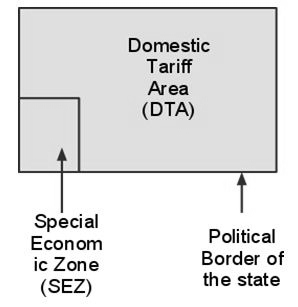
 Figure 1

The host states can expect inter alia to earn increased export earnings, benefit from increased employment opportunities, improved training and skills, and transfer of modern technology (Muchlinski, 2007, p227). In return, foreign investors are offered incentives such as tax exemptions, duty free imports, exemptions from import quotas, capital mobility to remit profits, export allowances and subsidised interest rates within the SEZ. A significant incentive offered by the host state involves the legal control of labour relations. Specifically, the right to establish trade unions or take industrial action may be limited within the SEZ (Muchlinski, 2007, p229).

Political and economic stability, reliable infrastructure, inexpensive labour, market access, and efficient bureaucracy are factors that determine not only how attractive investors will find the SEZ, but are factors that eventually determine the success of the SEZ (UNIDO, n.d., p27).

Keeping in mind these objectives and demands, India embarked on a journey to use SEZs as engines of economic growth. India set up Asia’s first EPZ set up in Kandla in 1965. The government announced the SEZ policy in April 2000, claiming to “to overcome the shortcomings experienced on account of the multiplicity of controls and clearances; absence of world-class infrastructure, and an unstable fiscal regime and with a view to attract larger foreign investments in India” (SEZ India, 2011a, Introduction). The Foreign Trade Policy provisions governed SEZs in India prior to the implementation of the SEZ Act, 2005 in February, 2006 (Chandrasekhar and Ghosh, 2007).

Salient Features of the SEZ Act (2005)

‘The Special Economic Zones Act, 2005’ was passed on the 23rd June, 2005, in an attempt to give a framework to the implementation of SEZs in India. It includes several regulatory and investment fostering mechanisms.

i. Creation of SEZs and general administration:

The Act explicitly mentions a few guiding principles for the Central Government regarding the creation of SEZs. The objectives of the government, as stated by the Act, must be to generate additional economic activity, promote exports of goods and services, create employment opportunities, and develop infrastructure, all while maintaining the “sovereignty and integrity” of India

(SEZ Act, 2005, p8). Thus, SEZs have thus come to be justified as an engine of growth and employment generation, and not in terms of exports expansion alone (Sharma, 2009, p18).

The Act calls for the creation of the “Board of Approval”, which, as the name suggests, looks into applications to set up SEZs and gives approval to them if they meet the required criteria. This acts as a single-stop-shop for investors (called ‘developers’) to get the required regulatory permission to set up an SEZ. SEZs may be established under this Act either jointly or severally by the Central Government, State Government of any legal person. The Central Government, however, can suo moto set up SEZs, and can prescribe other requirements at a later stage (SEZ Act, 2005, p1-6).

The position of a Development Commissioner is established (p14), and this position is responsible for the general overview of the SEZ, from presiding over the Approval Committee (p17-18) to running the SEZ Authority, which is in charge of provision of infrastructure, promoting exports. reviewing the functioning and performance of the SEZ, and other such functions (p28-29).

ii. Tax Exemptions, Finance and Banking

By definition, SEZs are so-called “tax havens”. The Act specifies all those taxes and duties that the developers would be exempted from in the SEZs. There is exemption from Custom Tariff Act, 1975, Central Excise Act, 1944, Central Excise Tariff Act, 1985 and other similar laws (p24). 100% Income Tax exemption on export income for the first 5 years, and 50% for the next 5 years is offered (SEZ India, 2011a, Facilities and Incentives).

Attention is also given to the trade between the SEZ and the DTA. The Act (SEZ Act, 2005, p8) prescribes the exemption from the payment of duties, taxes or cess under all enactments of the First Schedule for trade between DTA to SEZ. However, any goods moved from the SEZ to the DTA would be subject to safeguarding duties, anti-dumping regulations and other instruments (p26).

The Act also specifies the financial governance structure of the SEZ. Bank branches in SEZs, for example, are defined as ‘Offshore Banking Units’ (SEZ Act, 2005, p3-4), and can be set up after the approval of the Reserve Bank of India (RBI), which is India’s central bank (p20). Other financial activities in the SEZ would be monitored by the relevant regulatory authorities in the DTA (p21).

iii. Law Enforcement

Were illegal activities to take place, the Act states that the Development Commissioner would have the cases investigated, and the cases would be heard at the court(s) appointed by the State Government and the Chief Justice of the state High Court (SEZ Act, 2005, p22). The Act also explicitly states that in case there is any inconsistency of this law with other laws, than this Act would have an overriding effect over others (p34).

iv. Amendments

Over the years, several amendments have been made to the Act. They have primarily revolved around specifying the provision of infrastructure and requirements for establishment of SEZs. The minimum area requirements vary across industries and regions. As an example, a multi-product SEZ has to be between 1000 and 5000 hectares, and at least 50% of the area needs to be earmarked for developing the processing area (SEZ India, 2010, ch II sec. 5, sub-sec 2 a).

Amendments also allow for the generation, transmission and distribution of power within an SEZ (sec. 5, sub-sec 5 c). Importantly, in the case of an information technology related SEZ, 24 hours of uninterrupted power supply is to be provided, apart from reliable connectivity (sec. 5, sub-sec 5A).

Importantly, a stated objective is the generation of positive net foreign exchange earnings, as it is specified that a unit would achieve positive net foreign exchange, calculated cumulatively for a period of five years from production (ch VI sec 53).

The Act is clear in specifying the framework regarding the implementation of an SEZ promotion strategy. The Act however, remains conspicuous in its silence on land acquisition and labour laws, which has become the bone of contention on the implementation of the policy.

A Brief Overview of SEZs in India

Prior to the enactment of the SEZ Act, 2005, there were 19 SEZs across India. The government has now approved 581 SEZs (SEZ India, 2011b) with a further 154 with in-principle approvals (SEZ India, 2011c). 130 of these SEZs are operational today. 283 of the 581 approved SEZs are in the three states if Andhra Pradesh, Maharashtra and Tamil Nadu (SEZ India, 2011d). Of the sectors, the Information Technology and IT enabled services sector has a 61% share of SEZs, while the biotech, pharma, textile sector and multi-product SEZs have less than 10% share each. Apart from these, there are three airport based multi-product, and eight port-based multi-product SEZs (SEZ India, 2011e).
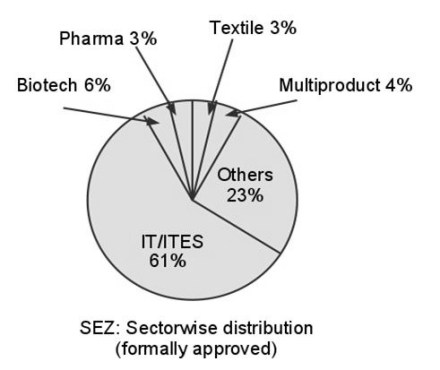
Source: SEZ India, 2011e

The Indian experience in the implementation of SEZs has brought to light major areas of concern in the economic and social spheres. In the economic sphere, these are related to fiscal costs, net employment generation and exports. The social experience of SEZs has brought up issues of worker rights, and those of land transfer, dispossession and displacement. The next two sections of the paper will look into these briefly.

The Economic Experience

i Fiscal issues and investment:

Tax holidays in the SEZ are generous, and provide 100% exemption for Income Tax on profits for the first 5 years of production and 50% for the next five years, apart from the tax breaks discussed above. In addition to this, land is given by the government to developers at low rates (Dutta, 2009, p23). Estimates by the Finance Ministry show that the losses to the state exchequer in terms of forgone revenue would be £24billion for an investment of £50billion (Chandrasekhar and Ghosh, 2007).

Owing to the perceived lost revenue, the Finance Ministry announced a Minimum Alternate Tax on the book profits of developers and units operating in SEZs in the 2011-12 Budget. The Commerce Ministry, however, wants to see a roll back of this tax and sees SEZs as “engines of growth” (Pannu, 2011). This points to differences between the Finance Ministry and the Commerce Ministry on the issue of SEZs.

In fact, Arunachalam (2010, p25) shows that the investment as of 2009 in approved SEZs stood at £416million, and not the figures cited by the Finance Ministry. He argues (2010, p20) that Indian SEZs failed to attract FDI as it would have liked because firstly, India has not used SEZ policies to test reforms which would later be adopted nationwide; secondly, Indian SEZs are small in size (especially when compared to their Chinese equivalents), and finally, because of the lack of labour market flexibility.

ii. Exports:

The Ministry of Commerce and Industry claimed that the value of exports from functioning SEZs increased from £1.9billion in 2003-04 to £30.6billion in 2009-10 (exchange rate £1 = INR72 as of 16th March, 2011). The growth rate of exports over the previous years increased from 25% before the SEZ Act, 2005 to 52% after its implementation, and it stands at 121.40% in 2009-2010 (SEZ India, 2011a, Export Performances). Note that these figures are inconsistent with the estimates of
losses by the Finance Ministry.

An example of a successful SEZ in this regard would be the Mundra SEZ. This SEZ houses India’s largest private port, has been most successful in seeing an increase in exports. It is expected to handle 100m tonnes of exports by 2013, with a growth rate of 40% in these years (Thakkar, 2008).

However, the Comptroller and Auditor General of India has pointed out that most of the SEZs sell goods within the country as “deemed exports” rather than actually exporting them overseas. This seems plausible as the exponential rise of exports from SEZs corresponds with stagnant national exports. The Finance Ministry speculates that some units have merely shifted to these zones from the DTA to avail tax benefits (Pannu, 2011).
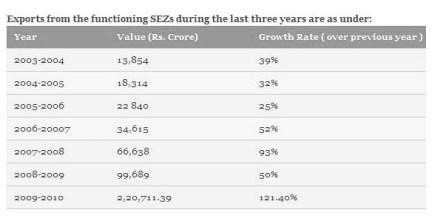
Source: SEZ India, 2011a, Export Performances

iii. Employment generation (or the lack thereof):

Proponents of SEZs have claimed that SEZs lead to employment generation, in addition to exports. While the total employment by all types of SEZs across India as of 2008 was about 370,000 (Reddy, Prasad and Kumar, 2010, p87), Mahanta (2010, p199) shows that acquisition of agricultural land by SEZs lead to a fall in food-grain output and agricultural employment. Importantly, he shows that this fall in agricultural employment is not offset by the increase in employment in SEZs.

Another point to note is that compared to countries around the world, Indian SEZs have not seen a high proportion of female workers. In 2003, only 37% of the workforce was female (Varma, Prasad and Krishna, 2010, p320-322). The claims of benefits of the generation of employment by SEZs are hence called into question.

The Social Experience

i. Land acquisition and displacement

Land acquisition is the ‘hot topic’ of India’s SEZ policy. The SEZ Act, 2005 makes no mention of it. The out-dated Land Acquisition Act, 1894, is applicable in this regard. Even the Land Acquisition (Amendment) Bill, 1998 has come under fire from for several shortcomings. For instance, land losers could have their land acquired even if a stated compensation isn’t paid (Asif, 1999, p1564).

Land acquisition is especially contentious and problematic when the land being acquired is populated with people living off the land, which is often the case with agricultural land, as was the case in Nandigram, West Bengal. In addition to this, Chandrasekhar and Ghosh (2007) argue that real-estate developers can engage in major land grab in the guise of setting up SEZs as the SEZ rules require only 25 per cent of the land to be used for industrial processing purposes.

While approved SEZs are to consume 95,000 hectares of land, (Balasubramanian, 2010, p53), the Ministry of Commerce stated that as of 2008, the land allocated to SEZs was about 0.070% of the total land area and 0.128% of the total agricultural area of the country (Reddy, Prasad and Kumar, 2010, p87). While this may seem low, it is has proven to be problematic because of the high population density in some of these areas.

An illustration of the flawed acquisition mechanism by the government would be the case of the state of Andhra Pradesh, where land is being acquired from the poorest people who had been earlier allocated land by the government in “land-for-the-poor schemes”. Legally, this land belongs to the government, so the government takes it back often without compensation on the behalf of SEZ developers (Oskarrsson, 2010, p368).

On the other hand, the Commerce Ministry has cited examples of how rise in land rates in barren, unproductive land has brought wealth to the poor and SEZs have brought infrastructure to the hinterland, as is the case with Mundra in the state of Gujarat (Bhatt, 2007). The wastelands in the coastal regions of Gujarat are mostly owned by the government, hence leaving out land acquisition out of the picture. Moreover, states like Tamil Nadu have seen the rural population welcome SEZs, because several years of social upliftment by the government has made the populace less dependent on agriculture for their livelihood (Murugesan and Bandgar, 2010).

ii. Labour relations

While the SEZ Act, 2005 makes no mention of changes in labour law, Tanwar (2010, p231) writes that changes to the prevailing pattern of application of labour laws have been made in SEZs. All units operating in SEZs are categorised as “Public Utility Service”, meaning that many labour laws become irrelevant. A Public Utility Service is defined to be a service that is of great value to the society, and the lack of provision of which can affect the life of everyone. In this case, employees have to give a 14 day notice before going on strike. Additionally, employees in SEZs don’t have protection in the form of a notice period or compensation against retrenchment. It follows that employees will be reluctant to raise a voice against their employers when the need arises. Moreover, employers in SEZs have the right to change the terms and conditions of service at any point of time. Mahanta (2010, p200) raises concern regarding the lack of labour unions, stating that the possibility of fall in real wages is high, although experience shows that SEZ wages are at par with non-zone wages (Varma, Prasad and Krishna, 2010, p326).

Conclusion

This essay has dealt briefly into a few contentious issues that arise with the establishment of SEZs in India. With significant employment not being generated, and with no real rise in national exports has taken place, the rationale of this establishment is called into question. The issue remains volatile, as was seen in the case of Nandigram, where the conflict continued to simmer after the scrapped its plans to establish the SEZ there (Dohrmann, 2008, p76).

However, governments are unlikely to give up on establishing SEZs, and it is imperative that laws are amended in order to make trade and investment flourish without disempowering the people who are displaced or the workforce in SEZs. The Land Acquisition Act of 1894 need to be looked into, and a transparent rehabilitation law needs to be put in place (Dohrmann, 2008, p79). In fact, the people need to be made stakeholders in the progress of the nation. Failure to do so may further prove former Indian Prime Minister VP Singh correct in his assessment of the SEZ policy of India, when he said (Dohrmann, 2008, p1), “the current promotion of SEZs is unjust”, and that it acts as a “trigger for massive social unrest, which may even take the form of armed struggle.”

__________________________________________________________________________________

References

  • Arunachalam, P., 2010. “Special Economic Zones and Foriegn Direct Investment in India and China”. In: Arunachalam, ed. Special Economic Zones in India. Serials Publications, New Delhi. ISBN 978-81-8387-336-9
  • Asif, M., 1999. “Land Acquisition Act: Need for an Alternative Paradigm”. Economic and Political Weekly June 19, 1999 Balasubramaniyan, R., 2010. “An Econometric Analysis of Special Economic Zones in India”. In: Arunachalam, ed. Special Economic Zones in India. Serials Publications, New Delhi. ISBN 978-81-8387-336-9
  • Bhatt, S., 2007. “Rivalry Between Business Houses has blown up the SEZ issue”. Rediff News 21st Feb, 2007. [online] Available at: http://www.rediff.com/money/2007/feb/21sez.htm [accessed 18th March, 2011]
  • Chandrasekhar, C.P., and Ghosh, J., 2007. “SEZs in India: The Record So Far”. Business Line, 27th November, 2007. [online] Available at http://www.thehindubusinessline.in/2007/1/27/stories/2007112750070900.htm [accessed 15th March, 2011]
  • Dohrmann, J. A., 2008. “Special Economic Zones in India – An Introduction”. ASIEN 106 (January, 2008) p60-80 [online] Available at http://www.asienkunde.de/articles/a106_asien_aktuell_dohrmann.pdf [Accessed 16th March, 2011]
  • Dutta, M., 2009. “Nokia SEZ: Public Price of Success”. The Economic and Political Weekly, 3rd October, 2009. Vol XLIV no. 40
  • Guangwen, M., 2003. The Theory and Practice of Free Economic Zones: A Case Study of Tinajin/People’s Republic of China. Peter Lang ISBN 0-8204-6508-9
  • Mahanta, A., 2010. “Special Economic Zones and its Impact on Agriculture and Employment in India”. In: Arunachalam, ed. Special Economic Zones in India. Serials Publications, New Delhi. ISBN 978-81-8387-336-9
  • Manoj, P. K., 2009. Special Economic Zones in India: Financial Inclusion: Challenges and Opportunities. Serials Publications, New Delhi. ISBN 978-81-8387-275-1
  • Muchlinski, P., 2007. Multinational Enterprises and the Law 2nd Ed. Oxford University Press
  • Murugesan, P., and Bandgar, P. K., 2010. “Land Acquisition for SEZs in India: Theoretical Perspective”. Southern Economist, 1st August, 2010 [online] Available at:  http://www.vesasc.org/Economics_-_Murugeshan_Sir.pdf [Accessed 19th March, 2011]
  • Nagayya, D., and Rao, T. V., 2010. “Special Economic Zones For Raid Insutrlization and Regional Development: Progress and Concerns”. In: Arunachalam, ed. Special Economic Zones in India. Serials Publications, New Delhi. ISBN 978-81-8387-336-9
  • Oskarsson, P., 2010. “Zoning Andhra Pradesh: Land for SEZs via tha Land for the Poor Program”. In: Arunachalam, ed. Special Economic Zones in India. Serials Publications, New Delhi. ISBN 978-81-8387-336-9
  • Pannu, S.P.S, 2011. “Ministries in a tug of war over tax on SEZs”. Business Today, 14th March, 2011 [online] Available at: http://businesstoday.intoday.in/bt/story/ministriesfightovertaxonspecialeconomiczones-(sezs)/1/13883.html [accessed 14th March, 2011]
  • Reddy, P., Prasad, A., and Kumar, P., 2010. “Generation of employment by Special Economic Zones in India”. In: Arunachalam, ed. Special Economic Zones in India. Serials Publications, New Delhi. ISBN 978-81-8387-336-9
  • Sharma, N. K., 2009. “Special Economic Zones: Socio-Economic Implications.” Economic and Political Weekly 16th, May, 2009 vol. XLIV no. 20
  • SEZ India, 2010, “SEZ Rules incorporating amendments upto July, 2010”. Ministry of Commerce and Industry (Department of Commerce), Government of India  [online] Available at: http://sezindia.nic.in/goipoliciessra.asp [Accessed 14th March, 2011]
  • SEZ India, 2011a. Special Economic Zones in India, Ministry of Commerce & Industry (Department of Commerce) [online] Available at http://sezindia.nic.in/ [Accessed 15th March, 2011]
  • SEZ India, 2011b. “ListofFormalApprovalsgrantedundertheSEZAct,2005, 2011”. Ministry of Commerce and Industry (Department of Commerce), Government of India  [online] Available at: http://sezindia.nic.in/writereaddata/pdf/ListofFormalapprovals.pdf [Accessed 14th March, 2011]
  • SEZ India, 2011c. “In Principle approvals granted under the SEZ Act, 2005”. Ministry of Commerce and Industry (Department of Commerce), Government of India [online] Available at: http://sezindia.nic.in/writereaddata/pdf/Listofinprincipleapprovals.pdf [Accessed 14th March, 2011]
  • SEZ India, 2011d. “SEZ: Statewise Distribution”. Ministry of Commerce and Industry (Department of Commerce), Government of India  [online] Available at: http://sezindia.nic.in/writereaddata/pdf/StatewiseDistributionSEZ.pdf [Accessed 14th March, 2011]
  • SEZ India, 2011e. “SEZ: Sectorwise Distribution”. Ministry of Commerce and Industry (Department of Commerce), Government of India  [online] Available at: http://sezindia.nic.in/writereaddata/pdf/Sectorwise%20distributionSEZ.pdf [Accessed 14th March, 2011]
  • Tanwar, S., 2010. “Relevance of Labour Laws in Special Economic Zones”. In: Arunachalam, ed. Special Economic Zones in India. Serials Publications, New Delhi. ISBN 978-81-8387-336-9
  • Thakkar, M., 2008. “Mundra Port: Anchored to Success”. The Economic Times 12th Nov, 2008 [online] Available at: http://articles.economictimes.indiatimes.com/2008-11-12/news/28448158_1_mundraportsezadanisbiggestport [Accessed 19th March, 2011]
  • Tantri, M. L., 2010. “Import Dependency of Special Economic Zones”. The Economic and Political Weekly 4th September, 2010 Vol. XLV no. 36
  • The Telegraph, 2007. “Red-hand Buddha 14 killed in Nandigram re-entry bid”. The Telegraph, 15th March, 2007 [online] Available at http://www.telegraphindia.com/1070315/asp/frontpage/story_7519166.asp [accessed 14th March, 2011]
  • The World Bank Group, 2008. “Special Economic Zones: Performance, Lessons Learned, and Implications for Zone Development”. The World Bank Group, April, 2008 [online] Available at: http://www.ifc.org/ifcext/fias.nsf/AttachmentsByTitle/SEZpaperdiscussion/$FILE/SEZs+report_April2008.pdf [accessed 14th March, 2011]
  • The Land Acquisition Act, 1894. Ministry of Law and Justice, Government of India, 1st Spetember, 1895 [online] Available at: http://dolr.nic.in/hyperlink/acq.htm [accessed 16th March, 2011]
  • The Special Economic Zones (SEZ) Act, 2005. Ministry of Law and Justice, Government of India. 23rd June 2005 [online] Available at http://sezindia.nic.in/goipolicies.asp [Accessed 13th March, 2011]
  • UNIDO, n.d. “Export Processing Zones: Principles and Practice”, United Nations Industrial Development Organisation. [accessed from the British Library of Political and Economic Science, LSE]
  • Varma, A. V. N., Prasad, J. C., and Krishna Y. R., 2010. “Special Economic Zones – The Socio Economic Dimensions and Challenges.” In: Arunachalam, ed. Special Economic Zones in India.
    Serials Publications, New Delhi. ISBN 978-81-8387-336-9

The Aryan Debate in the Indian Context

In this essay, the author analyses the debate surrounding the origin of the Indo-Aryan people who constitute a majority of the population in Northern India. While the traditional view is that the Aryans migrated from outside the subcontinent, a more recent view holds that they were indigenous to the region.


By Rebecca Aranha, 13 Oct, 2011

“The truth of ancient history is indifferent to our wishes, our politics, our religion… the idea of truth in history involves the idea that exists independent of our will, and is therefore difficult to know, because our interpretations are will-bound and our facts are never independent of our theories”  -Thomas R. Trautmann

The Aryan debate, ancient Indian history’s very own case of ‘whodunit’, has been raging in books, newspapers, and public forums of India for the last decade or so. It examines the following question: did the Sanskrit-speaking Aryans enter from the north-west in about 1500 BC, or were they indigenous to India and identical to the people of the Indus Civilization of 2600-1900 BC? This question is central to the debate that has shaped Indian history writing, and has been strongly contested in public discussions for over a decade.

The first position, the immigrant Aryan position that the Aryans came to India from outside in about 1500 BC, is called the standard view because it is the interpretation that has prevailed in schools and university textbooks and in academic journals and books. The second position, the indigenous Aryan position that the Aryans were the makers of Indus Civilisation, is called the alternate view, because it is challenging the established, standard view.

The resolution to the Indo-European controversy has been one of the most consuming intellectual projects for historians of Ancient India of the last two centuries. It has captivated the imagination and dedication of generations of archaeologists, linguists, anthropologists, historians, and many scholarly, and not so scholarly, dilettantes. In modern India, the discussion of Indo-Aryan migration is charged politically and religiously, with the debate having produced a lot of polemics on both sides.

Thus, apart from just being a historical debate, the Aryan debate has now acquired a political and social colour. Moreover, what used to be a debate among scholars has boiled and spilled over into the public arena, and the sober works of academicians are now swamped by the often heated writings of those who are not scholars trained in the history, linguistics and archaeology of ancient India. With such heated debates it becomes easier to be thrown off the track of historical truth in favour of political or religious objectives, thus allowing partisan politics to enter the debate. As may be questioned by many, why has this debate become so highly charged and contentious? In a general manner we may say that the past often becomes very important and debatable as ancient history serves as a character for society and marks its growth and continuance. When there are various visions about the future, it is the past, that sets precedence so to speak, that is looked upon to judge the ‘righteousness’ of the path. It also brings to light the matter of who were the ‘foreigners’ and who were the ‘natives’ and, as can obviously be seen, these matters are highly sensitive and lead to extremely charged debates!

It is extremely difficult to discover the truth behind the Aryan debate, because, as Trautmann rightly says, “the truth of ancient history is indifferent to our wishes, our politics, our religion… the idea of truth in history involves the idea that exists independent of our will, and is therefore difficult to know, because our interpretations are will-bound and our facts are never independent of our theories”.

I shall now attempt to contextualise this debate, to put it into today’s perspective. The relevance of the Aryan debate can be seen from the influence of the colonial period on India’s present to our current political scenario and, right up to controversial comments of certain Right-wing politicians in the very recent past. The present volatile situation in India has made Western, and many Indian, scholars particularly concerned about the repercussions of communal interpretations of history.

The theory of the Aryan race is not limited to historical reconstruction and is an example of how historical perceptions of the past can be related to conflictual situations of the present. This debate is intensely relevant to the constructions of several very different sets of competing identities: associations of coloniser and colonised, neo-colonial and Hindu fundamentalist, indigenous and foreigner, Hindu communal and Marxist secularist etc.

The conquest of the ‘fair-skinned Aryans’ over the ‘dark-skinned aborigines’ became the mechanism by which caste came to be viewed as a form of racial segregation and was central to Indian social institutions.

The debate over how ‘Aryanism’ was to be interpreted provides us insight into the political agendas of the groups who used it. These groups were involved in seeking identities from the past and in countering each other’s claims to these identities as well as choosing a homeland and working out a national culture. The interpretation therefore hinged on specific ideological needs. The primary concern in establishing an Indian identity was the need to define the rightful inheritors of the land. Here the question of origins and affirmations of common descent was central to nation-building. It is thus important to consider modern ideological underpinnings of this debate in India as different forces compete over the construction of national identity.

The Aryan invasion theory also has a genesis in colonial attempts to ‘discover’ the Indian past, a discovery which was rooted in the colonial present.

During the earlier phase of the ‘homeland of the Aryans’ quest, when India was still a popular candidate, many scholars were uncomfortable about moving the Indo-Europeans too far from their biblical origins somewhere in the Near East. There were those among the British, in particular, whose colonial sensibilities made them reluctant to acknowledge any potential cultural indebtedness to the forefathers of the rickshaw pullers of Calcutta, and who preferred to hang on to the biblical Adam for longer than their European contemporaries. Even well after Adam was no longer in the picture, there was a very cool reception in some circles to the “late Prof. Max Muller who had blurted forth to a not over-grateful world the news that we and our revolted sepoys were of the same human family”.  Muller noted, “They would not have it, they would not believe that there could be any community of origin between the people of Athens and Rome, and the so-called Niggers of India…”

The Indomania of the early British Orientalists was replaced by an Indophobia initiated by Evangelicalism. Charles Grant epitomised this by stressing the absolute difference, in all respects, between the British and the despicable natives of the subcontinent. Grant was by no means the first or sole Christian leader to engage in extreme denunciations against Hinduism – these continued throughout the colonial period. Christian evangelists, in fact, found advantages in discourses of Aryan kinship. For instance, Samuel Laing held that the “two races so long separated meet once more… the younger brother has become the stronger, and takes his place as the head and protector of the family… we are here… on a sacred mission, to stretch out the right hand of aid to our weaker brother, who once far outstripped us, but has now fallen behind in the race”.

Devendraswarup, a historian of the colonial period, finds the scholarly work of missionary intellectuals to be readily presenting the Brahmins as foreigners who had imposed their Vedic language and texts onto the aboriginals of India. The idea in this case was to create a sense of alienation from Brahmanical religion among the lower castes, thereby preparing them for exposure and conversion to Christianity.

Clearly, the developing pressure to justify the colonial and missionary presence in India prompted the denigration of Indian civilisation, and the shunning of embarrassing cultural and linguistic ties. Trautmann suggests that such considerations also explain why the British, despite having primary access to Sanskrit source material, did not pursue the study of comparative philology. Racial theorists paved the way for the postulate that the Aryans were an autonomous white race who brought civilisation and the Sanskrit language to the different races of India– a development Trautmann holds as pivotal to the political construction of Aryan identity developing in Germany.

The colonial view would endorse the idea that the progress of India was dependent on the return of the Aryan in the guise of the British. The British presence in the subcontinent could now be cast as a rerun several millennia later of a similar script, but a script that hoped to have a different ending. The British could now present themselves as a second wave of Aryans, again bringing a superior language and civilisation to the racial descendants of the same natives their forefathers had attempted to elevate so many centuries earlier. Devendraswarup argues that after the British were shaken by the Great Revolt of 1857, certain individuals suddenly found reason to stress their common Aryan bond with the Brahmins where others had previously shunned it. The Aryan connection was thus simply manipulated at will.

This view was partially responsible for the extreme nationalist rejection of the theory that Aryans were anything other than indigenous. Rajaram stated that the Aryan invasion theory is “the fabrication of a version of ancient history and tradition that was highly advantageous to missionary and colonial interests”. This discourse is also attacked as some claim that it attempts to promote disunity between Dravidians and northerners. Shankaracharya believed that “the Indologists and Orientalists introduced the till then unheard of concept of Aryans and Dravidians, which created mutual hatred”. Supporters of the migration theory are now faced with several accusations. The major one is that the British Raj from the 19th century to the present day promoted the Aryan invasion hypothesis in support of Euro-centric notions of white supremacy. Assertions that the highly advanced proto-Hindu Vedic culture could not have had its roots in India are seen as attempts to bolster European ideas of dominance.

I have earlier discussed how the discourse of Aryanism affected religious and political identities in post-Enlightenment Europe. I shall now go on to examine how the same theme has been utilized to support a variety of agendas on the Indian subcontinent in the modern period. It should however be kept in mind that not all scholars who have written for or against the Aryan invasion theory are politically motivated.

In this context, there are essentially two opposing interpretations, the Dalit one pioneered by Jyotiba Phule, and the Hindutva one pioneered by Veer Savarkar.

Let us begin with Hindutva, since this is the element of most pressing concern. The Hindutva interpretation follows a strong imperative to stress the racial unity of the Indian people prior to the coming of Islam and the solidarity of the Brahmins and non-Brahmins within Hinduism as well as the differences of Hindus from Muslims and Christians. It tends to reject an Aryan homeland outside of India, and to identify Vedic civilisation with the Indus Civilisation.

Savarkar’s Hindutva, literally ‘Hinduness’, or the essential quality of being a Hindu, has been a very influential expression of Hindu self-identity. Savarkar’s book on Hindutva was eventually adopted by the Hindu Mahasabha, and is still a seminal text of Hindu nationalist groups such as the RSS (Rashtriya Svayamsevak Sangh). Savarkar’s writings clearly reveal the crux of Hindutva – to be considered a native of Hindustan, a person’s religious faith must have an indigenous origin. What, then, of other Indians – those whose religious beliefs blossomed in other lands – where do they fit into such a scheme of things? Savarkar writes on – “That is why in the case of some of our Mohammedan or Christian countrymen who had originally been forcibly converted to a non-Hindu religion and who consequently have inherited, along with the Hindus, a common fatherland and a greater part of the wealth of a common culture are not and cannot be recognised as Hindus. For though Hindusthan to them is Fatherland, as it is to any other Hindu, yet it is not to them a holy land too. Their holy land is far off in Arabia or Palestine. Their mythology and godmen, ideas and heroes are not the children of this soil. They must set their holy land above their Fatherland…” Savarkar believes that the Muslims and Christians can never participate in the benefits (whatever they might be) of Hindutva because their prophet was born on the wrong side of the Arabian Sea!

Returning to the Aryan theme, it should be evident how the basis of Savarkar’s Hindutva is undermined if the Vedic Aryans came from central Asia. If that were the case, then the followers of Vedic religion would have to be disqualified from being Hindus, since the original founders of their faith were not born and bred in Bharat. Acceptance of the Aryan invasion theory according to Savarkar’s logic would then imply that the forefathers of the Vedic Aryans are undoubtedly foreigners and their followers essentially no different from those revering other “foreigners” such as Muhammad or Christ. Also, if the Aryans came from somewhere near the Caspian Sea area, adjacent to Persia, they would actually share close blood links with the proto-Iranians, thereby making the Vedic Aryans much closer relatives in language, proto-religion and blood with the Muslims who came to India from these areas.

Therefore, the opposition of other RSS leaders, such as M.S. Golwalkar, to the Aryan invasion theory was extremely aggressive. He said, “It was the wily foreigner, the Britisher, who to achieve his ulterior motives, set afloat all such mischievous notions among our people so that the sense of patriotism and duty towards the integrated personality of our motherland was corroded. He carried on the insidious propaganda that we were never one nation, that we were never the children of the soil but mere upstarts having no better claims than the foreign hordes of Muslims or the British over this country”. This brand of Hindu nationalism, which seems determined to alienate the Muslim community on the grounds of its lack of religious pedigree, is obliged to refute the Aryan invasion theory or risk logical absurdity.

Where Savarkar specifies the importance of India as the geographic land of religious revelation in his criteria for Hindutva, Shrikant Talageri considers the psychological bond to be more significant. He argues that while Indian culture absorbs and assimilates newcomers, Islam and Christianity do not; the leaders, founders, saints, sacred languages, scripts, holy places, traditional attire etc all owe allegiance to cultures outside India. He essentially requires that the Muslims, if not convert completely, at least accept Hindu concepts and beliefs, even those that might completely jar with their own religious sensibilities. He categorically stated, “The non-Hindu people in Hindusthan must either adopt the Hindu culture and language, must learn to respect and hold in reverence the Hindu religion, must entertain no idea but those of glorification of the Hindu race and culture… or may stay in the country, wholly subordinated to the Hindu nation, claiming nothing, deserving no privileges, not even citizen’s rights”.

There can be no doubt that Hindutva is easily pressed into service in alienating and targeting the Muslim minority in communally volatile, modern-day India. Irfan Habib said in a newspaper interview: “I would like to cite the example of the Nazis, of how a particular perception of history held by a respectable section of the German intelligentsia, which was not racist at least outwardly and certainly was not anti-Jewish, was so easily utilised by the Nazis… so, here you have an example of how a historical theory is created by someone who had no idea of what use it can be put to… before 1947 the idea that Aryans went out of India was hardly espoused by any serious historian… but now, while some people deny that they espouse the Nazi race theory, they have in fact espoused it”. Not surprisingly, the various Hindutva versions either deny the validity of the linguistic analyses or else ignore them. From this perspective, archaeology is now viewed as important to the identity of the Aryans, but not so linguistics.

The Dalit interpretation, on the other hand, maintained that the lower castes were the indigenous inhabitants who had been conquered and oppressed by Brahmins who represented the Aryan conquest. This view was expounded initially by Jyotiba Phule. Writing in the latter half of the nineteenth century, Phule argued that the original inhabitants of India were the Adivasis, among whom he included the Sudras, the ati-Sudras and the untouchables, who were descendants of the heroic peoples led by the Daitya king, Bali. The indigenous peoples under the leadership of Bali, fought the arrival of the Brahmins who for Phule represented the Aryan invasion, but the Adivasis were conquered and subordinated. Phule’s ‘golden age’ was the period prior to the Aryan invasion when Sudras were cultivators, landowners and warriors, and had their own culture. The Brahmins are said to have deliberately invented caste so that the Sudras would be kept permanently servile and divided among themselves. He argued that the rightful inheritors of the land were the lower castes, not the Brahmins.

Phule was not merely concerned with the indigenous origins of the lower castes but he was also a ‘social reformer’ working towards educating Sudras and women with the intention of providing them with a sense of relative independence. In the colonial-nationalist divide, his views were not entirely supportive of either.

The dichotomy between Brahmin and non-Brahmin was seen to provide a rational expression for the pattern of history and the suppression of the non-Brahmin by the Brahmin. Brahmins were seen as Sanskrit-educated Aryans and the other castes using Dravidian languages were the non-Aryans. The use of language for demarcation was perhaps one reason for the non-Brahmin movement being more influential in peninsular India (the heartland of Dravidian languages) than elsewhere.

There are others who support the Aryan invasion theory, but do not necessarily share Phule’s ideas, including Romila Thapar. She remarks: “The theory of the Aryans being a people has been seen as fundamental to the understanding of the identity of modern Indians and the question of identity is central to the change in Indian society from caste to class. The upholding of a false theory is dangerous. The next step can be to move from the indigenous origin of ‘the Aryans’ to propagating the notion of an ‘Aryan nation’”.

This ‘school’ of scholars is often branded ‘Left-liberal’ or ‘secular Marxist’ by opponents of the invasion theory, because its model of invasion and subordination corresponded to Marxist concepts of class struggle and ideology. Secular Marxists are accused of maintaining a defunct theory in order to insist that the arrival of the Aryans is analogous to the arrival of the Muslims, Christians, and other groups of newcomers to the subcontinent. In such an amalgamation of immigrants, no one has more claims to indigenous pedigree or cultural hegemony than anyone else.

Chakrabarti, an Indigenous Aryanist, has nothing but scorn for the Indian intellectual elite who “fail to see the need of going beyond the dimensions of colonial Indology, because these dimensions suit them fine and keep them in power”. The most maligned figureheads are precisely those who have most publicly opposed the Indigenous Aryan position, particularly R.S. Sharma and Romila Thapar. She, in turn, holds that “indigenism is intellectually and historiographically barren with no nuances or subtleties of thought and interpretation”. In India, some Indigenous Aryanists, being branded communal, then label their detractors either “colonial stooges” or “secular Marxists” who are motivated by their own political agendas.

The question of Aryanism and the beginnings of Indian history remains a complex problem because it still carries, at the popular level, the baggage of nineteenth century European preconceptions, even if in the European context it has now been rejected as a nineteenth century myth. It has overwhelmed Indian history, but is now less important to a nationalist reconstruction of the past, although the Hindutva version claims to derive from a nationalist cause and accuses those who disagree of being anti-national. Its real function in their hands is political, in that it is used to separate the supposedly indigenous Hindu Aryan from the alien, the Muslim and the Christian; or, in the case of the Dalit interpretation, the indigenous lower castes from the alien upper castes.

The crux of the debate is the crisis of identity and status in the claims to political and social power and a contestation over what is viewed as alternative forms of national culture and ethnic homogeneity. Though the debate itself may never truly be resolved for a lack of concrete evidence it continues to be relevant today not only in its controversial content but also because it shows us how misguided perceptions, narrow-mindedness and political agendas can be detrimental to the development of a nation and its international relations, the peaceful co-existence of its people as well as the analysis of its history.

________________________________________________________________________________

The views expressed in this article are the author’s own and do not necessarily reflect InPEC’s editorial position.