Energy Security: Concepts and Concerns in India

This essay is a literature review of the conceptual framework of ‘energy security’ in the international and Indian contexts. 


By Siddharth Singh, 24th September, 2012

The globalisation of energy markets has increased interdependence across the regions of the world. The access to energy today depends on international networks of infrastructure and transport. This has heightened the risks of major supply disruptions which result from of political conflicts, wars, technical system failures, accidents, sabotage, extreme weather events and financial market turmoil. Additionally, the global energy market is characterised by the reliance by energy importing economies on an ever-smaller group of countries (Chester, 2010).

Continue reading

Are Advances in Technology the Only Force for Tackling Climate Change?

This essay puts forward the argument that without several revolutionary ‘black swan’ innovations, technological advances will need to be supported by strategic planning and a restructured energy market to tackle climate change.  The current market ‘lock in’ of high-carbon energies and high cost of low-carbon technologies mean that the potential for new technologies to gain widespread adoption are highly restricted.


by Jack Hamilton, 24th March, 2012

‘Environmentalists are fiddling while Rome burns’.  This is the claim of Vinod Khosla, the founder of Khosla Ventures, a venture-capital firm that is currently investing over $1 billion into low-carbon technologies in the hope that a ‘black swan’ innovation will be a key to tackling climate change.  In Khosla’s estimations the green technologies of electric cars, wind turbines and smart grids will not be enough and rather there needs to be a ‘1000%’ change if the whole world is to enjoy the energy-rich lifestyle of the Western world.  Until the green technologies are available at a price which is affordable in the developing world, ‘everything is a toy’[i].  Others maintain that existing technology will be sufficient if market factors facilitate its widespread adoption.  Joseph Romm, the editor of Climate Progress, argues that the way to tackle climate change is through the ‘accelerated deployment of existing technologies’ in order to move down the cost curve more rapidly than a breakthrough[ii].  These two opposing views set up two fundamental questions: are advances in technology alone able to tackle climate change and if this technology exists why has it not been adopted?

Continue reading

Can China’s Growing Demand for Energy be Satisfied Without Conflict?

In this essay, the author assess the threat of China’s increasing demand of energy and whether conflict is imminent. The author analyzes the cases of potential conflict, particularly in the East China Sea and the Middle East. The probability of conflict is then assessed in each of these cases in accordance with recent developments.  


By Abd Al-Aziz Abu Al-Huda, 20th April, 2012

Access to energy resources is a vital ingredient to the economic and military development of any state in the international system. Yet, within the past two decades, China’s quest for energy resources has particularly generated much debate and criticism. The commonly held opinion is that China’s pursuit for energy resources is a prelude to conflict with the International community because China poses a long term threat on energy supplies. However, such observations have been criticized by scholars such as Kung-wing Au and Hongyi Harry Lai, who emphasize that China’s growing demand for energy has in fact increased its vulnerability resulting in gradual cooperation.

This paper then attempts to assess the threat of China’s increasing demand of energy and whether conflict is imminent. The paper will begin by looking at cases of potential conflict particularly in the East China Sea and the Middle East. The paper will then attempt to assess the probability of conflict in each of these cases according to recent developments. The discussion will then conclude by examining the level of cooperation in each of the cases and the probability of its persistence. Following an examination of the literature, one can argue that conflict will highly depend on developments in internal state policies, perceptions and more importantly the development of negotiations which can be hindered by historical and political factors.

East China Sea

Development and dependency on imported oil is not restricted to China alone, but is shared by the wider Asian region as states seek to expand production, electricity generation, and energy access to their military. The East China Sea is said to hold 60-70% of the regions oil and natural gas resources which creates conditions for conflictual foreign policy due to uncertainty in the global supply of energy resources (Lai, 2007). The most conflictual competition is that between China and Japan due to the unresolved sea border dilemma between the two countries. This is followed by Chinese fears over U.S presence in the Straits of Malacca, the key energy supply route for China. With Chinese and Japanese case particularly, the fundamental cause of the conflict is not just competition over resources but the conflict also results from political distrust resulting from historical grievances (Liao, 2008).

Sino-Japan Relations

Despite conflicting claims over the demarcation of the East China Sea, Japan and China continued to negotiate joint development in the disputed area (Au, 2008). Both sides proposed solutions to finalize the conflict particularly Japan which tried to come up with an equitable solution by coming up with the Median line. The Median line according to Au “runs from the north to the south and separates the sea with equal distances from the shores of the two countries”  (Au, 2008, p. 224). While this may seem like a fair solution, China still has not acknowledged the median line highlighting that it was unilaterally drawn by Japan without consulting China (Buszynski & Sazlan, 2007).

Alternatively, China argues that it has the right to develop the “subterranean resources on its continental shelf” which go past the median line creating overlapping claims with Japan  (Au, 2008, p. 224). Japan despite having proposed the Median line, is also concerned that many oil and gas deposits in Chinese waters are situated in close proximity to the Japanese side allowing Japanese reserves to be tapped by Chinese operations (Au, 2008). In return, Japan aimed at limiting Chinese operations by blocked joint development in the Diaoyu and Senkaku islands (Buszynski & Sazlan, 2007). The islands remain subject to territorial dispute despite being under current Japanese control. However, Japan feared that cooperation with China over the Islands would, according to the Law of the Sea, enhance China’s share in regional waters.

The UN convention on the Law of the Sea specifies that coastal countries can “claim 200 nautical miles from their shores as their Exclusive economic zones (EEZ)” (Au, 2008, p. 225). In regards to the East China Sea, the widest point is only 360 nautical miles barely permitting Japan and China to demarcate territorial waters without conflicting claims (Liao, 2008). Coupled with historical animosity, China has considered investing in a naval defense force to guard Chinese seaborne energy imports going through the Straits of Malacca and territorial claims (Kennedy, 2010).  The Japanese air force near the Median line have identified the presence of Chinese military warships on a few occasions and considered this a ‘Show of force’ by China (Liao, 2008, p. 66).

“The Malacca Dilemma”

Around 80% of China’s oil and gas imports pass through the Straits of Malacca (Bustelo, 2005). Being dependent on energy imports, the Straits of Malacca is particularly problematic for China because the United States navy patrols the straits. Initially, the U.S naval presence is beneficial to China because it wards off piracy. However, U.S naval presence also risks the U.S blocking the flow of energy due to China’s criticized increasing role in the Middle East and Africa. The U.S naval forces also pose a threat to China should they interfere in Taiwan by using their bases in the Philippines or Kyrgyzstan (Kennedy, 2010). Even without U.S naval presence, China seeks to diversity its land based imports because they lack a developed navy to challenge the U.S (Downs, 2004). China has specifically looked at Russia to build  the Tayshet-Skovorodino-Nakhodka oil pipeline but was challenged and beaten by Japan over the route (Lai, 2007).

The Middle East

Like the Straits of Malacca, China’s energy dependency also increases concern over the Straits of Hormuz in the Arabian Gulf where most of the Middle East’s energy passes (Calabrese, 1998). Despite heavy presence of U.S influence in the Middle East, China’s foreign policy gradually developed into building closer diplomatic relations with the Arab world and Iran in order to secure access to energy deposits. From the U.S standpoint, China’s ties with the Middle East poses several challenges because it goes against the U.S’s policy of containment (Calabrese, 1998). However, China views U.S policies as a unilateral initiative which doesn’t involve them because China’s ties in region are free from ideological or historical hostilities (Yetiv & Lu, 2007).

The Middle Eastern perspective holds positive views of China particularly after the U.S campaign on the ‘War on Terror’ which alienated most of the region increasing anti-Americanism (Garrison, 2009, p. 13). As sales to the U.S declined, The Middle East, particularly Saudi Arabia, began a series of ‘loans for oil’ deals creating new investments (Kennedy, 2010, p. 140). Saudi Arabia, as a result of increasing political and economic cooperation, also allowed the Chinese oil company SINOPEC to extract natural gas from one of Saudi Arabia’s basin’s (Lai, 2007).

With the wider Arab world, China has devised an agreement with the 15 members of the Arab League to establish a forum on politics and economy. The agreement specifically targeted concessions for mutual market access and cooperation in investment especially in oil and gas (Lai, 2007). Unlike the U.S, China has been successful in dealing with the Middle East because it sympathizes with the Arab world’s stance on Palestine. Since the ‘War on Terror’, China has been active in voicing Arab concerns calling for an end to regional violence and support for the ‘Land for peace’ and ‘Nuclear free Middle East’ initiatives (Yetiv & Lu, 2007). Additionally, Arabs prefer dealing with China because they share China’s policy of non-interference regardless Human rights issues unlike the U.S which seeks to impose democratization on authoritarian regimes (Ziegler, 2006).

Iran, like the Arab world favours Chinese energy involvement. China’s relationship with Iran also includes military cooperation which the US particularly criticizes even though reports confirmed that China is not involved in selling sensitive military technology to Iran (Calabrese, 1998). A more pressing concern for the U.S has also been China’s assistance in developing Iran’s oil extracting capabilities and purchasing it which violates U.N Security Council sanctions (Yetiv & Lu, 2007). The U.S perceives this action as assistance to the rogue Iranian regime as well as irresponsibility on China’s part for violating International norms.

Assessment

There is no doubt that China’s increasing presence in the field of energy security creates an ‘Energy security dilemma’ (Kambara, 1984). As China develops into a prominent power on the international scene, emphasis is focused on the fact that China is currently the second largest consumer of oil globally and rising (Downs, 2004). However, what crucially matters is not how much energy resources China consumes, but whether it’s increasing consumption will alter its foreign policy. Estimations of China by 2030 tell us that it will remain dominated by coal because of difficulties in increasing the domestic use of natural gas coupled with lacking infrastructure (Kambara, 1992). Even should demand for oil increase, conflict to ensure supplies will depend on policy makers at the time and how they perceive national interests and threats (Garrison, 2009)

While China is a growing power, it largely remains dependent negotiating deals with Oil producing countries that ultimately control supplies (Garrison, 2009).  One must point out that only a small share of oil actually goes back to China. Around 85% of imported oil and gas reserves are actually sold and injected into the open market (Garrison, 2009). In fact, one can argue that China’s oil deal with Iran actually increases the supply of energy in the global market restricting prices from increasing (Kambara, 1984). Additionally, regardless whether China sold its imports or not, the U.S would still not be affected because its oil imports from the Arab states are minuscule compared to the “1011.6 and 590.3 million tons of oil annually” purchased from Canada and Mexico (Lai, 2007, p. 531). China on the other hand only imports “51.7 million tons roughly 8.8% of the U.S imports” which are not large enough to upset the U.S (Lai, 2007, p. 531).

Arguably, one can also claim that China contributes to global energy security because until recently, they had a high degree of self-reliance of around 90% of energy being generated in China (Garrison, 2009, p. 144).  Now, China actually produces 10% of the world’s oil and so it is likely that no conflict on behalf of China, the U.S, or the region will be imminent because China lacks military capabilities and the U.S and the region, particularly Japan favour increased energy output which decreases the prices of oil and gas. As previously stated, any actual conflict will most likely be due to a political fallout rather than energy scarcity (Yergin, 2006).

Furthermore, China’s current economy is only a fraction compared to the U.S economy and slightly stronger compared to its Asian neighbours. In per capita, Zheng Bijian argues that “China remains a low income country and China faces constraints to get its 1.3 billion population out of poverty” (Bijian, 2005, p. 19). Taking this into consideration, it is likely that China would view continuing oil diplomacy as much more cost effective and successful compared to using its limited military means (Ziegler, 2006, p. 8). China also considers its dependence for supplies of oil products like “gasoline, diesel oil, kerosene and fuel which come from its neighbours in South Korea, Russia, and Singapore as well as Japan and Malaysia and the Philippines” which, with the exception of Russia, has U.S military presence (Lai, 2007, p. 528).

Cooperation

With increasing interdependence, states gradually come to share numerous challenges. China like other states shares the consequences to its economic development if there is a disruption in energy supplies. Additionally, with its continuing use of coal and fossil fuels, China is also affected by the transboundry environmental consequences that emerge (Garrison, 2009).So has China been cooperating? And will the U.S and its neighbours cooperate back? Economically, neighbouring countries according to Jean Garrison actually think that deepening economic ties with China would be beneficial for them in the long run (Garrison, 2009).  Chinese officials have also highlighted the importance of integration with its neighbours as part of their oil diplomacy to provide opportunities to develop economic and military relations (Ziegler, 2006).

Concerning China’s anxiety about U.S presence in the Straits of Malacca, it is highly unlikely that China would increase its naval capability or move them away from the Taiwanese Strait. The cost of forming a defense navy actually makes the idea more of a concept than a reality (Downs, 2004). Even if China should disrupt sea lanes in order to ensure energy demands, the action would provoke numerous lethal moves by the U.S, Japan, and its neighbours. Instead, from the current situation we can assume that China understands the necessary need for strong U.S naval protection to ensure the safety of sea lanes for its oil (Ziegler, 2006).

Logically, China is focusing on improving its diplomatic relations with its neighbours to provide alternate land routes, despite its dependence on seaborne energy imports  (Lai, 2007). One way has been through the “Strings of pearls strategy” which aims at building close ties along coastal countries from the Middle East to the East China Sea in order to defend sea routes from terrorist attacks. (Lai, 2007, p. 528). An example of these close ties is with Pakistan where both countries agreed to build an oil pipeline going from the Port of Gwadar near the straits of Hormuz to the Chinese region Xinjiang which bypasses the Straits of Malacca and the East China Sea (Calabrese, 1998).

On the international level, China has also been quite accommodating to the U.S and the international community despite criticisms of its involvement with authoritarian regimes. In 2002, China voted in favour of the U.S proposed resolution 1441 at the U.N Security Council which stipulated that Iraq, a Chinese energy partner till 2003, was in “material breach of disarmament obligations”  (Lai, 2007, p. 530). While the decision clearly affected China’s ability to extract Iraqi oil under Saddam Hussein, China did not veto the resolution which allowed the U.S to wage war against Iraq in 2003 (Yetiv & Lu, 2007).

As for Iran, when Iranian-U.S relations were deteriorating over Iran’s nuclear programme, it was widely held that China would support Iran considering the Iranian concessions made to Iran for joint development. But China in fact supported a proposal initiated by the U.S and the European Union to refer Iran’s nuclear programme to the U.N Security Council should Iran fail to cooperate with inspections  (Lai, 2007). Also, China agreed with the international community that Iran should not develop nuclear weapons (Calabrese, 1998).

In its own continent, China has been making gradual progress in cooperating over oil and gas. In 2002, China and ASEAN members assured that they will aim to resolve territorial disputes through peaceful means (Bijian, 2005). In 2005, China agreed to initiate joint exploration programmes of oil and gas with Vietnam and the Philippines including an agreement of cooperation on gas with Indonesia (Liao, 2008). China and India have also attempted to cooperate by signing a memorandum of understanding for enhancing cooperation in the field of oil and natural gas (Kennedy, 2010). Both agreed to cooperate on “energy exploration, production, storage, and stockpiling, research and development, and conservation” which would bring down energy prices in Asia (Lai, 2007, p. 533). Lastly, China was successful in building cooperation between India and Pakistan by proposing an Iran-Pakistan- India “Peace pipeline” (Lai, 2007, p. 533).

As for unstable relations with its Japanese neighbour, both governments have actually been making contributions since 1970 and expressed a willingness to assist each other and Asian states in utilizing non-oil energy like wind and solar power (Liao, 2008). Cooperation between both governments also extends to the East China Sea where Japan has refrained from drilling in disputed waters while offering China technological assistance for joint development (Manicom, 2008). In 2007, both Japan and china advanced dialogue pledging their commitment to peacefully settle territorial issues (Au, 2008).

In 2008, the ‘Cooperation Consensus’ highlighted considerable improvement between China and Japan. Both parties agreed to jointly explore the Northern part of the East China Sea and jointly exploit the Chinese Chunxiao oil and gas fields (Jianjun, 2009). In return for joint cooperation, Japanese energy firms even agreed to follow Chinese national laws and supply assistance for existing oil and gas projects (Jianjun, 2009). This cooperation was the result of, what Goa Jianjun describes as the “Disputed area approach” which allows for development while maintaining consultation about other parts of the East China Sea (Jianjun, 2009, p. 294).

The problem however is that the consensus is not singed but only a verbal agreement between both parties until a finalized territorial settlement (Manicom, 2008). Yet, both states agreed not to take independent decisions which would harm joint development and both states agreed that “no side is to interpret the consensus in way to prejudice the maritime delimitation” in order to maintain stability in the region. (Jianjun, 2009, p. 297). It is likely that if Japan assists China technologically by providing hydro and solar power, then China would be able to maintain its part of the agreement and not venture into further exploration in the East China Sea (Ziegler, 2006).

In conclusion, China’s increasing demand for energy does not have to be met with conflict. Competition does exist but has been exaggerated without highlighting the progress of cooperation. Any conflict, should there be one, will depend on future government policies and how China and the International community interpret energy security. From what we can tell, cooperation is still an option because China has taken international and regional steps not to jeopardize its future development into a world power. Countries like the U.S need to pay greater attention to China’s struggles and China as well. Good will gestures on both sides will help deter conflict. Overall, there is a powerful incentive for a productive, accommodating Chinese Foreign Policy.


Bibliography:

  • Au, K.-w. (2008). The East China Sea issue: Japan-China Talks for Oil and Gas. East Asia , 25, 223-241.
  • Bijian, Z. (2005). China’s “Peaceful Rise” to great power status. Foreign Affairs , 84 (5), 18-24.
  • Bustelo, P. (2005). China and oil in the Asian Pacific region: Rising demand for oil. New England Journal of Public Policy , 171-201.
  • Buszynski, L., & Sazlan, I. (2007). Maritime claims and energy cooperation in the South China Sea. Contemporary Southeast Asia , 29 (1), 143-171.
  • Calabrese, J. (1998). China and the Persian Gulf: Energy and Security. Middle East Journal , 52 (3), 351-366.
  • Downs, E. S. (2004). The Chinese energy security debate. The China Quarterly , 177, 21-41.
  • Garrison, J. (2009). China’s search for Energy Security. In China and the Energy Equation in Asia: The determinants of policy choice (pp. 1-14). Firstforumpress.
  • Garrison, J. (2009). Implications of China’s Quest for Energy Security. In China and the Energy Equation in Asia : The determinants of policy choice (pp. 141-151). Firstforumpress.
  • Jianjun, G. (2009). A note on the 2008 Cooperation concensus between China and Japan in the East China Sea. Ocean development & International Law , 40, 291-303.
  • Kambara, T. (1984). China’s energy development during the readjustment and prospects for the future. The China Quarterly , 100, 762-782.
  • Kambara, T. (1992). The energy situation in China. The China Quarterly , 131 (The Chinese Economy in the 1990s ), 608-636.
  • Kennedy, A. B. (2010). China’s New Energy-Security Debate. Survival , 52 (3), 137-158.
  • Lai, H. H. (2007). China’s oil diplomacy: Is it a global security threat? Third World Quarterly , 28 (3), 519-537.
  • Liao, J. X. (2008). Sino-Japanese Energy security and regional stability: The case of the East China Sea gas exploration. East Asia , 25, 57-78.
  • Manicom, J. (2008). Sino-Japanese Cooperation in the East China Sea: Limitations and prospects. Contemporary Southeast Asia , 30 (3), 455-478.
  • Yergin, D. (2006). Ensuring energy security. Foreign Affairs , 85 (2), 69-82.
  • Yetiv, S. A., & Lu, C. (2007). China, Global Energy, and the Middle East. Middle East Journal , 61 (2), 199-218.
  • Ziegler, C. E. (2006). The energy factor in China’s Foreign Policy. Journal of Chinese Political Science , 11 (1), 1-23.
  • Zweig, D., & Jianhai, B. (2005). China’s global hunt for Energy. Foreign Affairs , 84 (5), 25-38.

Durban COP-17: the end of the global climate regime?

In this article, the author explores the world of climate change diplomacy and the international efforts, or lack thereof, in fighting climate change. 


By Ugo Ribet, 1 Nov, 2011

From the 28 November – 9 December, the 17th Conference of the Parties (COP-17) of the United Nations Framework Convention on Climate Change (UNFCCC) will be meeting in Durban, South Africa, for the next round of climate change talks and negotiations.

The COP were set up nearly twenty years ago as meetings which would refine, improve and extend climate protection beyond the initial principles established in the UNFCCC in 1992. They form the basis of what is now known as the state led global climate regime: “a system of principles, norms, rules, operating procedures and institutions that authors agree or accept to regulate and coordinate actions” in climate protection[i]. The idea behind the regime is that the atmosphere is a global common and the effects of climate change go beyond state borders, thus requiring collective action. It provides a global solution to a global problem.

Progress was made in the early years, especially at COP-3 where the Kyoto protocol set out emissions targets for developed countries as well as mechanisms and funds to help developing countries to participate. However, since then it has achieved very little. The regime increasingly seems unable limit the global temperature rise under 2ºC (relative to 1980-1999) as the International Panel on Climate Change (IPCC) recommends to prevent the risks of abrupt or irreversible changes.  Following the disappointments of COP-15 in Copenhagen and COP-16 in Cancun, the Durban meeting is already seen as a ‘last chance’ to take concrete action and support global climate change mitigation. Indeed, very little has been achieved in terms of setting effective binding targets on green house gas emissions (GHG), and more importantly no realistic agreement has been reached for post 2012 when the Kyoto protocol first commitment period runs out.

Thus, it is fair to say COP-17 will either extend or end the current climate change framework. While progress on new institutions should be welcomed, it must be highlighted that only an ambitious global agreement could deliver the deep emissions cuts called for by the scientific community. Anything less will certainly commit the world to dangerous change. Sadly, the second outcome is the most likely given that countries such as Japan, Russia and Canada have already warned they will not be in favor of an extension of the Kyoto protocol. This brings us to wonder what alternatives exist today to mitigate climate change. What happens if Durban ‘fails’?  Is the global regime the only long term solution?

What went wrong since Kyoto?

As mentioned, the global climate regime seems incapable of properly dealing with climate change, and even more so as time advances. What is even more worrying is that while certainty about anthropogenic climate change has increased, chances of reaching an efficient global agreement have fallen. Even though most variables of climate change (atmospheric science, demography, economic growth, technology progress, political context, vulnerability and adaptive capacity) have strong uncertainties attached to them, it is now widely recognized that GHG emissions need to be regulated and cut down globally. The UNFCCC framework has not succeeded in bringing states to agree on effective legally binding targets despite scientific warnings, and as Giddens highlights “just at the time when the world needs more effective governance, international institutions look weaker than they have been for some years”[ii].

The main reason for the failure of the Kyoto protocol is certainly due to a lack of political commitment and enforcement mechanisms. Putting aside the fact that its objectives were not good enough, we can see that even the weak goals were not achieved. As Helm notes:“the trends are in the wrong direction, the timescale is short and a Kyoto style new agreement from 2012 is unlikely to make much difference to the underlying (upward) trend in emissions”[iii].

The reasons states have not met their targets is linked to the main reason the global climate regime is struggling to move forward: the fact that cutting GHG emissions is linked to economic and political interests. Indeed, climate change is produced as an externality of states, corporations and individuals pursuing their economic and political interests (energy production for example). Therefore, tackling climate change requires radical changes and efforts which states are not always willing to make if they consider that the costs are too high compared to the benefits. Adjustment costs are different for each country, those which have economic interests attached to a polluting energy industry like coal will incur more costs and be more reluctant to tackle climate change.

These economic implications of climate change are the main reason for what is known as the ‘North/South divide’. Developing countries claim developed countries should act first as they are historically more responsible for GHG emissions and climate change. Developing countries feel that being imposed climate regulations will slow their development. This is a relatively fair point which was recognized as the ‘common but differentiated responsibility of states’ in the UNFCCC and the Kyoto Protocol. However, countries like the US feel this leads to a competitive disadvantage for them with countries like the China, India and Brazil who are major emerging economies and remain free of emission targets. This is why it pulled out of Kyoto.

In twenty years of existence the global climate regime has therefore been unable to solve the disagreements between the major economies of the world and create the necessary incentives for an efficient global agreement. The costs and complexity make many countries hesitant to participate. In the meantime, GHG emissions are increasing and the timeframe to solve the problem is reducing. The institutional architecture in place seems rather incapable of affectively addressing climate change. The only ‘success’ of the regime has probably been in raising awareness about climate change. Indeed regular international meetings have served to spread knowledge, interest and concern about the climate change problem.

What alternatives to an international regime?

The increasing certainty and awareness of climate change along with the inability of the regime to find global solutions has led to the development of initiatives outside the regime to try to address the causes and symptoms of climate change. This has created a parallel, more flexible, fragmented and decentralized system which many have seen as an alternative to the international, top-down regime approach.

The first actors of this system are some of the few countries which have decided to act even without a global agreement. The most common example is the regional approach of the EU which is the only actor likely to meet its targets under Kyoto. It even wants to go further than the international agreement, by proposing to cut emissions by more than the protocol requires them to, going from 20% reduction compared to 1990 levels to 30% by 2020 if the conditions are right. It is clearly acting beyond the regime and trying to lead others by example, by showing that projects such as EU-ETS can be effective. Other countries have also decided to act voluntarily, without being bound by any treaty. Brazil for example, which sees itself as a vulnerable territory to climate change due to the Amazon forest, has adopted measures on deforestation and put carbon emissions targets into national law. Even though they know individual action will not solve the problem, these countries have acted voluntarily to encourage and influence others into doing the same thing.

Apart from States acting outside their international obligations, another important phenomenon is due to the increasing importance of non state actors (NSAs) in the global arena. Here I do not mean the increasing role and influence NGOs or MNCs may have on environmental regimes, rather the actions NSAs undertake on their own to reduce CO2 emissions, based and on their own principles, rules, norms and procedures, independently of the performance of the evolving climate regime (not to be confused with mechanisms such as the CDM or JI which involve actions by NSA but were put in place by the regime under Kyoto).

The failure of the international system in finding a realistic solution to regulating GHG emissions has left room for others to act, at many different levels. In the past ten years, many independent voluntary projects have appeared, going from the local to the global level and across the private and public sectors. Bellow the state level, actors such as regions or cities have been putting in place mechanisms to tackle CO2 emissions. In the US for example, despite that the federal government has been reluctant to adopt any emissions binding targets in climate negotiations, various initiatives have appeared at states level. This has led to inter-regional transnational cooperation efforts. The Western Climate Initiative (WCI) for example, which regroups American, Canadian and Mexican states and provinces has set the goal of reducing emissions by 15% below 2005 levels by 2020 and put in place a cap-and-trade program. Cities have also taken initiatives and created partnership networks. Some like the C40 cities encourage GHG emissions reduction through a range of efficiency and clean energy programs as well as information and technology sharing. Public non state actors have started to act at their own level, regardless of the climate regime.

The private sector has also made efforts. The most basic types of initiatives are CO2 reduction programs adopted by individual companies. Today, more that 100 US companies, such as Procter and Gamble, Coca-Cola, DuPont and Alcoa, have set or already reached voluntary targets. In some cases they have also decided to work with NGO’s or public actors. The most interesting initiative which has appeared outside the regime has been the voluntary carbon offset market, as opposed to the regime’s compliance market. It allows actors (companies, individuals, events) who are not bound by any caps or regulations to voluntarily buy emissions reductions by investing in projects to offset their carbon footprint. It is new and remains small compared to compliance sector but it possesses significant potential for growth. The Chicago Carbon Exchange is an example (CCX) where private members commit to emissions reduction targets. What is interesting is that it is voluntary but legally binding. Those who meet targets can sell their surplus allowance and those who do not can purchase an extra allowance.

Many other programs have arisen in the past years. The progress in governing climate change has resulted not just in the participation of a wide range of actors – from individuals through local communities to transnational organizations – but in the emergence of relatively new governance arrangements at all levels of social organization. Some have even advocated abandoning the climate regime as a solution to climate change, and concentrating on efforts which are working. Pattberg and Stripple highlight that while some nations hope to maintain a universal approach towards climate governance, others seemingly work towards new forms of a more fragmented and flexible order that places emphasis on hybrid and private mitigation policies[iv]. The failure of the current climate regime has led to divergent polities and principles on how the overall architecture of climate governance should be structured.

No one in favor of mitigating climate change will say these multilevel voluntary initiatives are no good, they are. However, an increasingly fragmented and flexible governance of climate change does present some problems. A decentralized, multi-level governance system cannot be an effective alternative to the global climate regime.

The need for a top-down approach

As explained earlier on, climate change is a global problem. Multilevel, transnational initiatives do have positive impacts, but if they are not acting within a globally set framework they will only have a limited impact. The problem of relying on a decentralized voluntary governance system is the absence of commonly defined objectives. Even though the main goal is to mitigate climate change, because there is a scientifically determined limit to how much CO2 we can emit before we reach an irreversible stage, actions must be coordinated globally to stay within that limit. Moreover, since the time-frame to remain within that limit is relatively short according to IPCC projections, actions must be organized and targets imposed from the global level.

If actions to reduce GHG emissions remain voluntary, some countries, regions, states or companies which have economic interests tied to a polluting energy or industry may simply not act and cancel out efforts made by others. To work, international environmental cooperation must rely on the legitimate coercion over private actors which only states and their organizations can do.  A global climate regime is necessary to prevent a collective action problem. Moreover, without an international regime some states may be willing to free-ride or even take advantage of uneven emissions controls to gain a competitive advantage on others.

Another problem with voluntary multi-level and multi-actor initiatives is that they create a complex web of different regulations and verification standards. Each actor decides on its own rules and ways of controlling and measuring efforts. This can lead to competing or even conflicting definitions or principles. Authors who write about the emergence of transnational governance recognize this problem of coordination and the need for policy coordination vertically, horizontally and across sectors.

These points clearly support the idea of having top-down regulations to coordinate efforts and allow multilevel initiatives to develop within an organized framework. Thus, a state led regime is a necessary condition for long term climate mitigation because only intergovernmental organizations can wield political power and public authority to provide an institutional infrastructure within which private activity and private governance can occur.  Only states have the power and legitimacy to regulate the actions of disparate actors who, in their pursuit of individual gain, might otherwise destroy the common objective.

Through intergovernmental organizations, states have played an important role in forming the climate regime and setting the international agenda. However, as mentioned earlier on, it has not been able to reduce GHG emissions and foster real international cooperation. This does not mean that an international state led approach is not the solution. It simply means the current regime is not the solution. We have also seen that a decentralized, fragmented and flexible system cannot work on its own.

A regime can work; it has in the past for other environmental issues. The most similar one to the climate regime also happens to be the most successful example of international cooperation up to date. The ozone protection regime has managed to deal with ozone depletion and the ozone layer is expected to recover by 2050. It is true that eliminating ozone depleting substances is probably a simpler task than limiting CO2 emissions which are widespread in our societies. However, the Montreal protocol is an example of efficient international cooperation and could inspire a future climate agreement. It did have an effect the Kyoto protocol in terms setting up funding and technology transfer for developing countries as well as the idea of ‘common but differentiated responsibility’. Unfortunately, mechanisms such as trade control with non parties, to encourage non parties to get involved or parties to meet their commitments, were not taken on board.

However, the point of this paper is not to discuss the structure of a new regime. What is clear is that the existing state led structure must be changed. The collective gains from cooperation are high but incentives for participation are low. An effective international treaty can change this prisoner’s dilemma by increasing incentives to act, especially for strong polluters. Moreover, it must be clear that international agreements on their own will not solve the problem. Ultimately climate change will require a transition to a low carbon economy; therefore an effective global climate regime will need to encourage initiatives from the global to the local level and mobilize resources and creativity at all levels.

What is missing to the UNFCCC regime?

The main missing ingredient is political will.  Climate change is produced as an externality of states, corporations and individuals pursuing their interests, therefore the struggle to cut down GHG emissions is linked to their economic and political interests. The interests of the hydrocarbon industry are at stake for example. Because this industry is large and powerful, it also has strong influences over politics (energy and job provider). Because it is a powerful lobby, policy and regulation has not facilitated the transition into the new system as much as it could have. It is up to governments to commit to the low carbon economy. Giddens points out that subsidies for fossil fuels have been estimated at $20-30 billion in OECD countries[v]. Unless this money is directly turned towards CO2 reductions and the transition into the green economy, the problems will remain. If scientists are right about the urgency of the problem, and if politicians believe them as they say they do, why has little been done to stop it? If policymakers where committed to prevent this disaster they would act like it.

I will conclude from the discussion above that the prospect of mitigating climate change seems weak. As we have seen, the current regime has been hitting a wall and unable to provide the necessary direction towards a positive outcome. The current regime has increased awareness on climate change, and by its failures left space for actors from outside the regime to take initiatives. This has created a multi-actor, multi-level system of climate change mitigation and adaptation projects. It was seen that these initiatives are encouraging and will be critical for the future, but that they cannot be a solution on their own. Climate change mitigation consists in meeting strict goals in a short time-frame, thus requiring organized collective efforts. Only a top-down, state led process can provide this on a global scale.

Due to a lack of political will and commitment to limiting GHG emissions and global warming, this top-down process has not sufficiently developed. The only hope for tackling climate change lies in a change in political commitment, policy and behavior. In Durban, the (unlikely) commitment to tackling the problem can be assessed by looking at three topics:

  • Agreement of developed countries on a second commitment period of the Kyoto Protocol


  • Progress on a broader, comprehensive agreement which includes all major emitters


  • Progress in putting in place new institutions such as the Green Climate Fund and technical mechanisms


Without a renewed commitment to the UNFCCC regime in Durban, as the International Energy Agency (IEA) warns, the world is on a path for a rise in global temperature of up to 6C, with catastrophic consequences for our climate.


[i] [i] Downie, D. (2011) ‘Global Environmental Policy: Governance through Regimes’ in Axelrod, R., VanDeever, S. and Downie, D. (Eds),  The Global Environment: Institutions, Law and Policy, 3rd Ed, Washington: CQ Press, p. 70.

[ii] Giddens, A. (2009), The Politics of Climate Change, Cambridge: Polity Press, p. 207.

[iii] Helm, D. (2009) ‘Climate-change Policy: Why has so Little been Achieved?’ in Helm, D. and Hepburn, C. (Eds) The Economics and Politics of Climate Change, Oxford: Oxford University Press, p.34.

[iv] Pattberg, P. and Stripple J. (2008) ‘Beyond the public and private divide:remapping transnational climate governance in the 21st century’, International Environmental Agreements: Politics, Law and Economics 8(4), p.368.

[v]  Giddens (2009), p. 140.

Technological Advancements Cannot Tackle Climate Change on their Own. Here’s why.


By Siddharth Singh, 26 May, 2011

Cornucopians have never been shy in dismissing what they call the “environmentalist hysteria” of climate change and resource crunch. In his article, Julian Simon once wrote that the “bad news” presented by several scientists and environmentalists about the environment and natural resources are contrary to available evidence. The claim made by all those who hold that view is that natural advances in technology can adequately tackle environmental issues such as climate change.

The IPCC argued in 2007 that greenhouse gas (GHG) emissions from industrialized countries must fall by 25-40% by 2020 compared with the 1990 levels to keep global warming to a maximum of 2 degrees Celsius. If technology alone cannot deal with climate change, the thrust by policymakers on technology alone could be detrimental. Indeed, prominent leaders such as the former US President, George W. Bush and the former Chief Scientific Adviser to the UK government, David King have held this view. Lawmakers in the US House of Representatives such as Sensenbrenner continue to actively propagate it.

In an attempt to analyse the role of technology in fighting climate change, this essay will first briefly look into the Cornucopian argument. It will then analyse the potential and readiness of technology in the near future to fight climate change. The essay will then describe the supporting policy infrastructure needed for such technology to flourish. Next, government policies that cut carbon emissions will be scrutinised, with focus on international climate change governance. Finally, a brief comment would be made on the issue of behavioural change.

The Cornucopian Argument

Proponents of the Cornucopian view include Matt Ridley and Bjorn Lomborg, who followed the footsteps of Julian Simon. Ridley writes that Lomborg exposed the “litany of environmental gloom” by showing how claims of climate change are grossly exaggerated in his book, ‘The Skeptical Economist’. Lomborg’s prediction of the indefinite improvement of the environment is based on a premise which is independent of human agency.

Ridley hence proposes that technological development will be able to deal with these issues adequately and that our concerns should instead be to “spread affluence” around the globe. It is important to note here that the basic premise of the “technology-only” argument in these cases comes from the claim that climate change isn’t as grave as it is made out to be, and the environment may in fact be improving.

The Potential and Competitiveness Of New Technology

Would markets be able to push out fossil fuel-based energy systems and replace them with renewables, as and when they become competitive? Reports by OECD (2003) have argued that it would be a grave error to believe that technical progress by itself can reduce Carbon dioxide (CO2) and other GHG emissions. In fact, technical progress can prolong emissions as there have been significant cost reductions in oil and gas explorations in the past few decades. This can be attributed to the research and development (R&D) and technical improvements in the fossil fuel sector. For instance, the cost of oil from deep-water platforms has fallen from US$25/bbl in the 1980s to US$10/bbl today.

CO2 emissions caused by energy-production can be reduced by technological improvements at different levels. These include end-use technologies in all sectors, fuel switching from coal to oil to gas, efficiency increases of energy conservation, phasing in non-carbon energy sources and CO2 capture and storage.

In particular, renewable sources of energy are a force to reckon with. Life cycle emissions of GHG are markedly low. Wind and solar GHG emission is 9 and 32 g CO2/kWh, as compared to a figure of approximately 1000 for coal. Solar and wind energy have the realisable potential of contributing around 40% by 2020 and by 2050 around 90% to the global energy mix.

In reference of the above, views on the readiness of low-carbon technology vary. The IPCC (2001) in its third Assessment Report asserts that technologies exist in pilot plant stage and these can be implemented successfully at a larger scale. In the USA for example, academic Makhijani has shown that it is possible to have a zero-CO2 producing electricity generation system within the next 30-50 years. A contrasting view held by Hoffert and others, who claim that low-carbon technologies aren’t ready to be implemented at a large scale and there is a need to intensify research on such technologies.

However, there is a widespread agreement that known technological options exist that could help reduce emissions significantly. The problem, however, isn’t of development but the dissemination of these technologies. Apart from solar and wind options discussed above, smart grid systems, also have the capacity to reduce GHG emissions. Automated distribution which match supply and demand reduces energy wastage, as does the use of super conducting materials. These and other features of smart grids make them an important innovation in the fight against climate change.

It needs to be borne in mind that the time frame to bring about meaningful cuts to fight climate change is only a few decades as per IPCCs recommendations. Hence, it is not only vital that the technology exists, but that it is successfully implemented around the world.

The costs of implementing non-carbon technologies are high, and often the underlying assumption is that these technologies will sooner or later become competitive on their own merits. This in turn will crowd out fossil fuel intensive technology.

The idea that R&D spending is the only form of intervention required is a form of the “technology-only” view, and it rests on an incorrect perception of the dynamics of markets and technology. To understand these dynamics, the next section will describe the evolution of technology, the concept of path dependence, and technology market creation.

The Process of Technological Change

Technological change is not a linear process but a cyclical one. The Schumpetarian theory of invention, innovation, diffusion and permeation of technology into the market place may not fully describe the mechanism of change. The process is cyclical because there is a feedback mechanism between the market experience and further technical development. Market development and technology development hence complement each other. In regard to this, Grubb has stated that endogenous (market induced) change in technology does accelerate development of low-cost solutions to CO2 emission abatement.

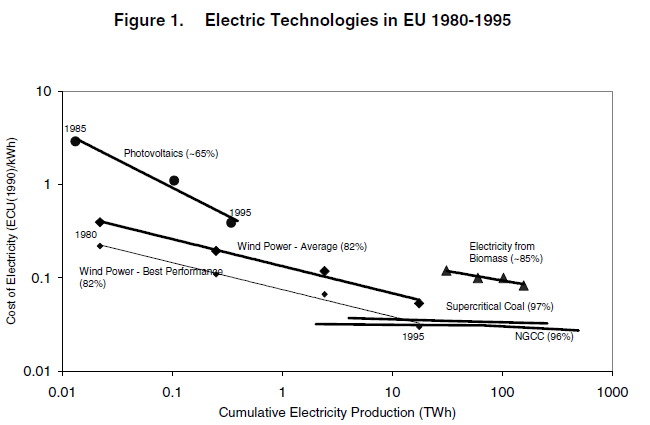
IEA (2000) illustrates that the costs of technologies fall as total unit volume rises. Technologies also learn faster from market experiences when they are new rather than when they are mature . Hence, new technologies become cost-effective over time if they benefit from dissemination. This can be seen in Figure 1 below, which shows the relationship between cost of electricity and cumulative production in electrical technology in the EU between 1980 and 1995.


Source: OECD, 2003

Projections have revealed that a break-even point would be reached by photovoltaics (PV) with fossil fuels by 2025 if historical growth of PV implementation continues at 15% a year. Such a break-even point may be reached even sooner for wind power, given how countries such as Denmark, Germany, Spain and India have been investing in it over the past several years.

The feedback from markets to technological improvements has several consequences. Technologies tend to get “locked-in” or “locked-out”. This happens not because an efficient technology has been adopted, but because it becomes efficient once it is adopted. This follows from the phenomena of increasing returns to scale (the more a technology is applied, the more it improves and widens its market potential). Hence, it is the very selection of technology which determines how competitive it becomes in the marketplace. Thus, Nakicenovic has taken the view that postponing investment decisions will not bring about technological change required to reduce CO2 emissions in a cost-effective manner.

Technological development is a multi-phase process that requires appropriate institutional framework, intellectual property rights protection, market-based licencing of those rights, innovative funding mechanisms and the removal of trade and investment barriers.

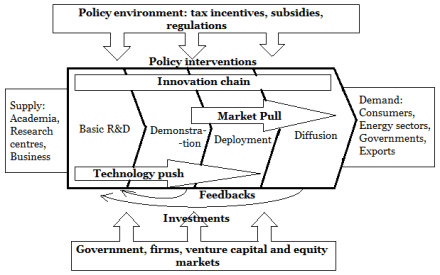
Figure 2 below shows how the phases of R&D, deployment and commercialisation are not linear. To induce private sector investment in innovation in the field of technology, governments will need to create a framework that will value the public benefits accrued.


Figure 2: Adapted from: CEE, 2008

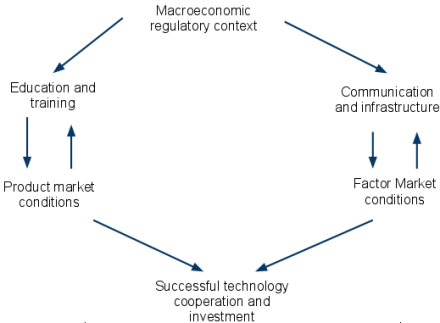
Figure 3 below shows the framework conditions that influence successful technology development and deployment. Apart from the supporting infrastructure discussed above, governments also need to develop human capital and infrastructure in order to facilitate technical change.

Figure 3: Adapted from CEE, 2008

There are two important policy implications on account of this. First, R&D efforts are unlikely to be sufficient to produce sufficient progress. The second implication is that investment decisions in the energy sector over the next 2-3 decades will determine long-term technological options. This will impact how successfully climate change can be impacted.

Tools for Policy

The dynamics of the technological change discussed above give room to governments to facilitate the speed of technical change. There are five specific policy paths that can be taken. Importantly, these policy tools are most effective when used in unison rather than in isolation.

First, R&D can be funded or subsidised. This is the traditional area of government intervention. One of the primary reasons for under-investment in R&D is “spillovers”, i.e. firms aren’t able to appropriate adequate benefits from their investments. However, Clarke and Weyant show that in the case of environmental control technologies, international spillovers might be positive for R&D.

Governments can support research by, 1) cooperating with the private sector to develop and diffuse technology, 2) by facilitating public-private and inter-firm collaboration for cleaner technologies, and 3) by seeking greater international collaboration. Unfortunately, OECD (2003) claims that current levels of energy R&D investments are unlikely to be adequate given the magnitude of climate change. Furthermore, Fischer and Newell (2004) show that R&D subsidies may be inefficient since they postpone the majority of the effort to displace fossil fuel generation until after costs are brought down, thus requiring huge investments to reduce emissions.

Second, governments can put in place technology and performance standards as they prove to be effective tool to disseminate environmentally friendly technologies. A softer kind of standard is making it mandatory to give information to consumers about the efficiency of the product or service, and these have proven to be effective tools. However, imposing standards are often considered more costly than market-based solutions, and hence are scorned by the industry. One way around this issue is the creation of markets through performance-based standards. This can be done by making the performance obligations tradable. However, OECD (2003) states that they are ‘ill-suited’ to stimulate technical innovation on their own.

A third policy path would be subsidising technological dissemination. In the past, several approaches such as earmarked taxes to straightforward government subsidies have been taken up. Some of the instruments used include fixed feed-in tariffs (used by US, Germany, India), bidding process (Ireland, France, UK), and tradable green certificate schemes (Italy, UK). Governments however are increasingly looking at making consumers rather than taxpayers subsidise renewable energy technologies. One issue that crops up regarding the funding of new technologies is the picking of winner. Jacoby states that picking winners has proved to be difficult and daunting.

Fourth, Pigouvian taxes and cap-and-trade systems may be used as policy instruments. Even though they aren’t specifically designed to foster technical change, they do have innovation effects, as both systems modify the price of using the commodity that creates the externality. Fischer and Newell show that emission price is the most efficient at reducing emissions as it simultaneously gives incentives for fossil fuel energy producers to reduce emissions intensity, for consumers to conserve and for renewable energy producers to expand production and invest in R&D.

Finally, voluntary agreements including non-binding agreements on reporting emissions and progress to legally binding self-defined targets to negotiated agreements can be put in place. Although there is limited evidence of their effectiveness, they have effects on the dissemination of information and awareness among the public.

International Governance

This essay has so far described the dynamics of technology and markets, their interrelationship, and the policy tools that can be used to foster them at a national level. This section will assess the role of international collaboration in facilitating this process.

Low or no carbon intensive energy technologies have characteristics that make it a public good. It is for this reason that they are likely to be provided in greater quantities through international collaboration. Moreover, countries are more likely to provide subsidies when there is a global agreement to do so. This is because innovations have a tendency to spillover to competitors and thus there is little incentive for any nation to move first. Additionally, international collaboration avoids the duplication of efforts. Barrett suggests an international agreement on R&D must be put in place which would eventually replace the Kyoto Protocol.

Over the past years, the primary tool for the promotion of technology in developing countries has been financial assistance by the means of preferential loans. The Climate Technology Initiative and the Global Environment Facility (GEF) have played important roles in this regard. GEF has given out $1 billion for climate change projects and has further assisted to an amount of $5 billion in co-financing. The programme funds technologies including photovoltaics for grid-connected bulk power, for advanced biomass power, solar thermal-electric technologies, wind power and fuel cells for mass transportation.

In addition to this, the Clean Development Mechanism (CDM) as proposed in the Kyoto Protocol is intended to facilitate the financing of emission reductions in developing countries and technology transfer from the private sector. However, the jury is still out on how effectively the CDM works, with CEE claiming that it hasn’t lived up to its expectations in bringing investments and technologies to developing countries.

Social and Behavioural Change

CO2 concentrations need to stabilise at or below 450 ppm by 2100 in case climate change is to be limited. This would require global per capita emissions to reduce to around 0.6tC from the current average of around 1.2tC. Rajan states that it is difficult to expect that incremental technological changes aided by policy framework alone would bring about major reductions in emissions relative to today’s levels.

Contrary to the technological-determination view as held by Hoffert and others, Rajan propagates a change in behaviour and consumption patterns to reduce emissions. This entails a social change leading to lifestyle and land-use changes.

It has been argued that gasoline or Pigouvian taxes would encourage people to take public transport and this would help reduce GHG emissions. However, such carbon taxes have been politically unviable, as there is great public resistance against them.

The willingness of people to transform their behaviour towards environment-friendly choices hinges on factors including availability of alternative modes, personal capabilities or skills, and attitudinal ones such as beliefs and values. These are not independent and indeed reinforce one another. In this regard, suggestions involving “push” and “pull” measures that provide behavioural incentives have been proposed, apart from cognitive-motivational ones which attempt to change people’s understanding. The former two involve having economic and legal frameworks to encourage people to cut down on carbon use, and the latter involves information provision and learning.

Conclusion

It can thus be concluded that policy making directed at curbing climate change must incorporate the development of technology markets, creating a framework for international cooperation, and bringing about behavioural change in consumers. In recent years, even Bjorn Lomborg has recognised the need for a low carbon tax to fund innovation in order to fight climate change.

Alternative sources of energy could provide a solution to curtailing CO2 emissions in the longer run. In the short run however, behavioural and structural changes need to be made together. The innovation of new technology alone will not be able to overcome the market inertia that prolongs the use of less effective technology.  As this essay has shown, technological improvements result from a basket of policies which include market transformation. It is thus vital that the dynamics of technological development are well understood among policy makers in order to be successful in containing climate change to manageable levels.

_____________________________________________________________________________

Citations available on request.

By Siddharth Singh, who can be followed on Twitter @siddharth3