
In this post, the author shares notes taken during his attendance to a popular TV show night in Kabul, called ‘Kabul Debate Live’, where participants and audience discussed the issue of ‘Reconciliation with Taliban’.
From the same author:
Photo essay: Stories from Kabul, Part I
Photo essay: Stories from Kabul, Part II
_____________________________________________________________________________________
By Abhishek Srivastava, 26 Jan, 2012
It was just before 11 at night, and I was thinking of calling a cab, when Dr Walid drove up and offered to drop me at my guest house. On any other day, travelling by road would have been an affordable risk to take in Afghanistan: a country fraught with suicide attacks, kidnappings and roadside bombings.
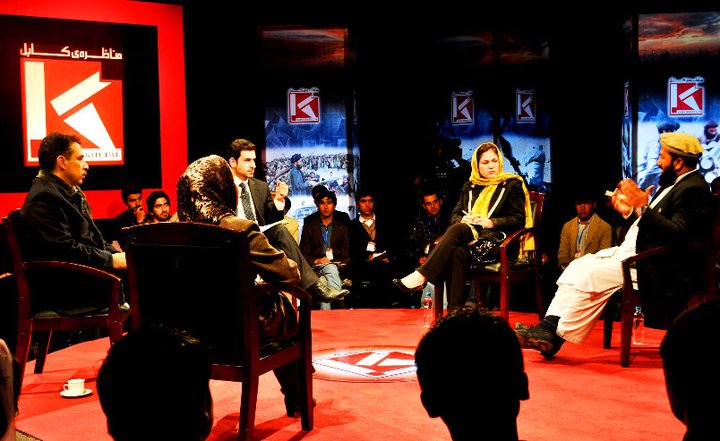
Paul, CEO of 1TV media group, had invited me to be part of a popular television debate called ‘Kabul Debate Live’. A crowd of about two hundred Afghans occupied the swanky studio of 1TV anxiously waiting to talk about the absence of peace, and to voice their opinion on one of the most closely watched debates of the country: ‘Reconciliation with Taliban’.
As the international troops begin to withdraw, especially with America announcing a complete draw down of its decade-long presence by 2014, the Obama administration is now looking at a gradual shift from a military solution to a political one.
“It is interesting and ironic to discuss Taliban reconciliation on a TV debate, when Taliban itself had banned television viewing. Even owning a TV set was a crime. Today, I have travelled a long distance to be a part of this debate. And I hope we get answers”, said Farshad, a second-year Kabul University student.
A study conducted by Altai Consultancy in October 2010 revealed that less than a quarter of Afghanistan’s population has satellite TV equipment. Cable TV is essentially an urban phenomenon, with a penetration of only 5%, while Radio, although a dying medium, has a penetration of 68%.
“TV is mostly used for movies and dramas, while news is accessed through radio sets”, said, Ahmad Rafi Maseer, a Kabul based IT consultant.
Minutes before going live, the host and the brainchild behind this ground-breaking concept, 28 year old Samiullah Mahdi is nervous. “One of the most important speakers of the day declined to participate at the last minute, but we requested a parliamentarian to be a part of the show”, said Samiullah rushing to the studio.
The guest who declined is Taliban’s former ambassador to Saudi Arabia, Habibullah Fawzi.
“It is disappointing not to have a Taliban voice in a discussion that talks about them. It says a lot about their commitment to the peace dialogue”, said Mostafa Mahmoud, News and Current Affairs Director of 1TV.
Samiullah enters the studio, followed by the speakers: Shahla Farid –a law and political science professor in Kabul University; Ahmad Wali Massoud –brother of the founder of Northern Alliance, the late Ahmad Shah Massoud; Professor Aminuddin Muzafary represents the High Peace Council –a loose group of people hand-picked by President Hamid Karzai to broker peace with the Taliban; and Fawzia Kofi –a Member of Parliament from Kabul.
‘What women want, is rarely a concern’
“Reconciliation with Taliban”, says Sami, throwing open the debate.
“We need to include women in any kind of peace dialogue. Women play an important role in nation-building” interjects Shahla Farid.
It is well documented that groups like Taliban and Hiz-i-Islami (Gulbuddin) have been synonymous with violent repression of women in Afghanistan.
Visuals of a burqa-clad woman squatting in the middle of a Kabul stadium, while bullets were sprayed into her skull point-blank with a Kalashnikov by a Talib, shocked the world and brought to light the barbarism of Taliban rule.
“I don’t think peace talks with the Taliban are possible because of our past experience. During the Taliban regime, women couldn’t go out; they couldn’t work or get an education. The Taliban would rather see a woman die in the streets than go to a restaurant to get food if men were around –these are the kind of people we are talking about”, said a female parliamentarian, on condition of anonymity, in an interview to Human Rights Watch (HRW).
Since the fall of the Taliban, women in Afghanistan have gained some rights and freedoms, but there are still insurmountable problems.
“I personally think the opinion of women is not given much importance in Afghanistan. But looking at the current situation, even if there is resistance they will be present because Americans want to include them, and Afghanistan is run by Americans right now”, intervened Mohammad Asif Ziar, while translating the debate for me, which was a mix of Pashto and Dari.
Majority of Afghan men are mired in a culture and belief system that hides ingrained misogynist policies. While they publicly preach a strict moral code and criminalise female prostitution, they procure young boys and sexually abuse them. The warlords who fought for Afghanistan and its ‘Islamic’ cause kept young boys as their sexual partners for long. Bacha Bazi (boy play) is a lucrative business in Afghanistan. “Just 500 Afghans for the boy to make your night”, said an Afghan friend, while making his offer.
Asif’s intervention reminded me of a conversation I had with a senior editor of a leading news agency in Afghanistan. He had sought my suggestion on marrying his junior colleague. The question seemed a bit odd, because he was already married, and the girl he wanted to marry was as old as his daughter. When I expressed my doubts, he said, “Afghanistan is an Islamic country, and I can marry four times, and the girl I want to marry has crossed her ‘marriageable’ age of 27, and she has no option but to marry elderly, married or divorced, or even handicapped men. So I am the best she can get. This is Afghanistan. What women want is rarely a concern”.
A large number of women in the Pol-e-Charkhi jail in Kabul are languishing on charges of ‘moral crimes’ that include premarital sex, running away from home, and adultery.
“If we intend to include Taliban in the peace process, then it is very important for them to recognise and acknowledge Afghanistan’s Constitution. That should be the first condition, if they are to be included in mainstream politics”, said Fawzia Kofi. The audience rose in applause.
It is noteworthy that while Article 22 of the Afghan Constitution guarantees equality of both men and women, Article 3 states that no law can contradict the Shari’a. Therefore, even if the Taliban accept the constitution in exchange for power, their interpretation of the Constitution will only curtail women’s rights.
According to a recent BBC report, on November 10th 2011 the Taliban allegedly stoned and shot dead a woman and her daughter in Afghanistan’s Ghazni province. The Taliban had accused the women of ‘moral deviation’ and ‘adultery’. The attack happened just few meters away from the governor’s office in Ghazni city, a place which is yet to be transferred to the Afghan security forces from hands of International forces.
Despite the presence of international forces, there are areas that are still in Taliban control. Women face death threats and even acid attacks regularly. There are those whose lives are in danger for working for the Americans or for not following the Taliban way of Islam. But there are groups that run the risk of opposing the Taliban. Like the Revolutionary Association of the Women of Afghanistan, or RAWA –an underground group that fights for secular democracy and women’s rights.
The debate moves on. A charged audience is anxious to speak after hearing the guests. Samiullah tries his best to steer the 60-minute debate.
‘Taliban, after all, are sons of Afghanistan’
“What has your organisation done for the peace process? Did you make any headway in your talks with the Taliban?”, asks Samiullah.
“People think that talking to the Taliban and bringing them back into mainstream politics will take us back ten years. I want to say that as an organisation promoting peace, we will work only towards that end, and we will care for the rights and prosperity of the Afghans”, says Professor Aminuddin Muzafary, a representative of the High Peace Council.
Afghan President Hamid Karzai formed a High Peace Council in September 2010 to further peace talks with the Taliban and other insurgent groups as part of a reconciliation process. The composition of this 70 member group raises serious concerns over the success of peace negotiations.
Head of this council was former Afghan President, and a jihadist –Professor Burhanuddin Rabbani, who later helped the invading US army topple the Taliban regime in 2001. Others include former warlords Abdul Rab Rasoul Sayaf and Haji Mohammad Mohaqiq who are bitter rivals. Both have fought the Taliban. Sayaf is even accused of massacring Hazaras –a minority community in 1993. These men are an unlikely choice for peace-making with the Taliban.
A big blow to the peace dialogue came on the night of September 20th 2011, when two men pretending to be peace emissaries gained entry to Professor Burhanuddin Rabbani’s house, in a highly secured zone of Kabul, and brutally assassinated him by detonating a bomb, hidden inside the turban.
Assassinations in Afghanistan are an everyday phenomenon. In fact, a surge in the number of high-profile assassinations in recent months –including commander of the northern police zone, General Daoud Daoud; Kunduz Police Chief, Abdul Rahman Sayedkheli; and now Professor Rabbani– is being seen as a swift elimination of people standing in the way of peace favouring the insurgents, especially the Taliban, that is reminiscent of the civil war.
The Taliban has however, repeatedly denied peace talks. They have asserted that they will not enter into dialogue with the government until there is complete withdrawal of all international troops from Afghanistan.
The audience gets impatient. Sami finally takes opinions from the audience.
“All the council members are puppets of the U.S. government. They have been bought and are here only to serve their own interests. We don’t accept them. So there’s no point in them talking peace on our behalf, says Muzhary Fazal Rahman, a young journalist from Kabul.
“Taliban after all are children of Afghanistan. They are sons of our soil. Why alienate them? They are committing acts of violence because we are under American influence”, said an emotional old frail voice among the audience. This was followed by a mild applause, showing not many in the audience seem to agree.
“The High Peace Council is not in favour of omitting the Taliban from Afghanistan’s political ground, we want them to re-think their strategies”, said Professor Aminuddin Muzafary.
“The moment we acknowledge the Taliban and involve them in the ‘peace-process’, we give them the status of a legitimate organisation. So it’s better we avoid that”, said Ahmad Wali Massoud.
The intense debate that lasted 90 minutes ends with an audience poll. More than half (54.4%) say the Taliban should be defeated militarily. The rest want peace talks along with a withdrawal of foreign troops.
The debate did not bring out concrete solutions, but it symbolised hope and change, for about seven years ago such a TV programme with two women speakers would not have been possible.
Assassination
It was ten past eleven. I had finished dinner with 1TV crew and the guest speakers when we heard the news of the assassination of the police chief in Kunduz, Northern Province.
Realising that the situation had turned tense, Dr Walid Roshan, the executive manager of 1TV, walked up to me and offered a ride to my guest house.
The dark night had an eerie silence. Kabul’s streets were cordoned off and a large number of police vehicles with blaring sirens were zipping. Dr Walid had just hit the road when a police personal in an SUV across the road trained the barrel of his gun at us. I could not stop but shout, “Dr Walid, gun”! He immediately stopped and so did the trigger. After a brief chat with the police he continued driving. “Sorry, I did not realise they were coming. They saw a potential threat in us and they don’t hesitate in shooting”, said Walid.
As we made our way through the many checkpoints to reach the guest house, the entire day flashed in front of my eyes; that microcosm made me understand Afghanistan’s impending challenges. Especially the definition of ‘peace’ in a highly volatile and trigger-happy time of Afghanistan.
While Afghanistan assimilates the fragmented peace that prevails in the country, the Taliban and other insurgents groups continue to pull-off a series of spectacular attacks. In a big blow to the US earlier this month, Taliban shot down a US helicopter, Chinook, during a combat mission, killing 31 US special operation troops. According to a latest UN report, more civilians have died in the first six months of 2011 than any other time during this decade long conflict.
All these signs, coupled with the much talked about U.S. troop-withdrawal just as Karzai’s term ends, send out the message that Afghanistan might just slip into an abyss deeper than it was in 2001.

 InPEC Magazine