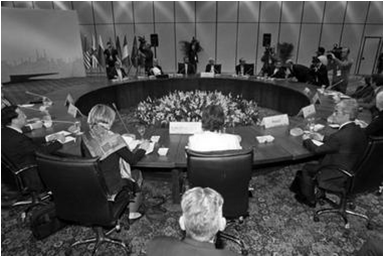
Palestine, the UN and Statehood – The relevance of the UNESCO vote

In this article, the author looks into the legal relevance and implications of the recent UNESCO vote which recognised Palestine as a full member of the United Nations agency.


By Abdulaziz Khalefa, 2 Nov, 2011

Of the 193 member states of the United Nations, 127 have recognised a Palestinian state. When the UN cultural body (UNESCO) voted on admitting Palestine as a full member, what came as a surprise was that of the 66 states not recognising Palestine, seven (Myanmar, France, Spain, Finland, Greece, Ireland and Austria) voted yes. One Israeli academic expressed a pervasive view among those states which stand against the Palestinian bid for full UN membership.

Continue reading

Khawaja Complex and the International Political Order

By: A. Almuslem
March 1st 2024

The Khawaja complex might be understood by some as mere favoritism towards European ethnic groups with neutrality towards other groups. Such an assumption, however, is difficult to sustain when it becomes apparent the European favoritism can also be coupled with in-group derogation where the middle easterner would be inclined to associating members of his own group, along with others from the postcolonial world, with negative traits at first glance all the while maintaining a less cooperative attitude with them. Continue reading

“Good fences make good neighbors”?

Writing about her visits to the West Bank, the author shares with us her impressions of the separation wall.


By Margaret McKenzie, 5th July, 2014.

It will have been a decade on July 9 since the International Court of Justice (ICJ) passed its advisory opinion saying Israel must cease construction of the Wall and dismantle sections, compensate for damage caused; and, return Palestinian property or provide compensation if restitution is not possible. The Wall has always been contentious with radically polarizing opinions, exemplified by the many different terms for the Wall depending on who you speak to – “Separation Fence”or “gader hafradeh” in Hebrew, “Apartheid Wall” or “al jidar al azil” in Arabic, are just a few terms used to describe the Wall separating the West Bank from Israel. The Wall depicted in the photos below around the West Bank is illegal under international law.

Continue reading

Iran Should Not Allow the Talks to Be a “Success” If …

In this post, Shirin Shafaie offers a policy recommendation paper for Iran ahead of the Moscow talks between the P5+1 and Iran.


By Shirin Shafaie

Iran should not allow the Moscow talks (18 June, 2012) to be announced, declared or referred to as “successful”, “positive”, “constructive” or even “promising” by the other party or the Western media in the absence of absolutely concrete and tangible concessions from the West in terms of sanctions relief and normalisation of Iran’s nuclear file in the IAEA. I explain why.

Continue reading

Addressing the Asymmetry in Negotiations between Iran and P5+1: a critical review of Oxford Research Group’s briefing

In this article, the author presents a critical review of the briefing, “Iran´s Nuclear Impasse: Breaking the Deadlock”, published by the Oxford Research Group on 1 May 2012. As negotiations over Iran´s nuclear programme stall, the author criticises the lack of neutrality of the briefing by the Oxford-based think tank, and calls for a review of the same in order to avoid some of the mistakes of the past, when pro-war think tanks played a key role in manufacturing consent for the 2003 invasion of Iraq.


By Mehrnaz Shahabi, 10 July 2012

The Oxford Research Group’s briefing, Iran’s Nuclear Impasse: Breaking the Deadlock (1 May 2012) [1], published before the second round of negotiations between Iran and P5+1 (permanent Security Council and Germany) in Baghdad on 23 May, whilst proposing some positive principles for a successful outcome of the negotiations – such as Iran’s right to enrichment, “reciprocity”, “defining endgame”, and “taking regime change off the table” – suffers serious drawbacks, which have become even more glaringly clear with the result of the recent Moscow negotiations.

Continue reading

Time to reframe the debate on the Iranian nuclear programme

In this article, Paul Ingram* argues it is time to reframe debates on the Iranian nuclear programme. If we want to solve the current impasse, we need to move from a pervasive rhetoric based on security threats and mutual accusations to a cooperative framework more apt for negotiations. 


By Paul Ingram, 25th April, 2012

All too often the story around the Iranian nuclear issue is framed as our effort to contain the wild ambitions of a delinquent revolutionary state that with nuclear weapons given half a chance will threaten the stability of the world. This frame sticks for two key reasons: firstly because it plays into some of our greatest fears, and second, because there is enough of a hint of truth to it that people forget the qualifications, the underlying causes and the contrary evidence. In short, we fail in the face of complexity to understand the challenge, and the role of both sides in creating it. And in fact, many of the accusations made against Iran are mirrored in Tehran in things said about the West.

Western intelligence agencies continue to confirm that there is no strong evidence to back up the claim that Iran is engaged in a technical sprint to fulfil an ‘ambition to attain nukes’. Postulating reasons why Iran might want such capabilities is all very well, but such approaches are fraught with analytical and cultural traps. There are equally persuasive explanations for Iran’s programme that it would be equally dangerous to depend upon, such as the idea that Iran is caught up in an effort to demonstrate its modernity through the development of cutting-edge technologies, or that it is pursuing an energy-mix that both brings in foreign exchange and provides for an ever-increasing energy-hungry economy. The truth probably includes a balance of many explanations, including the fact that its technology development gives the administration a future option for nuclear deployment that may be seen as valuable in itself.

The talks in Istanbul last weekend between the E3+3 and Iran were best summed up by Guardian journalist Julian Borger as a play for a score draw, at least for now. Emerging without recriminations was in itself an achievement. But of course the challenge is how we get beyond this to reaching more substantive agreement in Baghdad on 23 May, when there have been so many factors in the way. Over the coming months, Iran faces some pretty severe additional sanctions, on top of crippling ones recently imposed. When previously people may have accused them of playing for time this is no longer be the case. In fact if anything it was Catherine Ashton, lacking a mandate, who last Saturday was playing for time when Jalili was looking for a deal that would soften impending sanctions. The best way of securing stocks of material in Iran is by negotiating access, not by threats, which only provide Iran an incentive to continue. Israeli protests over Iran’s increasing ‘immunity’ to attack ignores the fact that Iran has every right to protect themselves against illegal military threats. As Peter Jenkins, former UK Ambassador to the IAEA puts it, Iran bought itself immunity from attack by being a member of the United Nations and a signed up member of the NPT. Israeli military threats only make it more difficult for Iranian politicians and diplomats to sell any deal to their constituents.

There are plenty of frameworks out there to negotiate on that take the parties step-by-step in the direction of a technical agreements whilst the underlying trust essential to lasting improvement can be built up. Indeed, this is the only approach that holds any promise of working in negotiations. It will require parties to drop preconditions and talk with a view to understanding the other side’s perspective. Each step will need to involve net gains for both sides, as well as a clear sense of where the process is going. There will need to be maximum exploitation of common interests in other security areas – such as counter-terrorism and counter-narcotics activities. Positive signals such as those given recently by both President Obama and Ayatollah Khameini will need reflection, and negative, hostile rhetoric scaled back.

But we will also, in parallel have to tackle some of the deep-seated fears and attitudes that prevent progress. One such on the western side is a deep-seated exceptionalism around sovereignty that pervades the majority view. How much do we all share the attitude that we have a right to demand unlimited access and control over others’ nuclear programmes whenever we have our own suspicions? We have every reason to develop international systems based upon agreement and universal application, but we cannot force others into agreements, and certainly not those we are not willing to submit ourselves to. As a nuclear weapon state Britain is unwilling to seriously consider abandoning the highly expensive practice of keeping a nuclear submarine at sea at all times, or to share such a practice with France, for example, because we have such a powerful attachment to the concept of British sovereignty based upon the ability to threaten massive retaliation against any other state on the planet. This is bound to drive proliferation, sooner or later. Regionally, the inconsistent focus on Iran without any clear plan to address Israeli possession of a nuclear arsenal cannot be justified by a legalistic appeal to Israel’s non-membership of the NPT. As non-signatories the Israelis may not be directly breaking the law, but if we are to claim that the health of the international community depends upon a strong ethic of non-proliferation, then Israel cannot remain an out-law.

We cannot continue to have partial approaches to dangerous technologies. Did you know that India’s successful missile test this week broke a UN Security Council resolution, just as North Korea’s failed one last week did? Few have reported it.

On the Iranian side, it’s time they evolved the rather male pig-headed pride so ably illustrated in last year’s prize-winning film ‘the Separation’, an approach that too often characterises (though not uniquely) Iranian diplomacy and politics. Standing on one’s rights or maintaining an inflexible position can harm one’s own interests in fundamental ways, and destroy one’s position within the community, international or otherwise. International communities require trust, empathy and reassurance. They also depend upon a level of transparency and responsibility. Iranians have to recognise that for a variety of reasons they have a long way to go to build the trust of their neighbours, the sort of trust that will enable them to overcome the isolation they have suffered, isolation that threatens to deepen as the Syrian government goes down and their allies in Lebanon and the Occupied Territories start to look elsewhere for sponsorship in the context of the Arab Spring.

But the deeper choices lie in the international community’s relationship to nuclear deterrence, and how power has in the past been mediated by possession of nuclear arsenals. If we cannot break free from Cold War theologies that place such magical powers in the possession of nuclear weapons, we will only have ourselves to blame when the weapons spread, and those we fear most acquire the magic we have sought to invoke in defence of our privileged positions.

The views expressed in this article solely reflect Paul Ingram’s personal perspective.

____________________________________________________________________________________

*About the author: Paul Ingram is Executive Director of the British American Security Information Council (BASIC) where he develops BASIC’s long-term strategy to help reduce global nuclear dangers through disarmament and collaborative non-proliferation, coordinating operations in London and Washington. He is also a weekly talk-show host on Iranian TV. This article was first published in Open Democracy on 23 April 2012 (the original article can be accessed here).
Life After Gaddafi – The Future of Foreign Intervention

In this article, the author assesses the precedent of Libya in foreign intervention after the death of Muammar Gaddafi. In a world in which there are now increased calls for intervention and isolationism the case of Libya is being presented as both an example of a successful intrusion and a reason to reform the UN Security Council. Military capabilities and the tensions within NATO may act as a check to the boisterous rhetoric in the wake of Gaddafi’s death but the key lesson may be the message it has sent to those who are still clinging to power.


By Jack Hamilton, 23 Oct, 2011

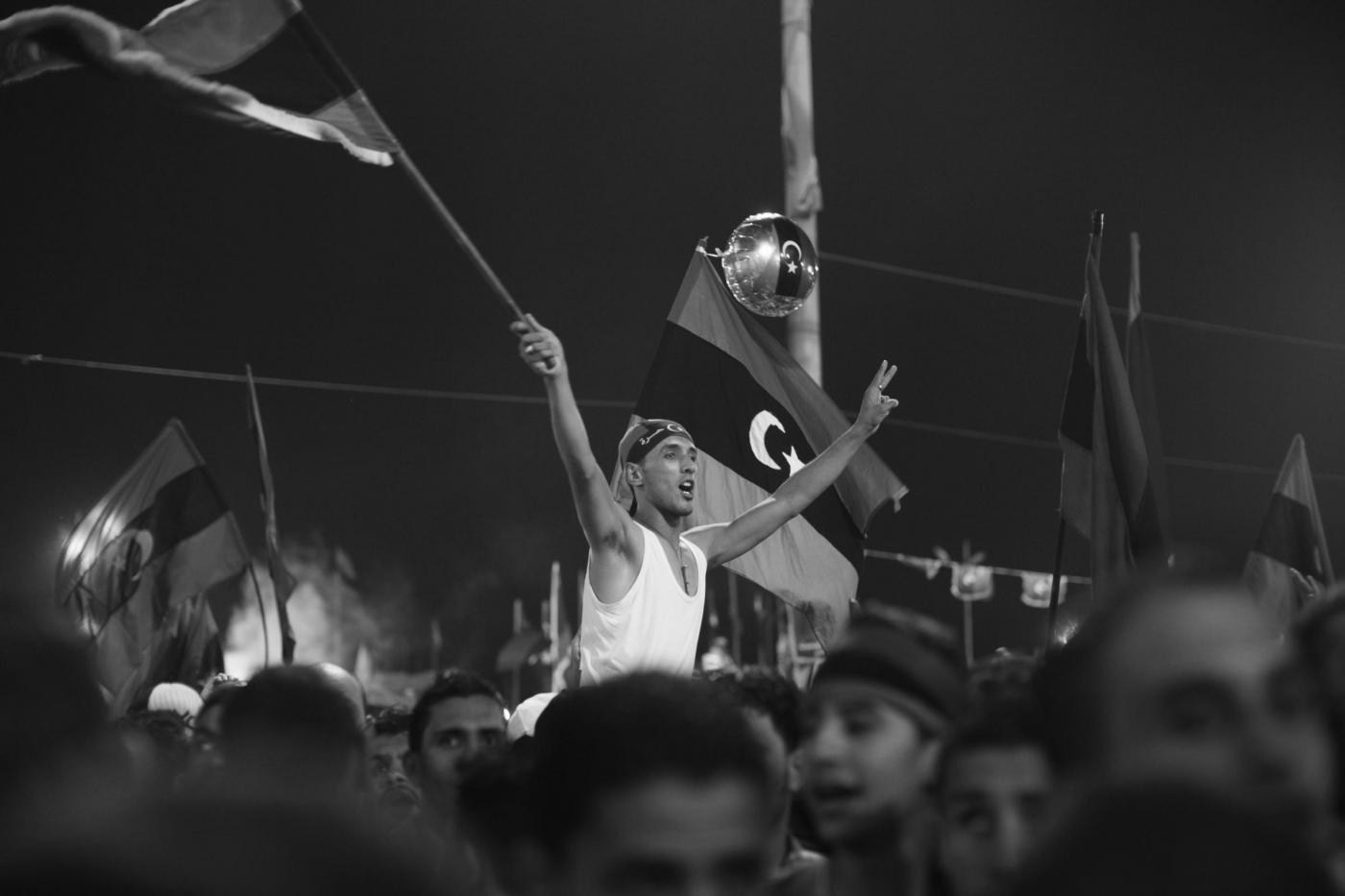
Today the Libyan transnational government has declared national liberation before a triumphant crowd in Benghazi, the city where the fight against Gaddafi began.

There are scenes of jubilation in Libya and NATO offices around the world.  Muammar Gaddafi is dead and attentions are now turning to the future of the Maghreb state and the implications of NATO’s intervention in the broader Arab Spring.  In such a celebratory atmosphere what will be the future response to rebellious populations rising up against murderous rulers?

Libya and the Future of Intervention

Nicolas Sarkozy has already made a direct comparison between the conflict in Libya and the plight of the people of Syria in facing down the armies of Bashar al-Assad.  He mused that “The best thing I can do is dedicate our visit to Tripoli to those who hope that Syria can one day also be a free country”.  The Obama Administration has toed a similar line in their policy of ‘Leading from Behind’ by touting the example of Libya as a framework for future interventions.

Deputy National Security Advisor for Communications Ben Rhodes stated that the Libya experience would provide the basis for future interventions with emphasis placed on the need for regime change to be based upon “indigenous political movements” rather than the ambitions of the United States and the importance of “burden sharing” amongst other nations.  The problem is that this does not fit into the model for preventing atrocities which the United States advocated so heavily in the 1990s.  In London and Paris there is talk of prevention and the need to take the lead while the US, perhaps due to domestic constraints, is taking up a more isolationist tone.  The question must therefore be asked if the example of Libya may hinder rather than assist future responses.

Military Capability

The first issue that must be addressed is military capability.  Don’t be distracted by the rhetoric of ‘no boots on the ground’, Libya was a huge military intervention.  The British and the French with help from the Norwegians and Danes, carried out the bulk of the airstrikes and provided the machinery to carry out the naval blockade.  This does not mean that the US should be discounted.  It was American air and sea forces that opened the intervention with decisive attacks on Libyan air bases allowing the European forces to act with greater freedom.  Specific American military capabilities in intelligence, surveillance and reconnaissance were key to the success to say nothing of the supplies of munitions that were supplied to the European forces.  The lasting images of the war will be of the final rebel push on Tripoli but it is the heavy NATO influence which will resonate in international relations.

A Frayed Alliance

The second impact is the increased tensions between the NATO powers.  Germany’s foreign minister hinted at an early stage that the country would refuse to take sides and eventually abstained from the vote on Security Council Resolution 1973.  The French have long advocated a reform of NATO and the obvious north/south European divide in capabilities has intensified this call.  Whether the military alliance is now in a position to oversee another campaign is debatable.

‘You Break It, You Own It’

NATO leaders have frequently referenced the ‘lessons of Iraq’ when discussing Libya.  The opposition of the National Transitional Council to any foreign troops in a post-war Libya has been welcomed by Western powers hesitant to adopt an increased military role in a time of economic uncertainty.  In this sense there has been a strong adherence to Colin Powell’s Pottery Barn mantra: ‘You Break It, You Own It’.

The Future of Intervention

So what will the lasting impact of the Libyan intervention be?  Crucially, both Britain and France seem to perceive the situation to have been an anomaly.  A nation with a small population and a weak military on the doorstep of Europe with regional actors who were unlikely to support the dictator.  It was seen as an easy case.  Additionally, the Western powers insisted on gaining the support of both the Arab League and the Security Council before intervening.  It is difficult to see such a situation emerging elsewhere in the Arab Spring and Russia has already blocked tentative discussions regarding Syria.

The question of Syria has been largely ignored in Washington.  Syrian opposition is increasingly turning to armed response with army defections burgeoning and calls for international intervention increasing.  People are being gunned down in the streets as the ‘liberators’ of Libya struggle to find the words to escape the precedent they have set.  It is unimaginable that international forces would enter Syria for a variety of reasons.  For that reason Libya must be viewed as an anomaly, not a precedent.

Reforming the Security Council?

Another impact of the intervention has been the rallying of non-interventionist states.  China, Brazil, South Africa and India have not been slow to point out the hypocrisy of the Security Council in elevating its own role while using the mandate of protecting civilians.  Perhaps the lasting message of Libya in international relations will be the claim these nations have demanded for many years: a reform of the Security Council.

Bloody Sheet, Noose, Cage or Condo?

The final message of the conflict in Libya is to those clinging to power in other nations.  It is a message to the Assads and Salehs of the world.  Like Gaddafi or Hussein they can go out on a bloody sheet or at the end of a rope.  Mubarak and Milosevic wound up in cages.  Ben Ali stepped aside amid violent persuasion and now resides comfortably in a condo in Saudi Arabia.  The bloody sheet, the rope, the cage or the condo?