From Fiesta to Siesta: Spain, Merkozy, and Neo-Eurosclerosis

In this article, the author analyses the Euro crisis by taking a look at Spain and fiercely criticises European conservatives’ obsessive focus on austerity, a trend that is inevitably leading the old continent towards a state of Neo-Eurosclerosis.

_______________________________________________________________________________________

4 Jan, 2012

European politics is a tough game: on the one hand, there is the political struggle in which parties seek to win a domestic electorate with old-fashion programs covering issues such as the level of state intervention, economic growth, and social integration and protection. Here the talk is usually centred on taxes, employment, state regulation, and welfare programs. On the other hand, European integration and monetary union are forcing member states to strengthen their positions in an attempt to resist challenges to state sovereignty. Here the talk is usually centred on fighting back transnational forces and financial markets, enhancing national identity, and resisting the transference of sovereignty. Hence, political parties find themselves in the odd situation of having to win two battles: one with a domestic electorate, and one with the effects of European integration. Three battles if we include the struggle against financial markets that do not seem to respect boundaries of any sort. The 2008 economic crisis and subsequent sovereign debt crisis and crisis of the euro have only exacerbated these trends. The case of Spain comes in handy here.

When Mariano Rajoy of the conservative People’s Party was elected Spain’s President in November he stated that Spain “will stop being part of the problem and start becoming part of the solution”. Later, in his first address to Parliament he confirmed that he would not raise taxes as a measure to reduce public budget deficit (one of his electoral promises). Yet this week the government that Mr Rajoy presides announced the most severe measures since Spain turned into a democracy in 1978, including very large cuts in public expenditure and a significant rise in income tax rates. This, it was argued, is what Spain needs to do in order to meet the European budget deficit target of 4.4% by the end of 2012.

The current exact figure of Spain’s public deficit is a matter of serious debate. According to the outgoing socialist government, Spain’s deficit is of the range of 6% whilst the incoming conservatives estimate the figure is closer to 8% thus justifying extraordinary measures. But Spain is a semi-federal state in which a large proportion of the current aggregated national public deficit is dependent on the deficit incurred by each of the different autonomous communities. This means that the debate over the exact figure of public deficit is in turn cascaded down to the politics of each of the autonomous regions (the majority of which are now in control of the conservative government). In other words, numbers and figures are political. Those seeing things through red lenses believe the figures provided by the incoming government have been inflated; those seeing things through blue lenses claim that the outgoing government was too optimistic about the level of public deficit.[1]

Regarding the measures announced by Mr Rajoy, two points come immediately to mind. First, Mr Rajoy’s measures will tax employees and therefore hit the middles classes, and not big companies or the richest strands of society (despite the argument that he has chosen to raise taxes on income over taxes on consumption on the basis of the former’s equity and progressivity –however, there are already rumours that VAT, a tax on consumption, will be increased in or after March. That may explain, inter alia, what Mr Rajoy’s number two Soraya de Santamaría meant when she claimed that the measures announced this week are only ‘the beginning of the beginning’). Second, the conservative government has justified these measures on the grounds that resolving the debt crisis must be Spain’s top priority. Cutting public expenditure (in other words, social welfare) is not enough and so an additional increase in taxes is what Spain needs to do to achieve the paradisiacal budget deficit of 4.4%. This, according to the conservatives, will not worsen the economy and, if it does, their position is that reducing public deficit is more important than reactivating a stagnant economy. Yet reactivating the economy and creating jobs was the promise and the campaign slogan of the conservative party presided by Mr Rajoy (official data says Spain has 4.42 million unemployed).

So what has happened here? Have Mr Rajoy and his cabinet changed their minds or did they know the policies they would adopt and implement once they found themselves in power? I think any doubts in this regard may offend the reader. Spain is no movie like others, but the script is the same elsewhere in Europe these days: see Greece, (in that case though the government of Mr Papandreu lied about public accounts), Ireland, Portugal, and Berlusconi’s Italy where the new government has not even been democratically elected. Then came Spain, with Mr Rajoy making pacts with Merkel. In this regard, not only is the Franco-German axis abusing intergovernmental cooperation to worrying levels, bypassing regional integration and European institutions such as the Commission, but they are also increasingly perceived as dictating what other countries must do.

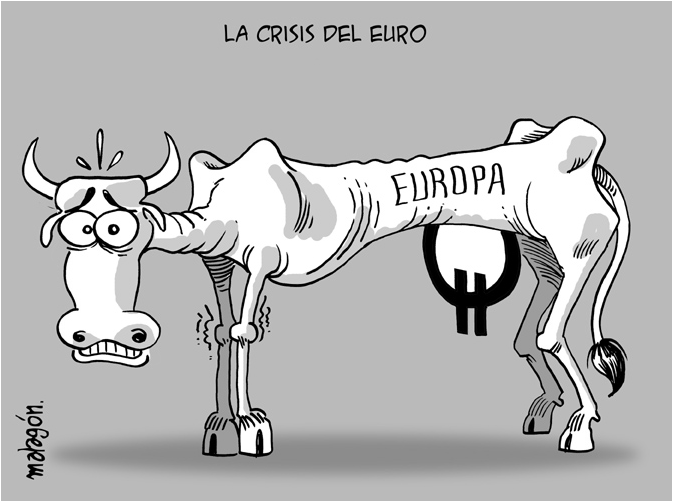
In an essay published in November by the Centre for European Reform the authors provide an excellent analysis of what exactly is going on in Europe. According to the authors, the principal problem is that the monetary union was never coupled with a fiscal union. The introduction of the euro therefore triggered a flow of debt from core, creditor countries in the North, to periphery, debtor countries in the South, ‘spurring the emergence of enormous macroeconomic imbalances that were unsustainable, and that the eurozone has proved institutionally illequipped to tackle’. But the Franco-German axis and North-European policy-makers, with the backing of conservatives elsewhere, do not agree with this interpretation and instead of acknowledging the institutional pitfalls of the eurozone, they blame the crisis on the behaviour of certain member states (the so called PIGS that Paul Krugman rightly prefers calling GIPS), namely on government profligacy and loss of competitiveness.

Hence, Spain is forced to apply stricter rules to emulate the virtuosity of creditor countries like Germany as if Germany itself had played no role in the run-up to the crisis (by lending money irresponsibly and far from innocently). Yet experts like Krugman are very clear about the impact that an obsession with austerity and low inflation is having on European economies: austerity in times of crisis inevitably leads to more recession and not necessarily to a decrease in bond yields. IMF’s Chief Economist Olivier Blanchard has backed this view by declaring that ‘some preliminary estimates that the IMF is working on suggest that it does not take large multipliers for the joint effects of fiscal consolidation and the implied lower growth to lead in the end to an increase, not a decrease, in risk spreads on government bonds’.

Krugman claims that nobody understands debt and he cites a quote by John Maynard Keynes that all governments, blue or red, should learn by heart: “The boom, not the slump, is the right time for austerity at the Treasury”. I think though that Krugman is making a very benevolent interpretation of the current state of play. Surely Mr Rajoy (and Sarkozy and Merkel) understand debt, but their lenses are blue. It was Roosevelt and not Hoover that led the US and the world to recovery during the last Great Depression, and he did so by injecting money in the economy, not by enforcing austerity. The eurozone suffers from institutional flaws that need to be sorted (such as the lack of ‘real’ fiscal union). Some experts believe the latest agreement reached by the 17 members of the eurozone on 9 December 2011 is a ‘fiscal union’ only in paper (this may explain the reaction of the financial markets which, after taking a brief break, are back on their feet ready to take on another victim).

The question therefore is whether there is anything that will satisfy the financial markets. In this regard the answer seems to lie in Blanchard’s statement according to which financial investors are schizophrenic because they first react positively to austerity and then negatively when they realise that austerity does not lead to growth. Which means that the key to this puzzle is as simple as it is old: financial markets want to recover their investments, and the way to guarantee such outcome is by generating growth, not by enforcing austerity. Mr Rajoy in the meantime, guided by European conservatives’ obsession with austerity, continues to hit the wrong button; let’s hope it will not be too late before European leaders realise that their lenses are leading Europe towards a state of Neo-Eurosclerosis.


[1] Blue is the colour of Spain’s conservative People’s Party but blue is later used throughout the rest of the article to refer more generally to conservatives across Europe

The Apocalypse in Twenty First Century International Politics

In this article, the author provides a brief overview of the presence of the apocalyptic in twenty first century International Politics by looking at the particular case of the (ab)use of apocalyptic frames in US-originated discourses on nuclear weapons.*

___________________________________________________________________________________

By David J. Franco, 19th December, 2011

The Apocalypse in Twenty First Century International Politics

As often noted the apocalyptic has served as a source of inspiration in literature, philosophy, and culture. Why, then, would international politics be immune from this phenomenon? That apocalyptic thinking was much present during the Cold War has been widely acknowledged. However, apocalyptic rhetoric continued and in some senses increased in the post-Cold War era. As we approach 2012 (a year marked as apocalyptic by some Millennia movements) the apocalyptic continues to be present in international politics as numerous discourses are framed, with varying fortunes, in apocalyptic terms or tone. Thus, examples of apocalyptic rhetoric in twenty first century international politics include: global warming discourses, environmentalism, overpopulation warnings, global war on terror rhetoric, media coverage of the global economic crisis, nuclear weapons discourses, accounts of AIDS, feminism, and many others.

This raises important questions. Amongst these, two are worth exploring separately: Why do actors seek to frame their discourses apocalyptically? What are the effects or implications of using this type of frame and does a secular apocalyptic rhetoric have less negative implications than a religious one? At this stage it is worth noting that just as discourses are intersubjective and contingent to historical context, so too the apocalyptic, as a particular type of frame, is subject to changes in the historical context in which it operates. Hence, apocalyptic meaning and thinking has evolved significantly due to the impact on religion of enlightenment philosophy and the broader, gradual process of secularization. Any study on the apocalypse must therefore seek to reflect upon this historical evolution.

Case Study: The Apocalyptic in Nuclear Weapons Discourses

One particular area where apocalyptic frames are usually employed is in nuclear weapons discourses. Through the study of four different but interrelated discourses originated in the US** I identify three reasons why actors seek to (ab)use this type of frame: first, the choice for apocalyptic frames responds to a strategic move according to which actors seek to arouse and mobilize public support in a manner that would be less obvious with the use of less passionate and universalising frames. Second, apocalyptic rhetoric, especially in its secular or enlightened version, has the capacity to increase the perceived urgency of the threat. And third, apocalyptic frames, also in their secular version, are thought to have the capacity to mobilise men and women to change the course of history (mobilise in its active and passive meanings; that is, by doing something –i.e. taking action- or by not doing anything –i.e. not opposing action).

But apocalyptic frames risk having serious negative implications. Amongst these, I distinguish at least four: first, the risk of apocalyptic rhetoric turning into self-fulfilling prophecies; second, the possibility that an abuse of the rhetoric may lead to a decrease in the credibility of framers; third, the danger of fundamentalists seeking to push harder to see their prophecies fulfilled; and fourth, the risk that the rhetoric may help obscure political agendas. An additional negative implication is where apocalyptic rhetoric has the unintended effect of paralysing the audience (assuming this is not an intended purpose). Accordingly, although a turn to more secularised and less aggressive apocalyptic frames is something to be applauded and encouraged, such a turn does not completely solve or reduce the negative externalities of apocalyptic rhetoric. And this, I suggest, is as valid for nuclear weapons discourses as it is for other discourses found in twenty first century international politics.

The apocalyptic in IR: the need for more research on the functional and the symbolic

Arriving at this point we must ask why apocalyptic frames are still so popular despite their negative implications and their failure to help connect actors and audiences effectively (if they achieved their objectives nuclear weapons would have long been reduced to zero). Is it because there are no alternative frames available? Are there any other reasons besides those based on mere strategic rationale? Asides from a possible functional explanation, my view is that there may also be a symbolic or psychological explanation beneath the surface. It may be that apocalyptic rhetoric is driven by forces other than simply rational and strategic purposes. Accordingly, in examining the apocalyptic one should also seek to address the following questions: what role or roles, asides from a purely functional standpoint, does the apocalyptic play in human life? Does the apocalyptic respond to a mere rational choice or does it also play a symbolic or psychological role for either the messenger or the audience at which the rhetoric is directed (or both)? Is apocalyptic rhetoric expression, or satisfaction, or both, of a buried anxiety originated in past personal or collective traumas? Is it expression of an exacerbated destructive instinct found in human beings?

A comprehensive study on the presence of the apocalyptic in twenty first century international politics simultaneously addressing the functional and the symbolic is therefore necessary. In this regard, existing studies are out of date and only partially relevant. It is also my view that such a study should avoid being confined to the apocalyptic as expressed or projected only in, and by, Western circles or culture. Albert Einstein and Sigmund Freud’s short (and failed?) attempt to address the question of “Why War?” in the 1930s should encourage scholars to carry out a similar task perhaps under the heading “Why the Apocalyptic in Twenty First Century IR?”. Ours in an age in which boundaries between disciplines help only maintain the status quo while curtailing the chances of better understanding the world we live in. This is often ignored by mainstream IR theorists who narrowly focus on the rational leaving aside the too often wrongly labelled irrational. My view therefore is that the myopic legacy of mainstream IR paradigms must be sidestepped when analysing the apocalyptic. It is our duty to tear down existing barriers and join disciplines. We can only benefit from such a task.

Conclusion

Western apocalyptic thinking and sensibility permeates numerous twenty first century international politics discourses. In particular, apocalyptic frames are recurrently used in US-originated discourses on nuclear weapons. This is due to the functional or strategic advantages that these type of frames are thought to generate. However, apocalyptic rhetoric, whether religious or secular, risks having serious negative implications for international peace and security.

Further, any study on the apocalypse that addresses the functional and fails to address the symbolic or psychological is incomplete. Accordingly, since existing studies fail to address both elements simultaneously I believe a full comprehensive study on this subject is necessary. Until that happens, I am afraid that any attempt to propose either a re-articulation of the current rhetoric or the use of alternative frames may be premature.

*This article is a summary of a 10,000 words dissertation. Please contact the author for further details or a full list of bibliographical references.

**These include the following four US-originated nuclear weapons macrosecuritisation processes: the Doomsday Clock of the Bulletin of the Atomic Scientists, first appeared in 1947; the Nuclear Threat Initiative launched in 2007 by former US service men; the anti-nuclear weapons campaign launched in 2008 by US social movement Global Zero; and President Obama’s 2009 public speech in Prague.

The Revolution is Being Televised

In this article, the author explores the role of the media in reporting the protests seen around the world in the past few months.


By Mikael Santelli-Bensouda, 31 Oct, 2011

We live in exceptional times. The seemingly endless reach of the media brings popular movements and struggles of all persuasions into the public domain. From protests against educations cuts and austerity measures to pro-democracy revolutions, in one way or another, they are all accessible. But in what capacity are they being presented to us? There are huge inconsistencies in the manner in which societies’ information distribution mechanisms reflect upon the mobilisation of the masses.

As Derrida sensibly wrote, “nothing exits outside a context”. As such, any specific event is ascribed meaning through its contextualisation. Much like blinkers, context frames a given reality within a discourse that permits understanding. These blinkers are (consciously or not) constructed through an amalgamation of cultural norms and values, national history and worldviews. It is thus pertinent to understand that, from sender to receiver, information will have been contextualised in accordance to the sender’s worldview that is formulated by the media. In essence, the exchange of information between official outlets – whether the media, police or politicians – and the general public is pre-framed to influence the receiver.

The Fires of London

The disturbances that took place in August in London seemed to appear out of nowhere and spiraled out of control to a level on par with the social unrest in the 1980’s. Those events were widely condemned by the national media, political leadership and the majority of the British public alike. Whilst not wishing to dispute the validity of specific incidents, the virtually unanimous description of the incidents as riots and looting established a deep seeded negative connotation. In fact, the lexicon used to report the events seemed to oscillate around terms including thugs, opportunism and youth culture. The consequence of this is the establishment of a generalised and disconnected group, in this instance young people of a certain political class and ethnicity, and their separation from the main public body. By doing so, there emerges the establishment of a them, the maladapted and disruptive elements of the society, which, by extension reinforces an us. It is through this process that we can explain why blame derived from almost every angle (unruly attitudes, the decadence of education, computer games, rap music and even according to one (un)credible commentator, Patois) except the very societal factors that may have contributed to such disconnectedness.

The overwhelming drive to establish this group as a deviant societal sub-category suffocates deeper analysis especially one that attempts to understand their rationale, even if it is found that, by and large, there was none. Such condemnation transcended all levels of society, from the Prime Minister to the local cabby, and was especially prevalent within the media. The latter subtly reinforced the dividing lines between the deviant hooligans and the bastions of authority the police, who were interestingly described as the force in a bid to restore their legitimacy in the epically over-hyped battle to reclaim the streets. So, we ignored what may have been a nation-wide cry of dissatisfaction with society, swept it under the rug, and occupied our time by demanding a return to social order and punishment for troublemakers. Perhaps most worryingly is the unintended consequence of this affair. Whilst creating an other may foster a sense of unity amongst us, it risks sewing the seeds of a self-fulfilling prophecy wherein this disconnected group begins to believe what society thinks of them by accepting its deviant status and even embraces it.

Qualms with Capitalism

The recent protests aimed at the corrupt and immoral financial system that has severely affected virtually ninety nine per cent of us. It is epitomised by the ‘Occupy campaigns’ that have sprouted across the west from its original formation in New York to sympathetic permutations in London, the Republic of Korea and Jamaica to name but a few. These parallel movements showcase their frustration against the corrupt and unjust banking and financial systems that have been able to get away with the biggest economic injustice since colonialism. It is not a sentiment that is held by a mere minority. Anger and disbelief are global phenomena.

Intriguingly, a substantial amount of the reporting on these protests empathise little with the causes. There is little or no media support for the protests whatsoever; little or no glorification, no accounts of brave people who dare to speak on behalf of a disgruntled society. Instead, they are confronted with headlines like The Siege of St Paul’s, and their cause is belittled by generalization and the callous infusion of negatively connoted terminology including: anarchists, anti-capitalism, communism, disgruntled students and even Marxist revolutionaries.

The information that is espoused intends to devalue the efforts that are being showcased as they are portrayed as disturbing the order. By doing so, there emerges the establishment of a socially constructed and generalised group that is detached from society through a process of association and differentiation. Once a group has been identified as deviant it generally perturbs the general public and deters affiliation. Much like the consequences of the London riots, rather than engaging in debate about the true nature of discontentedness; which in this instance is the demand for greater accountability, transparency and judicial equality (after all these ideals are the foundation of our society), there is a manipulation of the movement to reduce its impact. Its very essence is intentionally distorted to evoke a separation between those who want to overthrow the capitalist system and every one else; who will remain pacified.

Another Day, Another Struggle

Moving beyond manipulation of social unrest within the west, we are confronted with seemingly endless stories of struggles in distant lands. It seems that there is an increasing sense of inevitability of events that originate in the global south and its redistribution. Education protests in Chile, religious solidarity in Nepal and democratic revolutions in Syria are, more often than one would like to think, contextualised through a veil of western superiority. As those people strive to attain a societal standard on par with what we have in the west, we hold the power to confer legitimacy upon such incidents (or not). Yet, needless to say, unless action in a foreign place threatens our interests, it remains out of our sphere of interest.

It is interesting to note that different geographical examples of social mobilisation, despite similar intentional goals, often receive a distinctly varied reception dependent on its location and its relation to the reporting press. For example; education protests in the UK were troublesome but in Chile they are conceived as a sign of progress in society. Similarly, protests against oppressive rule in Palestine are constructed within a negative frame and often ignored while those occurring in Iran are encouraged. Although it may be unfashionable to refer to orientalism in this day and age, it is hard to overlook the fact that the western media conveys a post-colonial hierarchy among states by granting selective support to its government’s clients.

Double Standards

The Arab Spring exemplified a media and political phenomenon across the world. Looking back to the initial outbreak of mass popular protest across North Africa it is interesting to notice that the media and politicians seemed to adopt no real stance. Perhaps for the first time in modern Arab history (excluding events in Palestine) the west abstained from publicly passing judgment, if only temporarily. A waiting game ensued.

In fact, a delicate balancing of interests was underway. Whilst initially not wishing to alienate authoritarian allies, whom for so long they had propped up and abused as geopolitical tools, the West could not jump on its archetypal bandwagon of backing democratic demands. However, it could not condemn such popular power in the event that the movement was successful. It is for that reason that, only once the dice of history had been firmly cast on the side of the people, did the west find its position. The discourse machine then went into overdrive; pro-democracy revolutionaries, heroes of the Arab world and lovers of freedom invaded the headlines and framed perceptions.

What was occurring was an attempt to overcome distance and difference by removing the sense of otherness by creating unity; people who share the values of democracy. So, unlike the discourse constructed on protests within the West, the context of the Arab Spring was intended to unify groups and extend legitimacy upon the events. Surely then it is no surprise to see how the events unfolded in Libya. Images of distress and asymmetric warfare resonated deep across peoples, as we had grown attached to these like-minded freedom lovers and, consequently, military intervention to assist the march of democracy against tyranny received widespread and unquestioning acceptance.

As history has proven, the West only conducts military operations when there is just cause, usually established through the construction of a narrative and on the odd occasion has been a matter of ‘self-interest’. The narrative constructed prior to the Libyan intervention emphasised shared values. It surely had nothing to do with oil, not this time. The connection of values/interests established through cross-societal bonding via image bombardment and discourse assimilation ultimately produced general acceptance for the ‘need to act’. Yet what about the uprisings in Syria?  A similar process to create empathy occurred but commitments were only made to economic sanctions. Perhaps, it was assumed that they are capable of fighting for themselves against a regime far more oppressive and evidently trigger happy than Ghaddafi’s. What about the protests in Bahrain? That is a story that should only be whispered. Limited reporting on attempts to overturn the constitutional monarchy stems directly from the fact that it threatens the Saudi Royal Family’s monopoly on authority and has taken painful steps to crush what is framed as a Shia rebellion. Due to the world’s insatiable appetite for oil, the Saudi’s prerogative ensures that the events either follow their own narrative construction or are lost in an informational void. Blinding self-interest is the driving force behind the way the West has viewed, acted upon and has constructed the narrative for the Arab Spring.

Revolutionary Inflections

These differing examples highlight how discourses surrounding certain events emerge from its initial contextualisation prior to dissemination. It helps to explain why certain acts are perceived in differing ways, even if they share the same principles. Such contextualisation derives from the desire to understand the reason for certain events by viewing it through a familiar lens (i.e., a British worldview). Through this process it reinforces cultural norms by creating dividing lines between what is acceptable in society and what is perceived as deviant even if there remains huge inconsistencies in its implementation. Essentially, if a certain movement challenges or questions the societal structure, and the position of a privileged elite, they are likely to be perceived negatively regardless of whether the country observes the universal values of democracy.

Revolutions all over the world are being televised. Over the past few months there have been constant updates on the progress being made by NATO and the NTC in Libya, how Basher Al-Asad continues to brutalise the people of Syria and the spread of the Occupy campaigns throughout the world like wildfire. However, their intended messages are often distorted or manipulated to serve a greater purpose, one that continues to sustain the hierarchical cross-societal structure that has dominated the world for centuries. The revolution is being televised with the intention of preserving the class structure within the UK, the West or the world.

Life After Gaddafi – The Future of Foreign Intervention

In this article, the author assesses the precedent of Libya in foreign intervention after the death of Muammar Gaddafi. In a world in which there are now increased calls for intervention and isolationism the case of Libya is being presented as both an example of a successful intrusion and a reason to reform the UN Security Council. Military capabilities and the tensions within NATO may act as a check to the boisterous rhetoric in the wake of Gaddafi’s death but the key lesson may be the message it has sent to those who are still clinging to power.


By Jack Hamilton, 23 Oct, 2011

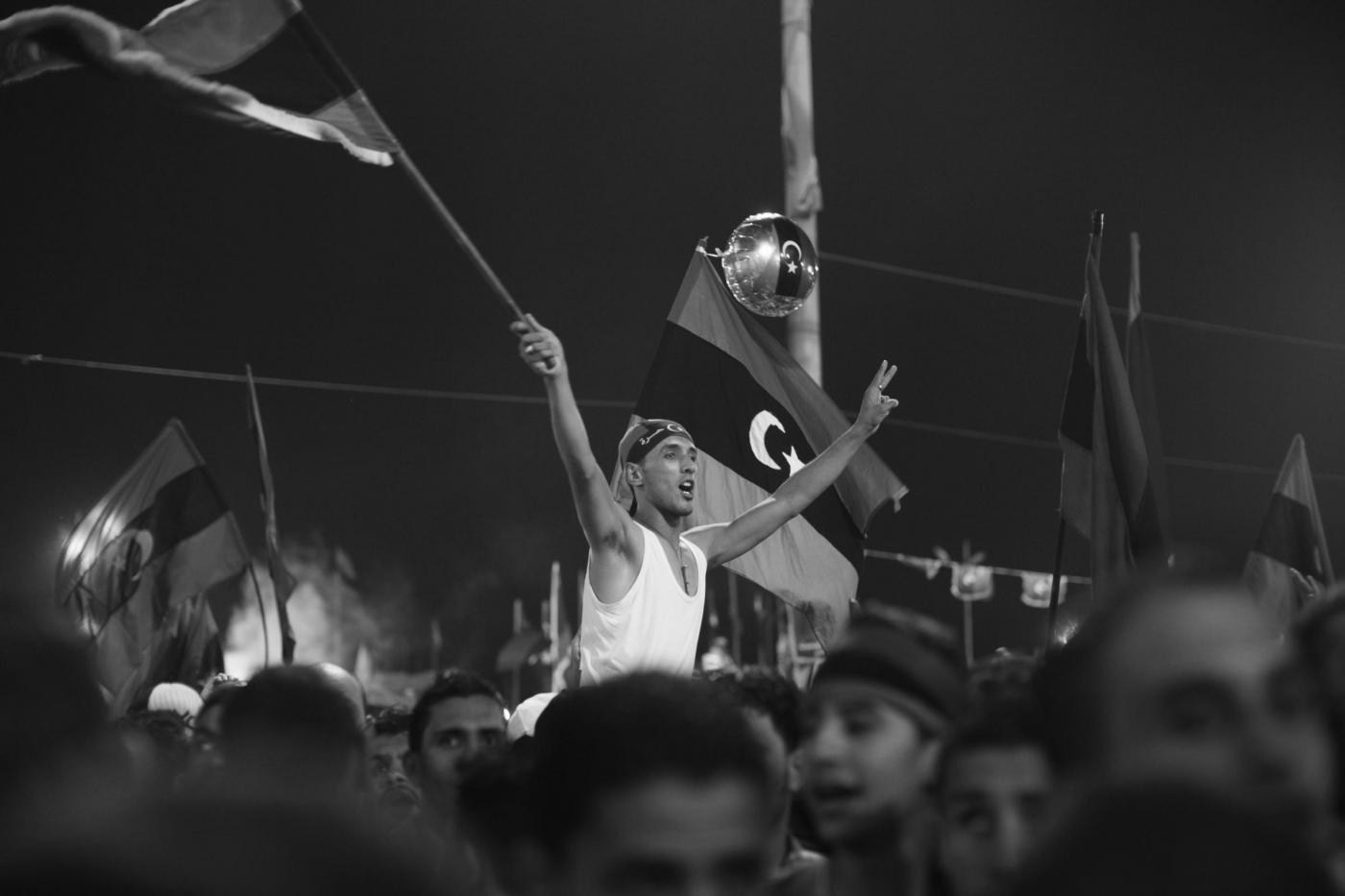
Today the Libyan transnational government has declared national liberation before a triumphant crowd in Benghazi, the city where the fight against Gaddafi began.

There are scenes of jubilation in Libya and NATO offices around the world.  Muammar Gaddafi is dead and attentions are now turning to the future of the Maghreb state and the implications of NATO’s intervention in the broader Arab Spring.  In such a celebratory atmosphere what will be the future response to rebellious populations rising up against murderous rulers?

Libya and the Future of Intervention

Nicolas Sarkozy has already made a direct comparison between the conflict in Libya and the plight of the people of Syria in facing down the armies of Bashar al-Assad.  He mused that “The best thing I can do is dedicate our visit to Tripoli to those who hope that Syria can one day also be a free country”.  The Obama Administration has toed a similar line in their policy of ‘Leading from Behind’ by touting the example of Libya as a framework for future interventions.

Deputy National Security Advisor for Communications Ben Rhodes stated that the Libya experience would provide the basis for future interventions with emphasis placed on the need for regime change to be based upon “indigenous political movements” rather than the ambitions of the United States and the importance of “burden sharing” amongst other nations.  The problem is that this does not fit into the model for preventing atrocities which the United States advocated so heavily in the 1990s.  In London and Paris there is talk of prevention and the need to take the lead while the US, perhaps due to domestic constraints, is taking up a more isolationist tone.  The question must therefore be asked if the example of Libya may hinder rather than assist future responses.

Military Capability

The first issue that must be addressed is military capability.  Don’t be distracted by the rhetoric of ‘no boots on the ground’, Libya was a huge military intervention.  The British and the French with help from the Norwegians and Danes, carried out the bulk of the airstrikes and provided the machinery to carry out the naval blockade.  This does not mean that the US should be discounted.  It was American air and sea forces that opened the intervention with decisive attacks on Libyan air bases allowing the European forces to act with greater freedom.  Specific American military capabilities in intelligence, surveillance and reconnaissance were key to the success to say nothing of the supplies of munitions that were supplied to the European forces.  The lasting images of the war will be of the final rebel push on Tripoli but it is the heavy NATO influence which will resonate in international relations.

A Frayed Alliance

The second impact is the increased tensions between the NATO powers.  Germany’s foreign minister hinted at an early stage that the country would refuse to take sides and eventually abstained from the vote on Security Council Resolution 1973.  The French have long advocated a reform of NATO and the obvious north/south European divide in capabilities has intensified this call.  Whether the military alliance is now in a position to oversee another campaign is debatable.

‘You Break It, You Own It’

NATO leaders have frequently referenced the ‘lessons of Iraq’ when discussing Libya.  The opposition of the National Transitional Council to any foreign troops in a post-war Libya has been welcomed by Western powers hesitant to adopt an increased military role in a time of economic uncertainty.  In this sense there has been a strong adherence to Colin Powell’s Pottery Barn mantra: ‘You Break It, You Own It’.

The Future of Intervention

So what will the lasting impact of the Libyan intervention be?  Crucially, both Britain and France seem to perceive the situation to have been an anomaly.  A nation with a small population and a weak military on the doorstep of Europe with regional actors who were unlikely to support the dictator.  It was seen as an easy case.  Additionally, the Western powers insisted on gaining the support of both the Arab League and the Security Council before intervening.  It is difficult to see such a situation emerging elsewhere in the Arab Spring and Russia has already blocked tentative discussions regarding Syria.

The question of Syria has been largely ignored in Washington.  Syrian opposition is increasingly turning to armed response with army defections burgeoning and calls for international intervention increasing.  People are being gunned down in the streets as the ‘liberators’ of Libya struggle to find the words to escape the precedent they have set.  It is unimaginable that international forces would enter Syria for a variety of reasons.  For that reason Libya must be viewed as an anomaly, not a precedent.

Reforming the Security Council?

Another impact of the intervention has been the rallying of non-interventionist states.  China, Brazil, South Africa and India have not been slow to point out the hypocrisy of the Security Council in elevating its own role while using the mandate of protecting civilians.  Perhaps the lasting message of Libya in international relations will be the claim these nations have demanded for many years: a reform of the Security Council.

Bloody Sheet, Noose, Cage or Condo?

The final message of the conflict in Libya is to those clinging to power in other nations.  It is a message to the Assads and Salehs of the world.  Like Gaddafi or Hussein they can go out on a bloody sheet or at the end of a rope.  Mubarak and Milosevic wound up in cages.  Ben Ali stepped aside amid violent persuasion and now resides comfortably in a condo in Saudi Arabia.  The bloody sheet, the rope, the cage or the condo?

Iranian-American Relations: Explaining the Recent Allegations against Iran

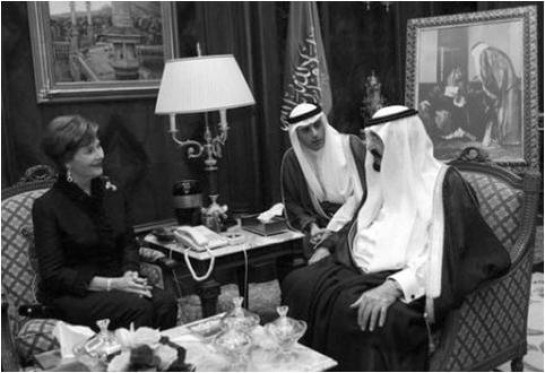
US agents state that a "significant terrorist act" linked to Iran which would have included the assassination of the Saudi US ambassador Adel al-Jubeir (seen here seated with former US First Lady Laura Bush and King Abdullah) has been foiled recently.In this article, the author argues that the recent allegations against Iran have been largely shaped by America’s perceptions of, and prejudices against Iran, which were shaped by the changes in their relations post-1979.


By Aryaman Bhatnagar, 19 Oct, 2011

The most recent American allegations against Iran accusing it of plotting the assassination of the Saudi Ambassador in Washington and the Iranian dismissal of such allegations as being baseless have once again revealed the endless cycle of blame that characterises Iranian-American relations. This latest round of allegations and subsequent denials originates from the perception that America has of Iran.

The Quds Force (QF), a special branch of Iran’s Revolutionary Guards Corps has been accused by the United States of America and Saudi Arabia to have been part of the plot to assassinate the Saudi Ambassador to Washington. However, Iran’s alleged complicity in this plot has met with strong scepticism within the diplomatic community and from foreign analysts specialising in Iran. Moreover, the lack of evidence to indict the Supreme Leader, Ayatollah Khameini or the Revolutionary Corps in this plot does not help America’s claims. Despite this, the Americans are adamant that the plot had been sanctioned by the QF or directly by Khameini himself. The Americans are calling upon the international community to strengthen sanctions against Iran and have not completely ruled out the military option as retaliation for Iran’s “flagrant violation of international law”.

This has not been the first time that Iran has been accused by the Americans without any concrete evidence. Iran had been accused of bombing the American embassy in Beirut in 1983 and the Khobar Towers in Saudi Arabia in 1996, which was home to American troops at that point. Years of investigation failed to prove Iranian involvement but even this has failed to dispel American suspicions, who continue to believe otherwise. Similarly, Iran has been accused of providing aid to al-Qaeda and the Taliban in order to destabilise American operations in Iraq and Afghanistan. Although, there has been evidence to suggest that Iranian weapons have been used by insurgents in both Iraq and Afghanistan, there is nothing to prove that this is part of a deliberate policy. However, such allegations have been used by America to exclude Iran from all the major projects concerning the region.

The reasons for the continuous demonization of Iran in America can be traced back to the Iranian Revolution of 1979, a watershed for American-Iranian relations. The revolution changed the image of Iran from a modern ‘westernised’ ally of America to one of America’s most formidable foes in the Middle East, which was ruled by ‘Mad Mullahs’. The Islamic Republic’s use of ideology in its foreign policy and an alternate vision for the world social and political order were seen as a threat to the American-led world order. It was the hostage crisis of 1979, which shaped the image of Iran as an irrational actor and left a lasting impact on the American impression of the Islamic Republic. From this date onwards, Iran became synonymous with worldwide terrorism and the source of all evil. Thus, irrespective of where terrorism was committed, the finger was automatically pointed at Iran. Even if there was lack of evidence, it was assumed to be something that Iran was capable of doing and were, thus, condemned for it.

Such a negative perception of Iran has become institutionalised in the political culture of America. As a result, the US policymakers have found it extremely difficult to shed their prejudices against. This is most evident in case of America’s response to Iran’s nuclear programme. Although, there is strong evidence that Iran’s nuclear programme is meant for peaceful purposes, America is convinced that it is meant to cause harm to them. A nuclear weapon in the hands of religious fanatics is believed to be dangerous for the entire world. It is interesting to note that America had been instrumental in starting the nuclear programme in Iran prior to the occurrence of the revolution. Their paranoia then clearly is an outcome of their perception of the nature of the Iranian regime than the actual dangers posed by the nuclear weapons.

The US’ differences with Iran are also motivated by their different strategic interests as both want to establish their primacy over the Persian Gulf region. Moreover, USA’s alliance with Israel and the bitter Iran-Israel relations also act as an obstacle for normalising the Iranian-American relations. But USA has managed to work around such issues and resolve its differences in the past with other countries. It is the perpetuation of the perception of Iran as an inherently anti-American nation, which is always looking for an opportunity to subvert them that has not only prevented USA from reconciling with Iran but also encourages speculations about its intentions.

Occupy America – As Occupy Wall Street Spreads We Ask: Who Are the 99%?

Occupy DC


By Jack Hamilton, 12 Oct, 2011

What is the ‘Occupy’ Movement?

The ‘Occupy’ movement started four weeks ago on Wall Street and more than 100 solidarity movements have since sprung up across the country as activists have taken to the streets to oppose what they perceive to be the injustices of the corporate and financial sectors.

Contrary to some media attention the protests are not solely comprised of ‘hippies in hoodies’ and ‘tattooed vandals sporting Guy Fawkes masks’. I met with nurses and military veterans, fire-fighters and lecturers, librarians and libertarians. It is not an explosion of violence as a result of disenfranchisement or a day in the park but an ongoing event which seeks to focus attention on the issues of jobs and financial reform. There are also some crazy people there who I will come back to. For now it is important to focus on the goals of the ‘Occupy’ movement and the tactics through which they seek to achieve them.

Funny Signs Can Stop Bailouts

What Are Their Goals?

1. Urgency

Nouriel Roubini, better known as Dr. Doom for predicting the financial crash of 2007-2008 has rightly asserted “There’s a huge amount of anger”. The protestors remain steadfast in their belief that the current financial system is heading for another meltdown if no reforms are made and the current system continues unabated. Dr. Doom agrees. In an interview with Foreign Policy Roubini described the protests as “a symptom of economic malaise” that is being felt not only in the United States across the world. The first facet of the ‘Occupy’ movement is a rapid response to this impending disaster.

2. Agency

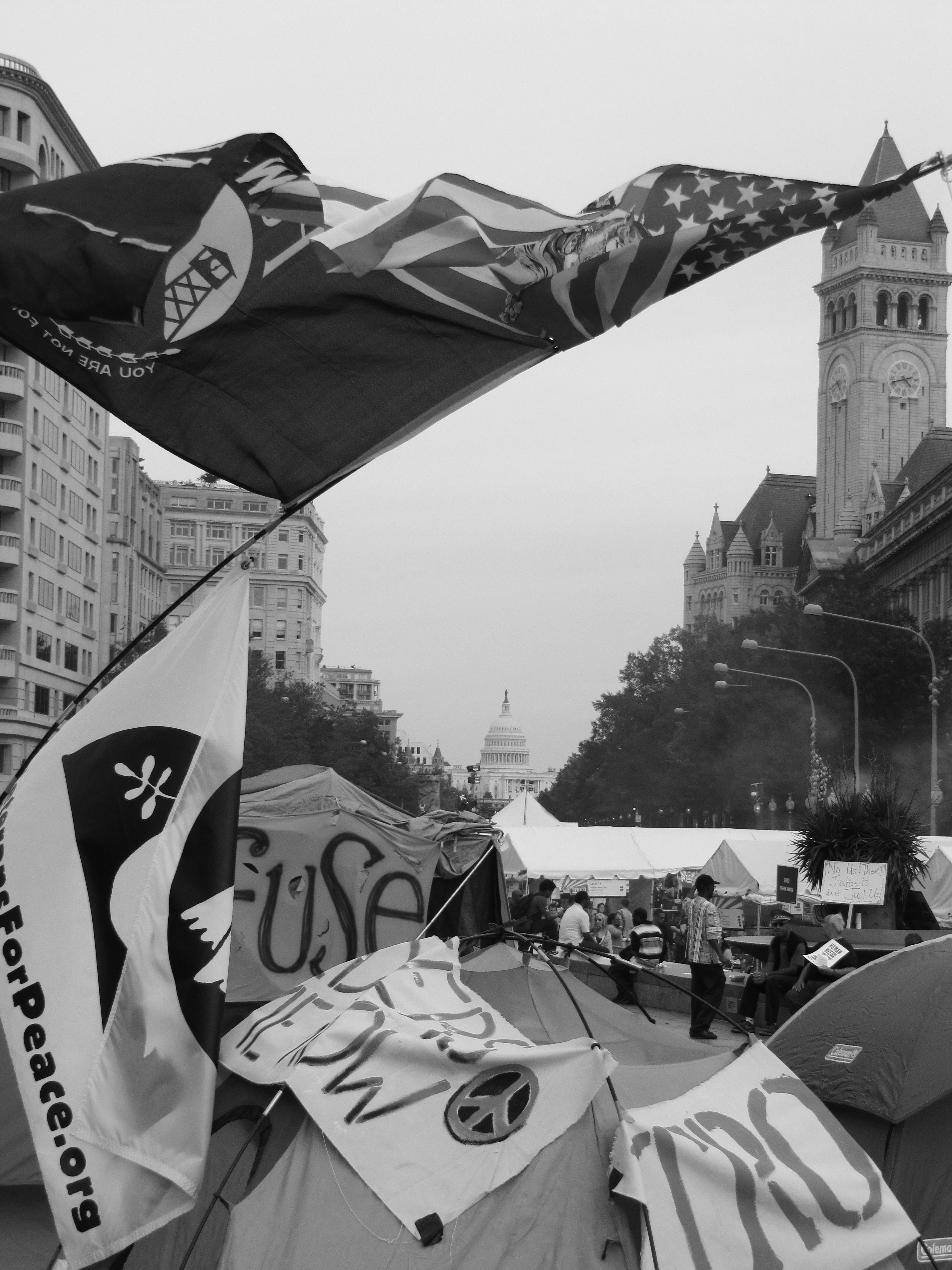
One of the most prominent signs at McPherson Square, DC read in bold letters ‘We need to Unfuck Ourselves’. This message clearly outlines the trope that the Occupiers perceive themselves to be the victims of the system and have taken it upon themselves to become active political agents and drive policy reform. The catchy image of the 99% rallying against the 1% has spread from the initial Wall Street protest across the various national spokes and it resonates strongly.

3. ?

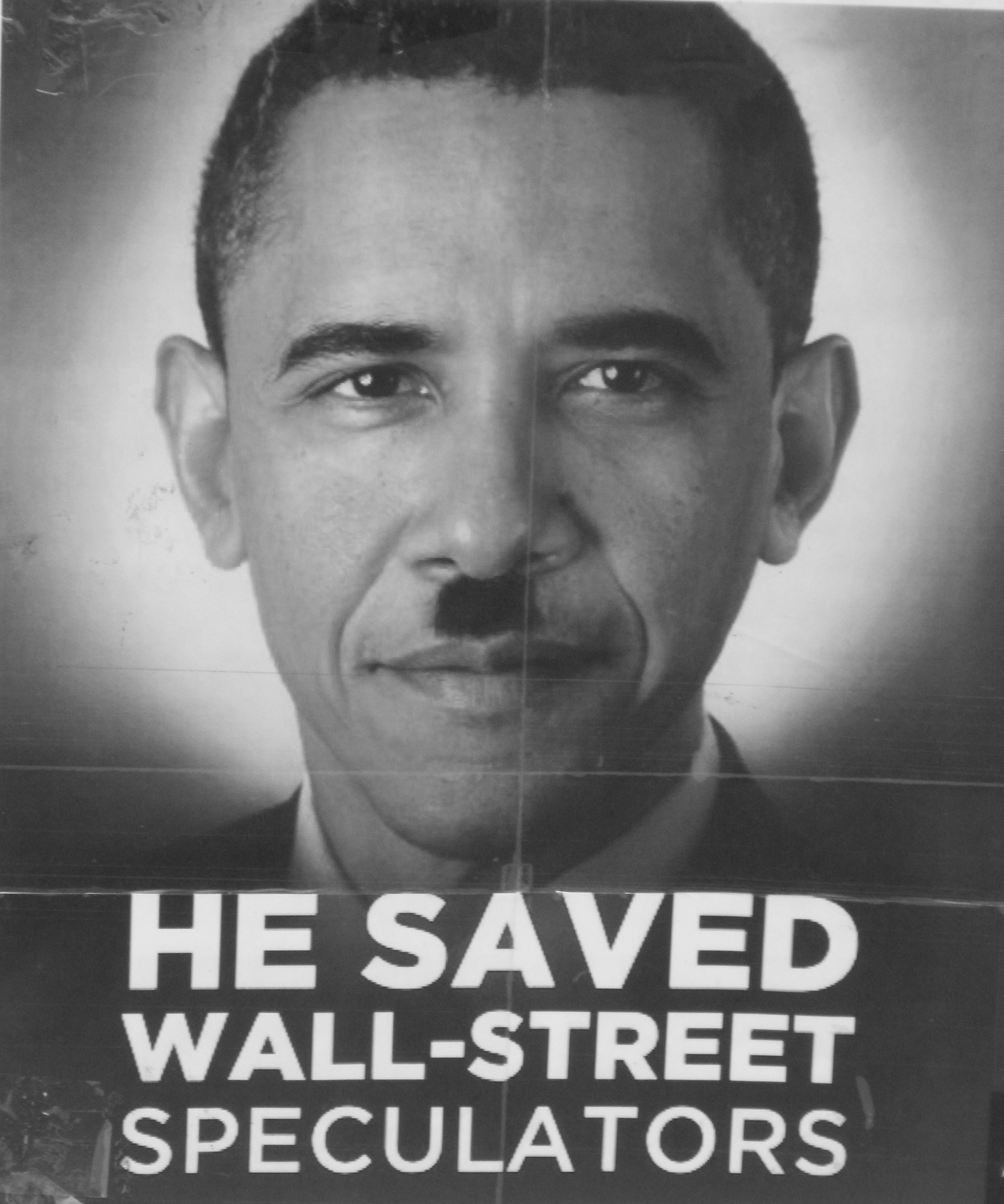
Urgency and agency can best be described as two themes of the protests but when it comes to clear and defined policy goals the unity lapses dramatically. For some Obama is simply Hitler, a narcissist and a puppet of corporatism who must be sacrificed for the more malleable alternative in Joe Biden. For others it is the ongoing imperialism of the British Empire which is subjugating the world economy to the demands of the monarchy (I am not making this up) and they do so under the guise of soft power organisations. One of the bastions of this soft power network is the Wildlife and Wetland Fund (still not making this up) which uses the guise of environmental aid to dictate policy across the world. It is worth saying at this stage that I am not impartial on the subject as my Mother is a member of the WWF and counts birds in Northern Ireland on occasion. I will be sure to ask her if she has been intrinsic to any global domination plots, ornithological or economic, when I speak to her tomorrow.

No Unity

The movement has been compared to the emergence of the Tea Party in 2009, breathing life into the conservative Republicans and influencing the 2010 elections which put in place a House of Representatives intent on blocking the Obama administration at every opportunity. By comparison the ‘Occupy’ protestors have no set of unified policy goals. The Tea Party opposed tax increases, demanded a cut in government spending and most of all rallied in opposition to something tangible: the sitting administration. The ‘Occupy’ protestors are apathetic towards Obama, who many of them voted for, but are also strongly opposed to all other parties. The narrative is clear: corporations have too much power. The policy alternatives and tactics are less so. Without tangible goals it is difficult to see tangible change occurring.

Chances of Success?

Is there any real pressure for the 1% to change their trajectory? The antipathy directed at the financial sector across large swathes of the globe has led to limited reforms and curtailed few bailouts. Protests in London and New York may lack a coherent agenda and action but there is no doubting that they have staying power and the longer they remain the more focus will be placed upon their agendas.

The Future

There are many questions that remain. The first issue is the nature of Roubini’s pending recession. Will it be another collapse along the lines of 2007-08 or will it be something more manageable. This may come down to the fate of the Euro-zone fringes. With Greece teetering on the brink of a disastrous default and Spain and Italy suffering the indignity of having their economies downgraded within the last week the crisis is showing little signs of abating. An article in The Economist posited that the continued uncertainty may actually play into the hands of Germany as it may be able to force the reform of the banking havens such as Ireland and Cyprus despite US objections. Merkel has a point. As soon as the European Central Bank intervened to stabilise Italy’s bond markets over the Summer, Berlusconi retreated from his austerity programme citing pressure from within his coalition. Financial panic is a self-fulfilling prophesy, a prophesy which the protestors should take heed of.

After the catastrophe in Japan earlier this year Germany took the lead in announcing that it would phase out nuclear power, whatever the cost, and turned to the nuclear power stations in France and Switzerland to plug the capacity gaps. When it comes to the sovereign debt crisis the most powerful country in Europe seems far more accepting of the risks of meltdown.

This does not mean that Europe is in a perpetual state of gridlock. Much has been made of the incapacities of European states to interact with each other the subsequent economic consequences. The strong European economies certainly resent having to bail out those who are perceived to have mismanaged their finances but that does not mean that they will cease to do so. One only needs to look at the passing of the Lisbon Treaty to see that the individual wills of European states can be subsumed in the European ideal and that the European institutions are much stronger than the Euro-sceptics are willing to accept. While the Mandelbaums and Thomas Friedmans of the world wax lyrical about the opportunities of a new Marshall Plan it must be remembered that this is not a post-war Europe and would not take kindly to being treated as such.

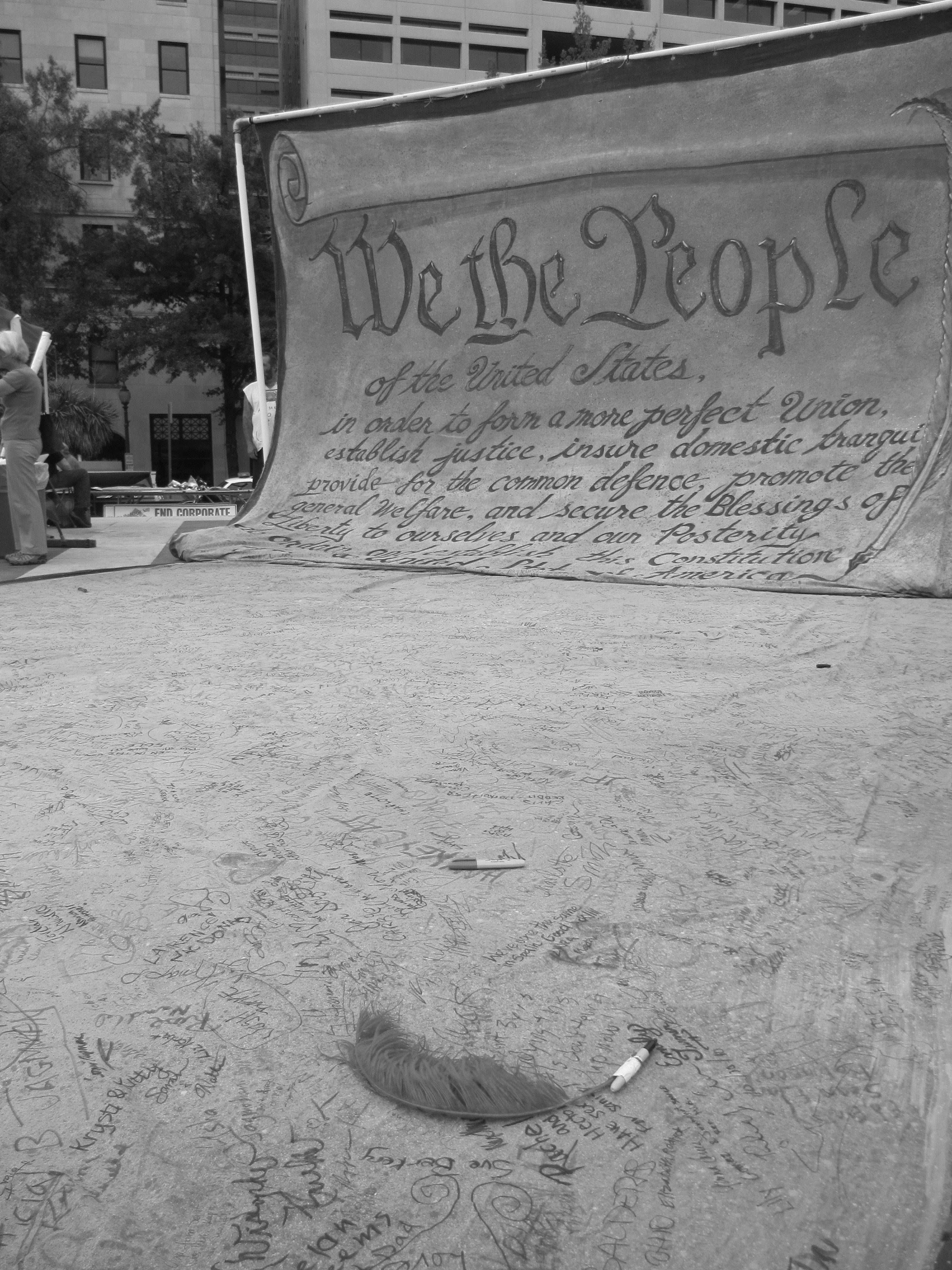
We the People

It is highly limiting to view 1% of society as being responsible for every problem of the 99%. Where does this leave the highly divisive issue of Medicare or the broader issues of over-consumption and overspending? While these issues are more acute in the ‘1%’ they are certainly wider than the ‘Occupy’ protests imply. If all of the problems descend from a simple high peak of American society then surely the solutions must simply focus on scaling that one summit? The reality is that those advocating financial reform need to look beyond their own mountain and see the full range. If the movement is to achieve its goals it requires a behaviour modification of much more than the top 1%.

The Lighthouse in the Desert


By Jack Hamilton, 9 Oct, 2011

Folklore spills across time creating and undoing history as it ebbs. Whole identities can be constructed and deconstructed in these stories but it is rare in these ages that entire maps can be reimagined due to a single small tree. The old addage “so geographers in Afric maps, with savage pictures fill their gaps” has long since faded but this is a story about one such ‘gap’, the one piece of life within it and the price of life that goes with it.

The Sahara Desert is awash with a sandstorm of whispers and this particular spec is the lonely Tree of Ténéré. It is a story which entails trust amidst gossip as well as the dangers of blind trust in a terrain in which one can see for miles. Upon first hearing the story I didn’t believe that such a tree could ever have existed. In recent weeks a terrorist cell linked to al-Qaeda was undone by their belief that the tree still existed. However, I must start by describing the story of the tree.

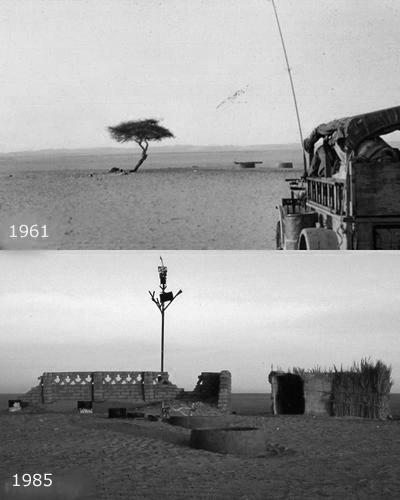
There was once a solitary tree standing in the centre of the Sahara Desert. Between the Baobabs of Senegal and the Olive Trees of Tunisia remained one sole survivor of a bygone era. Millenia ago the tree had been part of a great forest which had gradually died off as the Sahara became the inhospitable mother she is today. One tree remained to guide all those who dared to traverse the barren lands. It was a beacon: the lighthouse in the desert.

The nomads of the desert alone knew of this tree and used it as a tracking mechanism when traversing the most desolate depths of enduring beige. When these Tuareg would encounter the Fulani in north east Mali they would recount their tracks in order to let the Fulani know of their passage, including the waypoint of the tree in the middle of the desert. Having listened politely to the detailed directions the Fulani would thank the Tuareg and see them on their way providing that no disagreements had been reached.

At this stage the Fulani would all agree never to follow the route of the Tuareg. These men had seemingly been driven dangerously insane by the desert. Of course, there is no chance for a tree to exist in such a place. There are no trees for hundreds of miles in the Sahel (the shoreline of the desert), let alone the Sahara. If this route had a proclivity for perverting the minds of the fearsome Tuareg, it was no place for men.

This story circulated until the times when modern technology made it possible for mere mortals to take the route. Safe inside the machinery that would be used to fight the Second World War, Europeans were able to cross the desert here in hopes of cutting off a rival. It was at this time that they too believed themselves to have gone insane too as in the horizon the withered spectre of an acacia tree loomed. They had not been in the desert long enough to have reached the Libyan coast and had not crossed the Italian lines that would have inevitably preceded the water. It could not be Algeria as there had been no sign of the southern Air mountains. The story was true. They had discovered the Tree of Ténéré. The most isolated life on Earth.

It is here that a part of the mystery ends. Confused and in search of the truth the Europeans (a French division) decided to dig underneath the tree and discovered a well 35 metres down. While the fairytale of the tree was slightly depleted the beacon took on a new significance as not only being the only life but suddenly becoming a redeemer of life in the harsh conditions of the Sahara. The tree was not a mirage but the literal symbol of water in the desert.

However, as with all of these stories of the desert, it ends in tragedy. In the 1970s a Libyan truck driver somehow careered into the tree, allegedly drunk. Upon hearing this part of the story I was always interested to hear how the driver could explain this to his boss. He had somehow managed to hit the only tree in a 400km radius.

The reason I was reminded of this story was due to reading intelligence reports from the security forces tracking al-Qaeda in the Islamic Maghreb (the Saharan branch of the terrorist organisation). One of the Algerian trackers claimed that they had an intimate knowledge of the desert and in the pursuit they had passed the Tree of Ténéré. Today in the place of the tree stands a simple metal sculpture representing the optimism of the tree. Unfortunately the tracker described in great detail the tree as it looked before the 1970s, exactly the description that was recounted to me. It was clear that the ‘trackers’ did not know the desert and had possibly never crossed into Niger where the tree used to stand. They were found out immediately.

The idea of the Tree of Ténéré had always seemed to me like one of the lies which whispers around the desert. It brought a smile to my face that the myth was actually the truth and it was this fact that unveiled the fiction.


Jack Hamilton can be followed on Twitter @jmhamilton

A Nobel Intervention?

Why did the Nobel Committee Award the Peace Prize to Liberian President Ellen Johnson Sirleaf one week before the Presidential election?

Victory Assured?


By Jack Hamilton, 7 Oct, 2011

Today’s award of the Nobel Peace Prize to Liberian President Ellen Johnson Sirleaf has stirred controversy.  The ‘Iron Lady’ said this morning that she is humbled by the award and has stated that it is an award for the people of Liberia.  However, the timing of the award, coming one week before the Presidential elections in Liberia, has brought forth claims of the Norwegian-based Nobel Committee interfering in the internal politics of the West African state.

President Sirleaf’s main rival in next weeks’ election, Winston Tubman, has lambasted the decision of the Nobel Committee instead declaring that “She brought war here, she is a warmonger” to the BBC Voice on Africa programme.

Such vitriol is nothing new to the first elected female leader in Africa having risen to prominence in 2005 following a civil war that left a quarter of a million people dead and the Liberian economy in tatters.  This is not the issue.  Rather it is the question of the timing of the award in such close proximity to the election.

Nobel Committee Chairman Thorbjoern Jagland has told reporters today that the committee does not consider domestic politics in its selection process and the spokesperson for the Liberian National Election Commission, Nathan Mulbah, has already stated that the election will go ahead as planned on October 11, four days from the award of the Nobel Peace Prize.

Peace by ‘Peace’

The Nobel Committee is no stranger to controversial timing.  Awarding the prize to Barack Obama was seen by many as an over-zealous attempt by the organisation to garner attention by affixing itself to a popular President who had achieved little in the way of international peace at the time of the presentation (aside from the snide observation that he may have won due to the simple fact that he was not George W Bush).  That has since been described as an incentive for the President to foster peace and security throughout the globe.  This function of the peace prize should not be overlooked.

In 1998 David Trimble and John Hume were awarded the Nobel Peace Prize for their roles in facilitating the Good Friday Agreement and ushering in a more peaceful era in Northern Ireland.  This was by no means a solid peace deal.  Similar agreements had been reached at Sunningdale in 1973 and at Hillsborough in 1985 but failed spectacularly.  The prize was a recognition of the start of a process and acted as a lightning rod for the global attention at a time when atrocities in were being carried out in the Balkans and al-Qaeda had struck in Nairobi.

While the Peace Prize did not create the peace in Northern Ireland it associated the terms of ‘Northern Ireland’ and ‘peace’ at a global level which certainly acted as a catalyst to maintain some semblance of dialogue. It is difficult to ascertain the motives of the Committee with any great deal of certainty but one assume that they are attempting to bring the world together piece by piece: peace by ‘peace’.

Ballots not Bullets

This brings me back to Liberia.  The elections will take place in a few days and there is no doubting that the Nobel Peace Prize has again drawn attention to an ongoing peace process.  The Committee is surely aware that their award will have an impact on the election.  Is it so wrong that they have chosen a woman who so clearly embodies the values the Nobel Committee stand for?  Sirleaf has been instrumental in transforming Liberia from a post-conflict country to a developing one.  Under her the economy has grown by 6.5%, free and compulsory primary education has been introduced, and doctors’ salaries have doubled.  Furthermore, the election has so far been described by the electoral observers of the Carter Center as “peaceful” and “fair” as healthy competition remains between the two frontrunners, Sirleaf and Tubman.

The timing of the decision will be used by the opponents of Sirleaf to frame her as a puppet of foreign interests but it was not her choice.  However it was Sirleaf’s actions led to her accolade and these actions will surely prove to be more influential come October 11.  Neither Sirleaf nor the people of Liberia are the puppets of foreign intervention and such a claim devalues the progress that has been made in the past six years.

Today’s award is recognition of those achievements as well as an incentive to continue the difficult rebuilding process, whatever the outcome of the election.  However with the objectives of the Nobel Committee being repeatedly questioned, the jury is out on the future of the prize.


Jack Hamilton can be followed on Twitter @jmhamilton

Look East, Prime Minister Singh


By Siddharth Singh, 7 Aug, 2010

In his second term, Indian Prime Minister Dr. Manmohan Singh has taken up the challenge of improving India-Pakistan relations in line with his conviction that a nation which wishes to see itself as a global power must move beyond regional rivalries with a small neighbour. Consequentially, the Government of India has spent considerable time and effort into building this relationship in the face of public skepticism at home following the 26/11 attacks in Mumbai.

While this effort is laudable, evidence does not seem point towards a possible success in this initiative. The recently leaked Afghanistan war dossier confirmed what was long known in the policy circles: there is no unified face of the Pakistani leadership as groups and individuals within the administration are working towards different goals. These goals include helping jihadi groups that intend to establish control of Afghanistan once the NATO – ISAF forces led by the USA leave the region, and those that intend to fight India in Kashmir.

The popular opinion among Indians after 26/11 has not been accommodative of any dialogue with Pakistan, at least not until action is taken against the perpetrators of the attacks in Mumbai. Such a single minded focus of Indian foreign policy on terrorism is not acceptable to Pakistan, as it wishes to see issues – particularly Kashmir – to be discussed and resolved too. As a result of this mismatch, a rather ugly public falling out took place in Islamabad recently between India’s foreign minister Krishna and his counterpart Shah Mehmood Qureshi. Furthermore, it is unlikely that popular opinion in Pakistan will become receptive of any concessions made by their government towards India.

The memories of the bitter history between the two nations cannot be undone easily; at least not at the current juncture when the uncertainties of the Afghanistan war are encouraging the Pakistani administration to keep its options open. This hasn’t stopped Dr. Singh from insisting on the continuance of the talks even in the face of strong political opposition in India.

On the other hand, the Indian government is missing out on a golden opportunity to once and for all bury a petty regional rivalry between Bangladesh and India. The circumstances surrounding this relationship are such that if proper time and effort are invested, India and Bangladesh could bury the hatchet and move towards a stable South Asia.

Only recently, a military led caretaker government in Bangladesh was replaced by a coalition led by Sheikh Hasina’s Awami League. This government has shown the will to have strong relations with India. Bangladesh is the 7th most populated nation and has shown larger increases in the HDI index than Pakistan has in the past few years. It is expected to show a real GDP per capita growth rate of 6.8% in 2010. The Grameen Bank is playing a great role in poverty reduction in the country. They have also shown a steady improvement in the Corruption Perception Index.

Most importantly, the Supreme Court of Bangladesh recently reinstated a ban on religion in politics, implying that Islamist parties can no longer use religion to garner votes. The unifying identity in Bangladesh isn’t religious; it is linguistic and cultural.

India’s relationship with Bangladesh hasn’t been great historically for a variety of reasons, and this is holding back both countries to varying degrees. Bangladesh blames India of faulty water management (principally, the building of the Farakka Dam) on India’s sides of the borders that causes flooding and water shortages at different times of the year in Bangladesh. Additionally, The Border Security Force (BSF) of India is blamed for killing ‘innocent cattle traders’ from across the border frequently (The BSF maintains that they only fire in retaliation to the cattle ‘smugglers’, as cattle trade isn’t legal between the two nations). India is also accused of treating Bangladesh as an inferior state that is supposed to be obliged and indebted to India for the help that India gave during her freedom struggle.

India’s principal issue of conflict is a result of Bangladesh’s ‘sheltering of anti-India insurgents’. This claim is being countered as the new government has shown resolve to readily arrest and hand over anti-India insurgents to Indian authorities. The political right wing of India also speaks out against illegal immigrants from Bangladesh who cross over and do paltry jobs. Additionally, one incident that won’t be easily forgotten in India is the case where 16 BSF soldiers were killed by rogue Bangladesh Rifles (BDR) soldiers in 2001 (2 BDR soldiers were killed too).

However, India needs Bangladesh as much as Bangladesh needs India. For one, states and regions in India’s North East get completely cut off from the rest of the country in the face of local agitations, as was seen recently. This gives China a strategic advantage in the region, and this is critical given China’s claim over the Indian state of Arunachal Pradesh. India needs Bangladesh as a transit route to easily access its North Eastern states. Bangladesh needs peace with India to keep its focus on development and political stability rather than be distracted by military concerns.

There exist several advantages in the scenario surrounding India and Bangladesh that simply don’t exist in the case of India and Pakistan. For one, India’s opposition leaders are in favor of having better relations with Bangladesh, while they have a hawkish stance against Pakistan. Secondly, there is no ‘natural’ flashpoint such as Kashmir in the case of India and Bangladesh which could independently derail talks. Thirdly, Bangladesh shows the potential of having economic and political stability in the decade to come and the government has a united face.

Hard work will be needed by India to woo Bangladesh’s opposition, however. This is where Dr. Singh’s task is cut out. He has to go the extra length to bury the bitter history between the two nations. India must start treating Bangladesh as an equal in the region and must unilaterally offer economic concessions and access to its markets. Being in a better position economically, India can afford to do this. Bangladesh might eventually trust India enough to reciprocate. India must also resolve the water management issues that affect the average Bangladeshi. In turn, India must demand transit to its North Eastern states.

Dr. Singh also needs to convince the opposition in India to support the development of Bangladesh, for only a prosperous Bangladesh will lead to a fall in illegal immigration. The Prime Minister can also mull over immigration reforms to allow Bangladeshis to legally work in labour deficit regions in India.

China continues to woo Bangladesh in its attempt to create a chain of China-friendly states around India’s border for obvious strategic purposes. It is time India swallows its pride and get real by engaging Bangladesh. Proactiveness and conviction by Dr. Singh will get India much more than what Pakistan feigns to offer. Finance Minister Pranab Mukherjee’s recent trip to Bangladesh is a good start, but a lot more is required.  The time and effort being expedited on Pakistan must be replicated and overshadowed by India’s effort on Bangladesh. The timing for such an endeavor couldn’t be better.

__________________________________________________________________________________

The author can be followed on Twitter @siddharth3