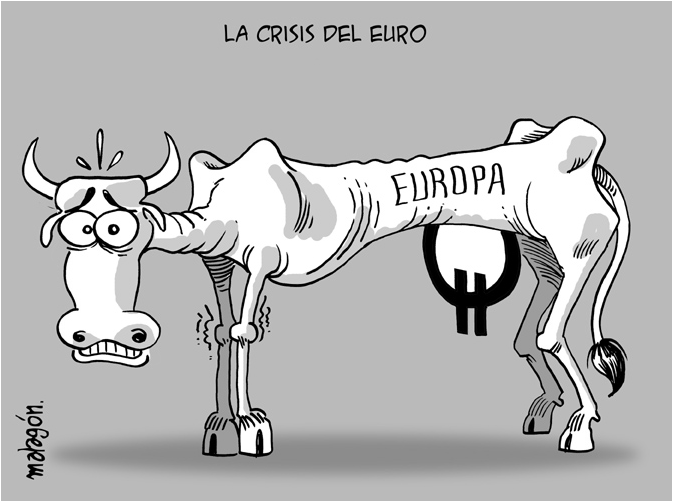
 In this article, the author analyses the Euro crisis by taking a look at Spain and fiercely criticises European conservatives’ obsessive focus on austerity, a trend that is inevitably leading the old continent towards a state of Neo-Eurosclerosis.
_______________________________________________________________________________________
4 Jan, 2012
European politics is a tough game: on the one hand, there is the political struggle in which parties seek to win a domestic electorate with old-fashion programs covering issues such as the level of state intervention, economic growth, and social integration and protection. Here the talk is usually centred on taxes, employment, state regulation, and welfare programs. On the other hand, European integration and monetary union are forcing member states to strengthen their positions in an attempt to resist challenges to state sovereignty. Here the talk is usually centred on fighting back transnational forces and financial markets, enhancing national identity, and resisting the transference of sovereignty. Hence, political parties find themselves in the odd situation of having to win two battles: one with a domestic electorate, and one with the effects of European integration. Three battles if we include the struggle against financial markets that do not seem to respect boundaries of any sort. The 2008 economic crisis and subsequent sovereign debt crisis and crisis of the euro have only exacerbated these trends. The case of Spain comes in handy here.
When Mariano Rajoy of the conservative People’s Party was elected Spain’s President in November he stated that Spain “will stop being part of the problem and start becoming part of the solution”. Later, in his first address to Parliament he confirmed that he would not raise taxes as a measure to reduce public budget deficit (one of his electoral promises). Yet this week the government that Mr Rajoy presides announced the most severe measures since Spain turned into a democracy in 1978, including very large cuts in public expenditure and a significant rise in income tax rates. This, it was argued, is what Spain needs to do in order to meet the European budget deficit target of 4.4% by the end of 2012.
The current exact figure of Spain’s public deficit is a matter of serious debate. According to the outgoing socialist government, Spain’s deficit is of the range of 6% whilst the incoming conservatives estimate the figure is closer to 8% thus justifying extraordinary measures. But Spain is a semi-federal state in which a large proportion of the current aggregated national public deficit is dependent on the deficit incurred by each of the different autonomous communities. This means that the debate over the exact figure of public deficit is in turn cascaded down to the politics of each of the autonomous regions (the majority of which are now in control of the conservative government). In other words, numbers and figures are political. Those seeing things through red lenses believe the figures provided by the incoming government have been inflated; those seeing things through blue lenses claim that the outgoing government was too optimistic about the level of public deficit.[1]
Regarding the measures announced by Mr Rajoy, two points come immediately to mind. First, Mr Rajoy’s measures will tax employees and therefore hit the middles classes, and not big companies or the richest strands of society (despite the argument that he has chosen to raise taxes on income over taxes on consumption on the basis of the former’s equity and progressivity –however, there are already rumours that VAT, a tax on consumption, will be increased in or after March. That may explain, inter alia, what Mr Rajoy’s number two Soraya de Santamaría meant when she claimed that the measures announced this week are only ‘the beginning of the beginning’). Second, the conservative government has justified these measures on the grounds that resolving the debt crisis must be Spain’s top priority. Cutting public expenditure (in other words, social welfare) is not enough and so an additional increase in taxes is what Spain needs to do to achieve the paradisiacal budget deficit of 4.4%. This, according to the conservatives, will not worsen the economy and, if it does, their position is that reducing public deficit is more important than reactivating a stagnant economy. Yet reactivating the economy and creating jobs was the promise and the campaign slogan of the conservative party presided by Mr Rajoy (official data says Spain has 4.42 million unemployed).
So what has happened here? Have Mr Rajoy and his cabinet changed their minds or did they know the policies they would adopt and implement once they found themselves in power? I think any doubts in this regard may offend the reader. Spain is no movie like others, but the script is the same elsewhere in Europe these days: see Greece, (in that case though the government of Mr Papandreu lied about public accounts), Ireland, Portugal, and Berlusconi’s Italy where the new government has not even been democratically elected. Then came Spain, with Mr Rajoy making pacts with Merkel. In this regard, not only is the Franco-German axis abusing intergovernmental cooperation to worrying levels, bypassing regional integration and European institutions such as the Commission, but they are also increasingly perceived as dictating what other countries must do.
In an essay published in November by the Centre for European Reform the authors provide an excellent analysis of what exactly is going on in Europe. According to the authors, the principal problem is that the monetary union was never coupled with a fiscal union. The introduction of the euro therefore triggered a flow of debt from core, creditor countries in the North, to periphery, debtor countries in the South, ‘spurring the emergence of enormous macroeconomic imbalances that were unsustainable, and that the eurozone has proved institutionally illequipped to tackle’. But the Franco-German axis and North-European policy-makers, with the backing of conservatives elsewhere, do not agree with this interpretation and instead of acknowledging the institutional pitfalls of the eurozone, they blame the crisis on the behaviour of certain member states (the so called PIGS that Paul Krugman rightly prefers calling GIPS), namely on government profligacy and loss of competitiveness.
Hence, Spain is forced to apply stricter rules to emulate the virtuosity of creditor countries like Germany as if Germany itself had played no role in the run-up to the crisis (by lending money irresponsibly and far from innocently). Yet experts like Krugman are very clear about the impact that an obsession with austerity and low inflation is having on European economies: austerity in times of crisis inevitably leads to more recession and not necessarily to a decrease in bond yields. IMF’s Chief Economist Olivier Blanchard has backed this view by declaring that ‘some preliminary estimates that the IMF is working on suggest that it does not take large multipliers for the joint effects of fiscal consolidation and the implied lower growth to lead in the end to an increase, not a decrease, in risk spreads on government bonds’.
Krugman claims that nobody understands debt and he cites a quote by John Maynard Keynes that all governments, blue or red, should learn by heart: “The boom, not the slump, is the right time for austerity at the Treasury”. I think though that Krugman is making a very benevolent interpretation of the current state of play. Surely Mr Rajoy (and Sarkozy and Merkel) understand debt, but their lenses are blue. It was Roosevelt and not Hoover that led the US and the world to recovery during the last Great Depression, and he did so by injecting money in the economy, not by enforcing austerity. The eurozone suffers from institutional flaws that need to be sorted (such as the lack of ‘real’ fiscal union). Some experts believe the latest agreement reached by the 17 members of the eurozone on 9 December 2011 is a ‘fiscal union’ only in paper (this may explain the reaction of the financial markets which, after taking a brief break, are back on their feet ready to take on another victim).
The question therefore is whether there is anything that will satisfy the financial markets. In this regard the answer seems to lie in Blanchard’s statement according to which financial investors are schizophrenic because they first react positively to austerity and then negatively when they realise that austerity does not lead to growth. Which means that the key to this puzzle is as simple as it is old: financial markets want to recover their investments, and the way to guarantee such outcome is by generating growth, not by enforcing austerity. Mr Rajoy in the meantime, guided by European conservatives’ obsession with austerity, continues to hit the wrong button; let’s hope it will not be too late before European leaders realise that their lenses are leading Europe towards a state of Neo-Eurosclerosis.
[1] Blue is the colour of Spain’s conservative People’s Party but blue is later used throughout the rest of the article to refer more generally to conservatives across Europe



 InPEC Magazine