Is Mali the ‘next Afghanistan’?

This article is a re-publication of a piece by Andrew Lebovich on his website, al-Wasat.  It analyses the popular attitudes on the security situation in northern Mali to look at the potential risks to international security and the risks that are, at present, overstated.

Mr. Lebovich is a contributor to the popular foreign policy blog The Washington Note, and his work has appeared at ForeignPolicy.com and The Atlantic Online. He also writes a formerly weekly, and now twice-weekly brief with Foreign Policy on legal issues in the struggle against terrorism, the Legal War on Terror (LWOT).


By Andrew Lebovich, 13th June, 2012.

The title of this post is a question I’m seeing more and more, and it reflects the growing concern in Washington, Paris, and African capitals that the security situation in northern Mali is spiraling out of control. In this kind of environment, bad news tends to echo loudly and quickly. The most recent example of this is the strong reaction in the international press to an interview Nigerien President Mahamadou Issoufou gave to France 24 this week, in which he said that Afghans and Pakistanis were in Mali training fighters, in addition to confirming that French hostages held for nearly a year and a half by AQIM were in “good health” and still alive. This news has garnered quite a bit of attention, especially in the Francophone media, though it should be noted that RFI reported the presence Pakistani trainers in Timbuktu and in Kidal a month ago, to considerably less attention. Still, this and other signs of the degradation in the security environment in northern Mali and the growth of AQIM have spurred speculation about whether or not northern Mali was becoming a “West African Afghanistan“, a new Somalia, or a jumping-off point for terrorist attacks elsewhere.

While I think some of this concern is warranted, I think some of this language and concern may be, for the moment, a bit overwrought, as I will explain in this piece. This post is my attempt to sort through some of the current popular attitudes about the security situation in northern Mali, the very real risks to regional and international security that may be looming in the north, and the equally real constraints on militant groups attempting to impose shari’ah in northern Mali or project force beyond Mali’s already porous (or nonexistent) borders.

Continue reading

Tinker, Tailor, Soldier, Guantanamo: Can Intelligence Agencies be Democratic?

In this article the author questions whether the methods being used to combat domestic terrorism are in fact contrary to the values they seek to protect. Using the case studies of the US and Pakistan, Camille Maubert looks at the discrepancy between democratic ideals and the often scandalous actions of intelligence agencies.


By Camille Maubert, May 15th, 2012

The superiority of democracy as a political system has become paradigmatic. In effect, it is known to be the best way for a state to simultaneously assert authority on its citizens and protect their basic rights from excessive uses of power. Yet, intelligence agencies are democracies’ Achilles’ heel. Scandals – from Watergate to Abu Graib – penetrated the layers of secrecy and exposed the discrepancies between democratic ideals and intelligence activities.

Continue reading

Heyns, the Final Straw for AFSPA in India?

In this article, the author discusses the controversial Armed Forces Special Powers Act (AFSPA), 1958 of India, which has been used in the North Eastern states of India, and Jammu and Kashmir where counter-insurgency operations were carried out in the past several decades. This Act has come under heavy criticism from human rights advocates.


By Rithika Nair, May 1, 2012

Christof Heyns, the Special Rapporteur on Extrajudicial Killings described India as “a living document … [of] human rights jurisprudence respected worldwide.” This extolling statement preceded his review of the country after brief visits to New Delhi, Gujarat, Kerala, Jammu and Kashmir, Assam and West Bengal. His detailed report on the issue will be submitted before the United Nations Human Rights Council only in 2013.

In a press release after his visit, he expressed concern regarding unlawful killings by State actors and non-State actors, delay in prosecution and lawful impunity. He touched upon the disproportional and unnecessary use of force by the police, encounter killings, custodial deaths, the death penalty, the Armed Forces Special Powers Act, communal violence, insurgencies and counter-insurgencies, violence against women, and most significantly measures of impunity and rewards instead of prosecution.

Continue reading

The UN Human Rights Council Resolution on Sri Lanka’s Alleged War Crimes

In this article, the author explores the resolution’s impact on Sri Lanka, and its probable implications with reference to Sri Lanka.


By Rithika Nair, 3rd April, 2012

The United Nations Human Rights Council’s (UNHRC) judgment on Sri Lanka’s efforts at post-conflict reconstruction, invited an abundance of opinions and debate globally. Newspapers cried out country decisions to the US sponsored resolution with regard to their foreign policies, domestic policies and moral policies. In lending an ear to all the global justifications and rationalizations, the importance shifted away from what Sri Lanka had to say with regard to the resolution and its possible impact on the island.

In 2010, the Government of Sri Lanka created the Lessons Learnt and Reconciliation Commission (LLRC) suo moto, to look into the causes of the conflict, its consequences on the people, and to promote national unity and reconciliation. The LLRC, though criticized for overlooking the violations of human rights and humanitarian law committed by the Sri Lankan army, stated that there were “considerable” civilian casualties. This was opposed to the government claims, which insisted on a zero-casualty rate.

The international community had already begun to push Sri Lanka to begin its post-conflict reconstruction agenda.  The LLRC report increased this demand for the Sri Lankan government to act – prosecute those who were accountable for civilian massacres, and bring relief to those displaced and devastated by the war.

This never happened.

The disappointing LLRC report largely exonerating the government, and the subsequent government inaction to suggested accountability procedures encouraged the international community to act.

In March 2012, the US submitted a resolution at the 19th session of the UNHRC, urging the Sri Lankan government “to address serious allegations of violations of international law by initiating credible and independent investigations and prosecutions of those responsible for such violations.” The resolution, after being slightly amended to word that the implementation of any external advice or investigation by the Human Rights Commissioner or Special Procedures must unfold only “in consultation with and the concurrence of ” the Sri Lankan government, was passed with 24 votes in favour, 15 against, and 8 abstentions.

The closing of Sri Lankan embassies in Europe, the threats to human rights defenders and the anti-Americanism in Sri Lanka are some of the immediate effects of the resolution. But it’s long-term implications – constructive and destructive, are nothing but analytical renderings as of now.

The resolution with its honorouble intentions could be a possible check on the quasi-dictatorship of Mahinda Rajapaksa. It could be the warning hand on the back, reminding Sri Lanka of what it had promised to deliver three years ago, a paternal gesture offering assistance if needed. It could imply that dialogue and soft diplomacy may harden, and the whispers of a ‘South Asian Spring’ may jump to reality with an international demand for the removal of Rajapaksa from his throne. With the Sri Lankan Tamils still dissatisfied with their government’s empty promises of reconciliation, and Sinhalese human rights activists being called traitors if they stood up for the Tamils, it would not be long before Sri Lanka could walk the line with Maldives, Libya, Egypt and Tunisia. If such a future be predicted, then the precautionary resolution – a very fair and balanced one, has been passed at a very appropriate juncture.

The resolution may have been a UN step to avoid being blamed for not taking action. Perhaps the UN was guilty of its own lack of action while the crisis unfolded over 26 years. Then, the resolution is but a ticking pendulum, softly but notably reminding Sri Lanka of its obligations and responsibility – and in doing so, delivering rehabilitation and hopeful justice to the victims of the war – the people of Sri Lanka.

On the other hand, the resolution placed the ball back in the Lankan court, and it ordered the multi-faced Lankan king to finish what he had promised to do. It asked him to submit an action plan detailing what he had done, and will do to implement the LLRC recommendations, and to address all matters that violated international law.

The king, with all ten heads, rejected the resolution.

Neither he nor his court thought that it added any value to the humanitarian and justice implementation process in Sri Lanka. They felt the resolution was ‘counterproductive’, ‘ill-timed’, and ‘an unwarranted initiative’. They perceived the supporters and sponsors of the resolution to be LTTE sympathizers – those who underestimated the violence and trauma that the LTTE had unleashed upon them. They felt that the unpunished situations in Afghanistan, Iraq and India removed the moral legitimacy of the resolution.  Lobbying against the vote in Geneva transcended into anti-America lobbying, and human rights activists and defenders of the resolution were threatened in Sri Lanka. In such circumstances, the significance of the resolution is undermined.

This resolution should not and cannot be rejected by comparing them to conflict situations where deeds committed by the sponsors and supporters go unchecked. This matter pertains to and reflects on Sri Lanka, and Sri Lanka alone. This does not mean that this case supersedes any of the other situations, but the current context is Sri Lanka, and that should be respected. If the world and its leaders were to act and re-act following the policy of every eye for an eye, and every tooth for a tooth, the vicious cycle of blame and revenge would never stop spinning.

However, as the ambassador for Bangladesh very prudently stated at the Council session, if Sri Lanka is not on board, then the resolution will have a very limited impact. Without the Sri Lankan nod to implement efficient rehabilitation and accountability measures, the resolution is but an empty bell with no sound.
China in Afghanistan: Valuable Ally or Emerging Threat?

In this article, the author explores the competing US and Chinese discourses on China’s Peaceful rise strategy, using the PRC’s economic involvement in Afghanistan as a case study. It argues that although China’s interest in Afghanistan is perceived and framed as a threat by the US, it also represents a momentous opportunity for Afghanistan and its neighbors.


By Camille Maubert, 17th March, 2012

Karzai’s attempt to build an Afghanistan with American democratic characteristics and Chinese economic dynamism highlights the delicate positioning at play, whereby Afghanistan is subjected to different and sometimes contradictory foreign influences. Indeed, while the US is the biggest player in Afghanistan, China is also preparing to assume a long-term role in the country. In fact, the successful Chinese Metallurgical Corporation’s bid on the Aynak copper mine in Lowgar province, worth US$4 billion, promoted China as the largest single foreign investor in the country’s history. This had the West shudder by reminding it how powerful – and potentially threatening – a neighbor the People’s Republic of China (PRC) is.

“We do the heavy lifting and they pick up the fruits” – the American narrative

Since 2001, China’s involvement in the country shifted from disinterest to ever-growing investments in the country’s infrastructures, mineral wealth and agriculture. However, its expanding commercial interests are deeply controversial because of their political reach. Indeed, China, who has gained control of strategic assets without shooting a single bullet, has been accused of free-riding on the stability provided by the American troops in order to secure access to natural resources. In fact, American troops not only bring general security in the Logar province, but they also trained the 1500 Afghan National Police soldiers who are directly protecting the infrastructures.

This behavior is perceived as unacceptable because of China’s refusal to share the International Security Assistance Force (ISAF)’s burden. Indeed, the Chinese Foreign Ministry Spokesperson, Mr Gang, made it clear that it is “out of the question to send Chinese troops (…) in Afghanistan” and discounted NATO’s request to use the Wakhan corridor for logistical supplies. This is interpreted as an indirect confrontation with US interests and goals in the region; and seen with suspicion by the West. Arguably, it is assumed that there is a correlation between increased economic power and amplified political weight; that is to say that because China expands its economic assets in Afghanistan, it will inevitably increase its political influence by the same token. Some indeed fear that China’s business in Afghanistan and Central Asia could alter the balance of power in areas vital to the US’s strategic interests.

By shunning away from any major security role and distancing itself from ISAF, China conveys the image of a profit-focused actor who utilizes its powerful national companies to expand influence in Afghanistan and who doesn’t balk at dealing with rogue actors. Indeed, while China benefits from the US tackling transnational Islamic terrorism, it also adopts a very cautious and balanced diplomacy with both the United States and the Taliban: Being a direct target of terrorist activities because of its policy on Xinjiang’s Muslim minority, and Aynak being located in a potentially Taliban-controlled area, China is in effect willing compromise with all regional actors to maintain stability.

However, the depiction of China’s involvement in Afghanistan and the wider region as a threat to Western interests is biased by the widespread “China Threat theory” which impregnates Western analysis. Because Western interpretations of China’s role in Afghanistan derives from the way the West sees China –as a threat – and the way it sees itself – as liberal and benevolent – it is fair to assume that an examination of the Chinese discourse is needed in order to grasp the other side of the story.

Afghanistan and the Direct Investment Model – The Chinese narrative

What distinguishes China from other actors in the Afghan reconstruction is its outstanding ability to project funds into unstable and high-risk areas. Indeed, its national companies have the capability to deal with risks associated with investing in remote and unsecure regions where Western companies cannot – yet – penetrate. The China Metallurgical Group, by accepting the risks associated with such investment and adding incentives like the building of infrastructures – power plant, hospital, mosque – outbid the West.

The comparative advantage of China over American and European investors is rooted in its Direct Investment model, which offers loans below market rates and have the attractive feature of not associating economic development with political reforms. Indeed, while Western donors and investors condition aid on democratic and human rights improvements, for developing countries like Afghanistan, China’s policy of non-intervention in internal affairs is appealing because it allows them to prioritize economic development. This strategy has been criticized in the West because it is seen as providing support for authoritarian regimes; but, so far, it seems more successful in bringing stability to war-torn countries that Western humanitarian and counter-insurgency missions. Based on successful results in Africa, this macro-level system will have a positive impact on Afghan stability in that it will promote a virtuous circle of economic development in the wider region – Central Asia, Xinjiang, Afghanistan – and will reduce Afghanistan’s dependence on international aid, therefore advancing the wider American goal of stability.

The reason for and implication of such strategy resides in China’s primary security interest in its Western province of Xinjiang. The PRC is indeed most concerned about cross-border terrorism coming from its Western and Southern neighbors. Despite the militarization of its borders and the increased security cooperation with the Shanghai Cooperation Organization, China is very vulnerable to Islamic militancy spillovers from Afghanistan and the Pakistani safe havens. Hence the implementation of a cautious policy of economic development and support to Afghanistan’s reconstruction which enforces stability while at the same time remaining distant from the US initiatives to avoid being associated with the controversial War on Terror.

By providing training to the Afghan police and anti-drug factions, investing in local resources and promoting cooperation between Central Asian governments on the “three evils” – fundamentalism, terrorism and separatism – China aims to maintain dialogue and cooperation and consolidate its long-term presence. This calculation is based on the assumption that by developing a Central Asian economic sphere – in which the opening of the Wakhan corridor would play a crucial role in reviving the Silk Road – China will securely reinforce its economic rise while avoiding becoming the target of Islamic militantism.

One could safely assume from its involvement in Afghanistan that China is pursuing a narrow interpretation of its interests. Although the PRC officially adheres to the shared principles of the War on Terror such as anti-terrorism – from which it profits to legitimize its Xinjiang policy – or anti-narcotics, it also rejects the all-encompassing US strategy and rather prioritizes domestic security and development. Indeed, China claims that far from seeking regional hegemony, it wishes to preserve the international order and pursue its national interest within it.

Afghanistan at the cross-roads of the US-China agendas

What stems from those two conflicting narratives is that the stereotypical distinction between a disinterested West and a voracious China is not relevant in the sense that it stems from ideological perceptions rather than rational observation. Consequently, the idea of China as a threat doesn’t stem from the reality of it as an expanding power but rather from “perceptions, especially those regarding the potential that Beijing will become an example, source or model that contradicts Western liberalism as the reigning paradigm” (Stephen Chan 1999). Indeed, because China, by making profits in Afghanistan, doesn’t fit in the normative expectations of the US on how it should act, it is displayed as a threat to global peace. This means that the idea of China as a threat to the regional status quo is more a self-fulfilling prophecy than an actual reality in the sense that, by framing China as a menace, the US may not only push it towards brinkmanship but also lose its attractiveness to the Afghan government and people, and therefore further get bogged down.

Afghanistan is the place where two narratives and strategic cultures met – the Western fear of losing its hegemony and the Chinese confidence in expanding its economy. Because China’s domestic and economic concerns shape its approach to foreign policy, it is engaging with Afghanistan in its own terms, which is understood as a threat by the West but also as an unmatched opportunity by Afghanistan.

What is Happening in Nigeria? Blood and Oil (Subsidies)

In this article the author looks at the current wave of political and economic turmoil sweeping Nigeria.  With a potential oil shutdown sending waves of panic across Brent Crude prices and terrorism forcing the closure of the borders the state is facing its largest crisis since its return to civilian rule in 1999.

_____________________________________________________________________________________________________________

by Jack Hamilton, 14 Jan, 2012

In 2010 the BBC released the controversial docudrama: ‘Blood and Oil’. It depicted a Nigeria crippled by corruption, protests and terrorism and was slammed for the tropes of endemic sleaze and violence. Executions, inhumane oil politics and the collusion of leading politicians in these atrocities were seen to reflect the Nigeria of the past. This is now the Nigeria of the present and it could be about to get a lot worse.

Occupy Nigeria

Naija Rising

This week the country closed its borders following counter-terrorism advice from the UN and a popular strike threatens to entirely shut down oil and gas production (accounting for over 90% of the export market) on Tuesday if demands are not met. There have been two crucial ultimatums:

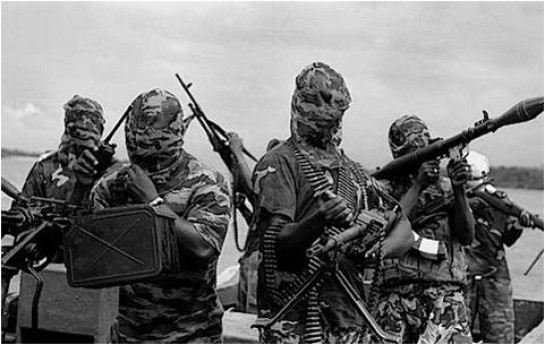
1. Boko Haram has threatened to kill all Southerners (read: Christians) in the north if their demands of religious reform are not met. The attacks have already begun.

2. Occupy Nigeria has threatened to grind Nigeria’s export economy to a halt if their demands to maintain the fuel subsidy are not met. The deadline has been extended until Tuesday.

Facing a potential civil war and economic collapse, the Federal Government of Nigeria must act decisively.  There is no quick-fix.

There Might Be Blood – Subsidy Strikes

Who is Drinking Nigeria's Milkshake?

Nigerian oil and gas workers have threatened to shut down the Nigerian oil market, deepening the strikes against the withdrawal of petrol subsidies.  The government and unions are locked in talks which have been extended by two days as of today.  This leaves the government until Tuesday to find a solution or face economic meltdown.

The Petroleum and Natural Gas Senior Staff Association of Nigeria (Pengassan) have put all production platforms on red alert in anticipation of a shutdown. This demonstrates the lack of optimism in resolution being reached in time.

The crisis in Africa’s largest oil exporter has already had an international impact. Oil prices have already risen in anticipation of the shutdown and Nigeria’s export reserves would only last for six weeks.

Brent Crude prices have risen by $1 per barrel in a single day and in a global crude market already shaken by conflict in the Middle East and North Africa, a shutdown in Nigeria could have expansive ramifications. In an election year the last thing a US incumbent would like to see is a pinch at the pumps.

While the true international impact of the crisis is yet to be fully realised, it has already had a devastating impact domestically. The price of fuel has already more than doubled and the prices of other goods, including food, are skyrocketing. People are struggling to get to work, to put food on the table and to run their electricity generators. If the strike turns violent it is these people who will suffer.

Subsidies are seen to be the only benefit most Nigerians receive from the vast oil riches of the country. The argument for their removal is that they cost the state $8 billion per year in funds that could be better used on infrastructure and development. In a country in which government corruption is rife and the trust in the state is dangerously low it is clear that the people would like to see the money conferred through subsidies rather than pilfered by the ‘1%’.

The subsidy involved a huge amount of corruption but its removal does not equate to the removal of the corruption. It is merely a relocation.

Spreading Terror

The north of Nigeria is ‘sliding towards a full-blown guerrilla war’ according to The Economist. Boko Haram bombing campaigns have intensified since the Christmas Day attacks and acts of retribution have been carried out in the Christian south. The burning of a mosque in Benin City, southern Nigeria, demonstrates the dangerous roadmap the northern insurgency could instigate.

Fears abound over the potential links between Boko Haram, a small cult whose primary objective is the removal of secular education, and al Qaeda in the Islamic Maghreb.  Assertions of a broader terrorist network were originally purported by sources in the American military (AFRICOM) and the Algerian Government but on Tuesday this fear was also echoed by the United Nations.

Secretary-General Ban Ki-Moon has stated that ‘concerns will increase’ as the popularity of Boko Haram grows. The alleged sophistication of the attacks, especially the bombing of the UN in Abuja, has provided some substance for these assertions but the most recent activities reflect burgeoning brutality, not capability.

Goodluck Jonathan has responded to the fears of a vast terrorist network by closing the borders of the country. Nigeria’s international borders are now operating on high alert as the latest measures demonstrate the degree of force the Federal Government is willing to use to achieve peace and stability across the country.

Elevated force does not necessarily provide a solution for the state.  They are fighting a guerrilla organisation, galvanised by support from those who fear the encroachment of an over-zealous central government.  Memories of egregious state violence mean that heavy state mobilisation is likely to increase rather than diminish the allure of the Boko Haram message to those who feel alienated from the state.

Will Things Fall Apart?

The Occupy Nigeria protests and Boko Haram attacks are entirely separate movements with the common theme of opposing the Federal Government of the country. With opposition to government threatening the security and the economy of the nation questions abound over the future of Nigeria.

Jonathan has announced palliative measures the mass production of buses to ease the transport issues in the country as well as reducing government salaries by a quarter (although they remain obscenely high in such an impoverished nation).

The most recent response to Boko Haram has been a change in language. Jonathan has acknowledged that the support base may be more than purely criminal. In his speech on Monday he admitted that there may even be members of his government that identify with the organisation.

Talks with Occupy Nigeria have been extended by two days but there is a general lack of optimism for a rapid resolution. Boko Haram are intensifying their attacks and flickers of retribution have begun in the south. At present neither crisis shows signs of abating and the Federal Government is floundering.

Nigeria is being plunged into a future which looks ominously similar to its past. In this scenario ‘Blood and Oil’ appears rosy.

______________________________________________________________________________________________________________

For more on the recent crises in Nigeria and terrorism across West Africa see these articles on InPEC:

The State of Terrorism in Nigeria: The Rising Threat of Boko Haram

Photo Essay: 6 Reasons Terrorism is Gaining Momentum in Northern Nigeria

Securing Emptiness: The Sahara Desert and the Global War on Terror

The State of Terrorism in Nigeria: The Rising Threat of Boko Haram

In this article the author assesses the rising threat of the Nigerian terrorist organisation, Boko Haram.  The most recent spate of bombings and executions has raised questions over the unity of the Nigerian state and the future of security on the continent.  It is therefore necessary to understand why Boko Haram is increasing in popularity as their attacks become increasingly barbaric.


By Jack Hamilton, 14 Nov, 2011

Unchecked Massacre

Brutal attacks in Nigeria over the past week have left over 100 people dead.  A single small religious group has transmogrified into a dynamic terrorist organisation capable of rapidly changing tactics and targets in a pattern of violence responsible for over 1000 deaths in northern Nigeria since 2009.

Last week the gunmen wandered around the northern town of Damaturu killing any Christian who could not recite the Islamic creed on the spot.  Nigeria’s Defence Minister Bello Halliru Mohammed has stated that the security forces once again have control and that there is nothing to fear but his words have assured few.

The fact remains that there is still no coherent strategy to combat Boko Haram.


Rising Intensity

The nature of recent events has shocked many, even in regions where Boko Haram attacks are frequent.  Residents expressed rage at the ease with which gunmen were able to take over the city and leave bodies littering the streets.  Police stations, mosques and churches were reduced to rubble before the security forces mobilised a response.  At that point members of the group engaged in gun battles across the city that lasted for hours.

The situation in northern Nigeria is degenerating rapidly.  International observers fear that Boko Haram may already have links to al-Qaeda and al-Shabab and that the campaign of terror shows no signs of abating.

In order to understand Boko Haram it is first necessary to look at who they are, what they want and how they believe they can achieve it.

Who

Boko Haram colloquially translates as “Western education is forbidden”.  It is a claim to reject all things Western from the theory of evolution to Western-style banking.  This has manifested itself in different tactics since the emergence of the group in 2002.  Before 2009 there were no signs that the group desired the overthrow of the state and rather preached to withdraw from the institutions of the non-Sharia Nigerian nation.  It was a law banning the riding of motorbikes without helmets that would prove to be the catalyst for violence.

In July 2009 the central government sought to enforce the law on helmets.  Boko Haram flouted the legislation and was subjected to police brutality which in turn set off an armed uprising in Bauchi, later spreading to Kano, Borno and Yobe.  By the time the army had suppressed the situation over 800 people were dead across the north of the country.

Since 2009 the group has spread rapidly.  The majority of the attacks have taken place in Borno state but Boko Haram have also expanded to the northern states of Adamawa, Bauchi, Gombe, Kaduna, Katsina and Sokoto as well as the attacks on Abuja and threats against Lagos.  In addition to the geographical spread there has been a change in tactics from the localised skirmishes to strategic suicide bombing campaigns and massacres directed not only at Nigerian security forces but also international targets such as the UN.

Tactics

Boko Haram have changed their tactics over the years.  Under their previous leader, Mohammed Yusuf, the group staged mass uprisings against the police and suffered hundreds of casualties.  After Yusuf’s death at the hands of security forces in 2009 they began using tactics more in line with jihadist terrorism including the first suicide bombings in Nigeria’s history.

The attack on the UN may have been an attempt to pressure the international community or perhaps it was simply to embarrass the Nigerian state but it succeeded in drawing global attention to a burgeoning problem.  Boko Haram may be diffuse but it is expanding geographically with increasing tactical sophistication.

Composition

As Boko Haram expands the questions over their composition complicate.  According to Paul Lubeck, an expert on northern Nigeria, Boko Haram is not a single group but a collection of splinters banded under one name by the Federal Government.  One section appears willing to negotiate while others remain determined to intensify the bombing campaign.

Some statements reflect a strict adherence to Islamic law while others cite a determination for a smaller Nigerian state as their raison d’être.  If the group is as amorphous as Lubeck claims it will make it very difficult to negotiate with let alone combat.

Grievances

Economic

The structural issues of northern Nigeria have allowed Boko Haram to thrive in recent years.  In addition to acute poverty the region has a high birth rate and 50% of the population are below the age of 30.

Inequality, unemployment and industrial stagnation have exacerbated the perception that the north has been marginalised by the liberalisation of the Nigerian economy.  The question of who owns the land has not been answered since independence and the Federal State seems too far away and blighted by corruption to deal with such issues.

Political

Grievances in the north were compounded by the election of a southerner, Goodluck Jonathan, as President earlier this year.  Jonathan assumed the office following the death of the northern Muslim President Umaru Yar’Adua and many northerners believe Jonathan should have stepped aside to allow another northerner to take Yar’Adua’s place.  This would have been in line with the ‘gentleman’s agreement’ that the Presidency should rotate between the north, the south-west and the south-east every two terms.

Security

The administration is treating Boko Haram as a security issue rather than tackling the divisive subject of poverty in the north.  Abuja’s response has been to flood the north with heavy-handed military and police forces that now stand accused of human rights violations against civilians.

Politicians in the north have begged for the numbers of security forces to be reduced as police corruption has become rife.  For many in the north the police are the face of the central government.  The people feel alienated from a force they perceive to be corrupt.

Responding to Boko Haram

For many the heavy military presence in the north is the single most important hindrance in securing any negotiated peace.  The failed attempt to destroy the group in 2009 was the greatest recruitment drive Boko Haram could have hoped for, especially the controversial extra-judicial killing of the leader Mohammed Yusuf.

The current strength of Boko Haram is largely a result of such poor foresight by the Nigerian state.  As a result there is now a security vacuum in the most heavily militarised region of the country.

Flagrant myopia has created martyrs and swelled the ranks of the guerrillas.  The legal response to the killing of Yusuf is a good first step but it does little to combat the issues of poverty and corruption that are integral to Boko Haram’s recruitment.

Opposition leaders in the north claim that the government has failed to understand the amount of support Boko Haram has amongst the population.  By stating their opposition to central government and corruption the group has grown far beyond their initial religious doctrine and the government will need to find a response to the structural inequalities in Nigeria if the terrorists are to lose their supporters.  It does not appear as if this is going to happen any time soon.  It is possible that Boko Haram may actually be growing beyond the borders of Nigeria.

The Anti-Social Network?

Many experts have questioned whether the increased tactical sophistication of Boko Haram is evidence of the group branching out to international terrorist organisations, especially al-Qaeda in the Islamic Maghreb (AQIM).  A change in tack to target international organisations with large high-tech bombs has caused concern.  General Ham, head of US Africa Command, believes that the worst case scenario already exists and that Boko Haram are working in tandem with AQIM and al-Shabab in a “loose” partnership.

Hard evidence for any such link is still to be produced.  The geographical distance between AQIM, Boko Haram and al-Shabab make such a partnership unlikely and the possibility remains that the increased military technology may have come from within Nigeria itself.  Alex Thurston, an expert on terrorism in the region, has posited that it is more likely the sophistication came from disaffected Nigerian soldiers than any international training.

The Future State of Nigeria

The failure of the government reactions have meant that Boko Haram has been successful in achieving one of their primary goals: the weakening of the legitimacy of the state.  Attacks on international organisations have created increased pressure on Jonathan to find a solution to the problem.  The short-term solution of heavy military deployment may eventually yield similar successes to those against the militant groups in the Niger Delta but it would also undermine the cohesion of Nigeria.  This would also act to provide momentum for Boko Haram.

The failure to develop a clear strategy to combat the small Islamic group in 2009 has forced the Nigerian state to face up to the larger structural issues concerning the north.  A solely military solution is no longer feasible.

The Lighthouse in the Desert


By Jack Hamilton, 9 Oct, 2011

Folklore spills across time creating and undoing history as it ebbs. Whole identities can be constructed and deconstructed in these stories but it is rare in these ages that entire maps can be reimagined due to a single small tree. The old addage “so geographers in Afric maps, with savage pictures fill their gaps” has long since faded but this is a story about one such ‘gap’, the one piece of life within it and the price of life that goes with it.

The Sahara Desert is awash with a sandstorm of whispers and this particular spec is the lonely Tree of Ténéré. It is a story which entails trust amidst gossip as well as the dangers of blind trust in a terrain in which one can see for miles. Upon first hearing the story I didn’t believe that such a tree could ever have existed. In recent weeks a terrorist cell linked to al-Qaeda was undone by their belief that the tree still existed. However, I must start by describing the story of the tree.

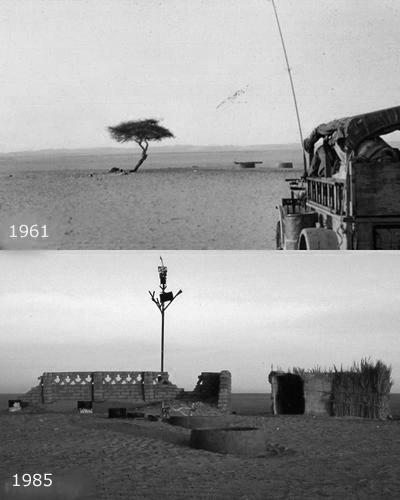
There was once a solitary tree standing in the centre of the Sahara Desert. Between the Baobabs of Senegal and the Olive Trees of Tunisia remained one sole survivor of a bygone era. Millenia ago the tree had been part of a great forest which had gradually died off as the Sahara became the inhospitable mother she is today. One tree remained to guide all those who dared to traverse the barren lands. It was a beacon: the lighthouse in the desert.

The nomads of the desert alone knew of this tree and used it as a tracking mechanism when traversing the most desolate depths of enduring beige. When these Tuareg would encounter the Fulani in north east Mali they would recount their tracks in order to let the Fulani know of their passage, including the waypoint of the tree in the middle of the desert. Having listened politely to the detailed directions the Fulani would thank the Tuareg and see them on their way providing that no disagreements had been reached.

At this stage the Fulani would all agree never to follow the route of the Tuareg. These men had seemingly been driven dangerously insane by the desert. Of course, there is no chance for a tree to exist in such a place. There are no trees for hundreds of miles in the Sahel (the shoreline of the desert), let alone the Sahara. If this route had a proclivity for perverting the minds of the fearsome Tuareg, it was no place for men.

This story circulated until the times when modern technology made it possible for mere mortals to take the route. Safe inside the machinery that would be used to fight the Second World War, Europeans were able to cross the desert here in hopes of cutting off a rival. It was at this time that they too believed themselves to have gone insane too as in the horizon the withered spectre of an acacia tree loomed. They had not been in the desert long enough to have reached the Libyan coast and had not crossed the Italian lines that would have inevitably preceded the water. It could not be Algeria as there had been no sign of the southern Air mountains. The story was true. They had discovered the Tree of Ténéré. The most isolated life on Earth.

It is here that a part of the mystery ends. Confused and in search of the truth the Europeans (a French division) decided to dig underneath the tree and discovered a well 35 metres down. While the fairytale of the tree was slightly depleted the beacon took on a new significance as not only being the only life but suddenly becoming a redeemer of life in the harsh conditions of the Sahara. The tree was not a mirage but the literal symbol of water in the desert.

However, as with all of these stories of the desert, it ends in tragedy. In the 1970s a Libyan truck driver somehow careered into the tree, allegedly drunk. Upon hearing this part of the story I was always interested to hear how the driver could explain this to his boss. He had somehow managed to hit the only tree in a 400km radius.

The reason I was reminded of this story was due to reading intelligence reports from the security forces tracking al-Qaeda in the Islamic Maghreb (the Saharan branch of the terrorist organisation). One of the Algerian trackers claimed that they had an intimate knowledge of the desert and in the pursuit they had passed the Tree of Ténéré. Today in the place of the tree stands a simple metal sculpture representing the optimism of the tree. Unfortunately the tracker described in great detail the tree as it looked before the 1970s, exactly the description that was recounted to me. It was clear that the ‘trackers’ did not know the desert and had possibly never crossed into Niger where the tree used to stand. They were found out immediately.

The idea of the Tree of Ténéré had always seemed to me like one of the lies which whispers around the desert. It brought a smile to my face that the myth was actually the truth and it was this fact that unveiled the fiction.


Jack Hamilton can be followed on Twitter @jmhamilton