Is Mali the ‘next Afghanistan’?

This article is a re-publication of a piece by Andrew Lebovich on his website, al-Wasat.  It analyses the popular attitudes on the security situation in northern Mali to look at the potential risks to international security and the risks that are, at present, overstated.

Mr. Lebovich is a contributor to the popular foreign policy blog The Washington Note, and his work has appeared at ForeignPolicy.com and The Atlantic Online. He also writes a formerly weekly, and now twice-weekly brief with Foreign Policy on legal issues in the struggle against terrorism, the Legal War on Terror (LWOT).


By Andrew Lebovich, 13th June, 2012.

The title of this post is a question I’m seeing more and more, and it reflects the growing concern in Washington, Paris, and African capitals that the security situation in northern Mali is spiraling out of control. In this kind of environment, bad news tends to echo loudly and quickly. The most recent example of this is the strong reaction in the international press to an interview Nigerien President Mahamadou Issoufou gave to France 24 this week, in which he said that Afghans and Pakistanis were in Mali training fighters, in addition to confirming that French hostages held for nearly a year and a half by AQIM were in “good health” and still alive. This news has garnered quite a bit of attention, especially in the Francophone media, though it should be noted that RFI reported the presence Pakistani trainers in Timbuktu and in Kidal a month ago, to considerably less attention. Still, this and other signs of the degradation in the security environment in northern Mali and the growth of AQIM have spurred speculation about whether or not northern Mali was becoming a “West African Afghanistan“, a new Somalia, or a jumping-off point for terrorist attacks elsewhere.

While I think some of this concern is warranted, I think some of this language and concern may be, for the moment, a bit overwrought, as I will explain in this piece. This post is my attempt to sort through some of the current popular attitudes about the security situation in northern Mali, the very real risks to regional and international security that may be looming in the north, and the equally real constraints on militant groups attempting to impose shari’ah in northern Mali or project force beyond Mali’s already porous (or nonexistent) borders.

Continue reading

Tinker, Tailor, Soldier, Guantanamo: Can Intelligence Agencies be Democratic?

In this article the author questions whether the methods being used to combat domestic terrorism are in fact contrary to the values they seek to protect. Using the case studies of the US and Pakistan, Camille Maubert looks at the discrepancy between democratic ideals and the often scandalous actions of intelligence agencies.


By Camille Maubert, May 15th, 2012

The superiority of democracy as a political system has become paradigmatic. In effect, it is known to be the best way for a state to simultaneously assert authority on its citizens and protect their basic rights from excessive uses of power. Yet, intelligence agencies are democracies’ Achilles’ heel. Scandals – from Watergate to Abu Graib – penetrated the layers of secrecy and exposed the discrepancies between democratic ideals and intelligence activities.

Continue reading

Can the American and Pakistani Positions on Islamic Militancy be Reconciled?

In this article, the author delves into the relationship between the United States and Pakistan in context of the Islamic Militancy in the extended region of Afghanistan-Pakistan. 


By Camille Maubert, 10th April, 2012

In 2001, Pakistan allied itself with the US on the grounds that it would assist in the War on Terror’s effort to tackle terrorism. At the time, the two countries’ interests seemed to coincide, as they had a common target – Al Qaeda and foreign fighters. Yet, from 2003 onwards, the expansion of the American war against the Taliban and its increased pressure on Pakistan to act against the Islamic militants who use the Afghan-Pakistani border to provide the Taliban with safe havens put the Pakistani leadership in a difficult situation. The unpreparedness of Pakistan to answer the US’s demands to repress these groups led to the current diplomatic standoff whereby there seems to be no alignment of strategic interests, let alone coordination between the US and Pakistan, and their respective policies remain fundamentally adversarial.

The premise of this study is to challenge the current understanding of the situation, which is overwhelmingly based on perceptions and representations rather than real insight into Islamic militancy.

Islamic Jihad or Pakistani Nationalism?

Despite the consensus on the decisive role played by militant organizations like the Lashkar-e-Taiba (LeT) and the Haqqani network in providing safe havens, logistical support and training to Taliban fighters, important questions like “who are the militants, who is supporting them and why?” are overlooked.

There is a strong argument that the reason why Islamic militants have such an overwhelming presence in the Afghan-Pakistani border region is because of the radicalisation of the population by madrassas and its sympathy for the jihadi ideology. Such an approach is flawed as it conveys a stereotypical understanding of the militant reality, and overlooks the deeper psychological and political fault lines underpinning it. Indeed, Islamic militants are fighting a revolutionary jihad for ideological purposes, to reform the state and impose a radical version of Islam. Conversely, most Pakistanis practice a more moderate version of Islam and thus do not support radical groups out of sympathy for their ideological agenda. Rather, those who join militant groups put forward reasons that stem from collusion, misinformation, support for the Afghan jihad and, mostly, Pakistani nationalism. Indeed, invasive American actions (drone strikes) have propped up support for militant groups out of patriotic sentiment. In other words, militant organisations have hijacked the nationalist concept of jihad as used during partition, and widely supported by Pakistanis, to justify violent action (against American infringements on Pakistani sovereignty and denounce the subordination of Pakistani leaders to American will (A 2009 Gallup Survey reveals that 59% of Pakistanis consider the US as the biggest threat, while only 11% chose the Taliban). As a result, support for Islamic militants spreads more easily through the various layers of Pakistani society, as they claim to act in the defence of the Muslim nation from external domination.

Therefore, it is the failure of Western analysts to make the distinction between ideologically motivated militants and nationalist Pakistanis that makes cooperation difficult. In the US, the post 9/11 environment and the need to mobilise people against terrorism promoted an unsophisticated understanding of what Islamic militancy is about by having the media “fuse shots of Osama Bin Laden, veiled women, (…) and riots in Kashmir and Palestine, thereby lending the visual impression that the West is confronted with a crazy, irrational faith” (Majid 2010:101). This securitisation of Islamic militancy is intrinsically flawed because it promotes an all-encompassing understanding that merges ideological and nationalist agendas into the same threat, making its targeting indiscriminate and, ultimately, counter-productive. Conversely, the Pakistani approach to Islamic militancy recognises that some elements – the Pakistani Taliban – do represent a threat, but it also acknowledges that it cannot crack down on those organisations as most jihadi groups historically enjoyed state sanction to wage jihad against the state’s enemies in the name of Islam and the Nation. Therefore, it is necessary to explore the relationship between the Pakistani state and Islamic groups in order to understand its reluctance to implement direct military action against them.

Islamic Groups as Pakistan’s Strategic Asset

Were the Pakistani civilian government willing to cooperate with the US, such commitment would only be a shallow promise if it proves to be unable – or unwilling – to convince the military and Inter-Services Intelligence to abide by its will. Not only is Zardari’s government unable to do so – given the historical weakness of Pakistani civilian governments – but it will not, as this would undermine the Pakistani strategic doctrine as a whole. Indeed, Islamic militants have been and remain the most reliable linchpin for Pakistan to project power where it matters; Kashmir. Since Partition, Islamic radicals and the army have teamed together to construct and secure Pakistan’s sovereignty and identity through the tactical use of guerilla warfare in Pakistan’s border regions.

Therefore, the reason why Pakistan does not – and will not – act against Kashmiri-based groups is that its whole foreign policy is founded upon issues of (Muslim) national identity, meaning that it uses militancy to challenge the Indian regional domination. Since this discourse informs Pakistan’s very identity narrative and exercises a powerful hold on the national imagination, it is impossible for Pakistani leaders to renounce it, especially as its influence has been reinvigorated by the fight for (Muslim) freedom in neighboring Afghanistan.

Similarly, Afghanistan is an aspect of Pakistan’s Indian policy. Indeed, Pakistan’s actions in Afghanistan are determined by its entrenched fear of encirclement and the necessity to limit Indian influence at its Western flank. Successive governments have therefore maintained strategic links with Islamic groups in Afghanistan and supported a proxy war aimed at undermining Indian assets. Interestingly, the post 2001 security environment increased the links between Kashmiri and Afghan groups, thereby strengthening the legitimacy of local groups and undermining the ability of the state to identify and target specific individuals.

However, this apparent predicament serves Pakistani interests in the long term; Aware of the need to preserve strategic depth against India and a friendly government in Afghanistan, Pakistan has no interest in withdrawing support to Afghan Islamic militants and the Pakistani groups that prop them up.

Questions like “how much support these groups truly get from the army and the ISI, and how much of it is provided by independent individuals”, remains unanswered. Yet what is clear is that the problem to which Pakistan is confronted with regards to Islamic militancy is one of control. Pakistan is in a situation where the state created organisations on the basis of identity for (geo)political purposes but has lost control over them as they were reinforced by traditional values and developed a life of their own. In effect, not only are Islamic organisations attractive to some sections of the population, they also are ingrained in the state apparatus – they recruit retired personnel from and have relatives working for the army. Given the kinship base of the Pakistani society, this makes them extremely difficult to root out. Consequently, Pakistan understands that disarming the militants would cause more damage than turning a blind eye, as it may lead to an internal conflict of interests within the army between pro-Western and nationalist elements. Such situation, it has been argued, would provoke the collapse of the only strong institution able of holding the state together.

Furthermore, the areas in which militancy is highest are those where the state doesn’t exert authority or governance – North West Frontier Province, Balochistan, Kyber-Pukhtoonkhwa. In these areas, the pre-eminence of Islamic organisations is all the more important that they fill the power vacuum and provide the population with social services that the state is failing to supply. The most notable example is that of LeT’s charity wing Jamaat ud-Dawa (JuD). After the 2005 earthquake and 2010 floods, JuD provided immediate relief to the population and further integrated itself at the grassroots level. As a result, LeT has been increasingly able to act independently from state sponsor, another reason for Pakistan not to provoke any rupture. What is needed, therefore, is a solution that acknowledges the structural weaknesses of the Pakistani state, the strength of its society, and promotes negotiation rather than coercion.

A Path to Reconciliation?

The difficulty with both US and Pakistani positions is that they are directly reliant on the states’ narratives. In that sense, finding a solution implies that they would have to compromise on those narratives. This is unlikely to happen since, on one hand, the American demands are based on the deeply entrenched ideological principles of the War on Terror, and, on the other hand, the Pakistani reluctance to comply is rooted in the certitude that militants are necessary to its regional strategy – and to an extent its national identity.

These discursive incompatibilities are reinforced by the process of securitisation at play. By framing Islamic militancy as a security threat, the US – and some pro-Western Pakistani civilian leaders – has promoted a military solution, which limits are becoming more visible. The protests steered by drone strikes and the backlashes met by the Pakistani army in Federally Administrated Tribal Areas and North West Frontier Province demonstrate that the use of force is ultimately inefficient as it increases anti-Americanism, steers sympathy for militants, and further disturbs Pakistan’s unstable political landscape.

As observed above, the reason why cooperation has so far failed between the two allies is the mismatch of each other’s vital interests. While the US demands are informed by the short-term requirements of its Afghan strategy, the Pakistani position is determined by a long-term approach to militancy and regional security. In addition, the securitisation process has led to a situation where the US promotes an all-encompassing definition of the militant threat which pushes for the elimination of all organisations linked to Islamic militancy. But what it fails to understand is that Islamic militancy is deeply rooted in the Pakistani society and state apparatus and, as such, it cannot simply be isolated or suppressed.

Therefore, any solution to the problem posed by Islamic militancy would have to acknowledge that it is not only a security threat but rather a socio-economic and nationalist phenomenon. Additionally, it would have to recognise Pakistan’s structural weaknesses and its lack of capacity to impose its will on some sections of the population. Pakistan is a negotiated state, which means that coercive measures from the top-down are unlikely to be successful if they are not supported by local stakeholders. In finding a solution, Pakistan itself has a role to play, as it would have to acknowledge its need for a consistent strategy against its home grown militants – which it lacks so far – to ease cooperation with the US and start to positively engage the militants.

There is a growing understanding that soft power is ultimately more likely to successfully change militant behaviours and counter the growth of violent extremism as it impacts directly on the grass roots level. Indeed, long-term American engagement in issues like education and development would decrease its perception by the population as a security threat and help diffuse more positive representations. Tactical attempts have mostly proven to be successful, as shown by the American help in flood relief in 2010. However, this policy so far happens to be unsuccessful on the strategic level as its positive contribution in winning Pakistanis’ hearts and minds is outbalanced by the negative impact of drone attacks. Therefore, in order to decrease the scale of Islamic militancy, Pakistan would have to restore its sense of sovereignty, which means that the US would have to cease its activities across the border. At the time of writing, such evolution is yet to happen. This is due to the intense climate of mistrust that characterises the relationship between the US and Pakistan, whereby neither side seems to be willing to tone its rhetoric – and demands – down for fear of being thought to make concessions on its narrative.

Islamic militancy highlights the complexity of the US-Pakistan bilateral relation by confronting their intrinsically different strategic and identity narratives. One demands a rapid military solution, the other prioritises its long-terms interests, and both are informed by domestic pressure and ideological discourses. Only when those uncomfortable realities are acknowledged will dialogue be possible. Ultimately, the militant challenge puts the ability of the two allies to engage in a long-term partnership to a test as it will show whether conflicting demands can be complemented by common goals.
China in Afghanistan: Valuable Ally or Emerging Threat?

In this article, the author explores the competing US and Chinese discourses on China’s Peaceful rise strategy, using the PRC’s economic involvement in Afghanistan as a case study. It argues that although China’s interest in Afghanistan is perceived and framed as a threat by the US, it also represents a momentous opportunity for Afghanistan and its neighbors.


By Camille Maubert, 17th March, 2012

Karzai’s attempt to build an Afghanistan with American democratic characteristics and Chinese economic dynamism highlights the delicate positioning at play, whereby Afghanistan is subjected to different and sometimes contradictory foreign influences. Indeed, while the US is the biggest player in Afghanistan, China is also preparing to assume a long-term role in the country. In fact, the successful Chinese Metallurgical Corporation’s bid on the Aynak copper mine in Lowgar province, worth US$4 billion, promoted China as the largest single foreign investor in the country’s history. This had the West shudder by reminding it how powerful – and potentially threatening – a neighbor the People’s Republic of China (PRC) is.

“We do the heavy lifting and they pick up the fruits” – the American narrative

Since 2001, China’s involvement in the country shifted from disinterest to ever-growing investments in the country’s infrastructures, mineral wealth and agriculture. However, its expanding commercial interests are deeply controversial because of their political reach. Indeed, China, who has gained control of strategic assets without shooting a single bullet, has been accused of free-riding on the stability provided by the American troops in order to secure access to natural resources. In fact, American troops not only bring general security in the Logar province, but they also trained the 1500 Afghan National Police soldiers who are directly protecting the infrastructures.

This behavior is perceived as unacceptable because of China’s refusal to share the International Security Assistance Force (ISAF)’s burden. Indeed, the Chinese Foreign Ministry Spokesperson, Mr Gang, made it clear that it is “out of the question to send Chinese troops (…) in Afghanistan” and discounted NATO’s request to use the Wakhan corridor for logistical supplies. This is interpreted as an indirect confrontation with US interests and goals in the region; and seen with suspicion by the West. Arguably, it is assumed that there is a correlation between increased economic power and amplified political weight; that is to say that because China expands its economic assets in Afghanistan, it will inevitably increase its political influence by the same token. Some indeed fear that China’s business in Afghanistan and Central Asia could alter the balance of power in areas vital to the US’s strategic interests.

By shunning away from any major security role and distancing itself from ISAF, China conveys the image of a profit-focused actor who utilizes its powerful national companies to expand influence in Afghanistan and who doesn’t balk at dealing with rogue actors. Indeed, while China benefits from the US tackling transnational Islamic terrorism, it also adopts a very cautious and balanced diplomacy with both the United States and the Taliban: Being a direct target of terrorist activities because of its policy on Xinjiang’s Muslim minority, and Aynak being located in a potentially Taliban-controlled area, China is in effect willing compromise with all regional actors to maintain stability.

However, the depiction of China’s involvement in Afghanistan and the wider region as a threat to Western interests is biased by the widespread “China Threat theory” which impregnates Western analysis. Because Western interpretations of China’s role in Afghanistan derives from the way the West sees China –as a threat – and the way it sees itself – as liberal and benevolent – it is fair to assume that an examination of the Chinese discourse is needed in order to grasp the other side of the story.

Afghanistan and the Direct Investment Model – The Chinese narrative

What distinguishes China from other actors in the Afghan reconstruction is its outstanding ability to project funds into unstable and high-risk areas. Indeed, its national companies have the capability to deal with risks associated with investing in remote and unsecure regions where Western companies cannot – yet – penetrate. The China Metallurgical Group, by accepting the risks associated with such investment and adding incentives like the building of infrastructures – power plant, hospital, mosque – outbid the West.

The comparative advantage of China over American and European investors is rooted in its Direct Investment model, which offers loans below market rates and have the attractive feature of not associating economic development with political reforms. Indeed, while Western donors and investors condition aid on democratic and human rights improvements, for developing countries like Afghanistan, China’s policy of non-intervention in internal affairs is appealing because it allows them to prioritize economic development. This strategy has been criticized in the West because it is seen as providing support for authoritarian regimes; but, so far, it seems more successful in bringing stability to war-torn countries that Western humanitarian and counter-insurgency missions. Based on successful results in Africa, this macro-level system will have a positive impact on Afghan stability in that it will promote a virtuous circle of economic development in the wider region – Central Asia, Xinjiang, Afghanistan – and will reduce Afghanistan’s dependence on international aid, therefore advancing the wider American goal of stability.

The reason for and implication of such strategy resides in China’s primary security interest in its Western province of Xinjiang. The PRC is indeed most concerned about cross-border terrorism coming from its Western and Southern neighbors. Despite the militarization of its borders and the increased security cooperation with the Shanghai Cooperation Organization, China is very vulnerable to Islamic militancy spillovers from Afghanistan and the Pakistani safe havens. Hence the implementation of a cautious policy of economic development and support to Afghanistan’s reconstruction which enforces stability while at the same time remaining distant from the US initiatives to avoid being associated with the controversial War on Terror.

By providing training to the Afghan police and anti-drug factions, investing in local resources and promoting cooperation between Central Asian governments on the “three evils” – fundamentalism, terrorism and separatism – China aims to maintain dialogue and cooperation and consolidate its long-term presence. This calculation is based on the assumption that by developing a Central Asian economic sphere – in which the opening of the Wakhan corridor would play a crucial role in reviving the Silk Road – China will securely reinforce its economic rise while avoiding becoming the target of Islamic militantism.

One could safely assume from its involvement in Afghanistan that China is pursuing a narrow interpretation of its interests. Although the PRC officially adheres to the shared principles of the War on Terror such as anti-terrorism – from which it profits to legitimize its Xinjiang policy – or anti-narcotics, it also rejects the all-encompassing US strategy and rather prioritizes domestic security and development. Indeed, China claims that far from seeking regional hegemony, it wishes to preserve the international order and pursue its national interest within it.

Afghanistan at the cross-roads of the US-China agendas

What stems from those two conflicting narratives is that the stereotypical distinction between a disinterested West and a voracious China is not relevant in the sense that it stems from ideological perceptions rather than rational observation. Consequently, the idea of China as a threat doesn’t stem from the reality of it as an expanding power but rather from “perceptions, especially those regarding the potential that Beijing will become an example, source or model that contradicts Western liberalism as the reigning paradigm” (Stephen Chan 1999). Indeed, because China, by making profits in Afghanistan, doesn’t fit in the normative expectations of the US on how it should act, it is displayed as a threat to global peace. This means that the idea of China as a threat to the regional status quo is more a self-fulfilling prophecy than an actual reality in the sense that, by framing China as a menace, the US may not only push it towards brinkmanship but also lose its attractiveness to the Afghan government and people, and therefore further get bogged down.

Afghanistan is the place where two narratives and strategic cultures met – the Western fear of losing its hegemony and the Chinese confidence in expanding its economy. Because China’s domestic and economic concerns shape its approach to foreign policy, it is engaging with Afghanistan in its own terms, which is understood as a threat by the West but also as an unmatched opportunity by Afghanistan.

Afghanistan in transition: a reporter’s diary

In this post, the author shares notes taken during his attendance to a popular TV show night in Kabul, called ‘Kabul Debate Live’, where participants and audience discussed the issue of ‘Reconciliation with Taliban’.

From the same author:

Photo essay: Stories from Kabul, Part I
Photo essay: Stories from Kabul, Part II

_____________________________________________________________________________________

By Abhishek Srivastava, 26 Jan, 2012

It was just before 11 at night, and I was thinking of calling a cab, when Dr Walid drove up and offered to drop me at my guest house. On any other day, travelling by road would have been an affordable risk to take in Afghanistan: a country fraught with suicide attacks, kidnappings and roadside bombings.

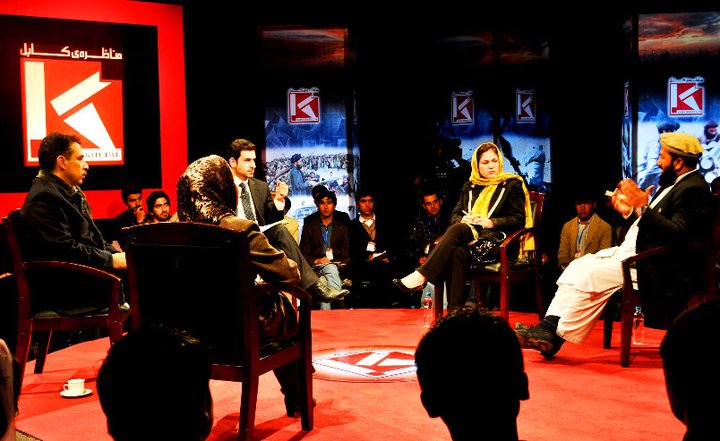
Paul, CEO of 1TV media group, had invited me to be part of a popular television debate called ‘Kabul Debate Live’. A crowd of about two hundred Afghans occupied the swanky studio of 1TV anxiously waiting to talk about the absence of peace, and to voice their opinion on one of the most closely watched debates of the country: ‘Reconciliation with Taliban’.

As the international troops begin to withdraw, especially with America announcing a complete draw down of its decade-long presence by 2014, the Obama administration is now looking at a gradual shift from a military solution to a political one.

“It is interesting and ironic to discuss Taliban reconciliation on a TV debate, when Taliban itself had banned television viewing. Even owning a TV set was a crime. Today, I have travelled a long distance to be a part of this debate. And I hope we get answers”, said Farshad, a second-year Kabul University student.

A study conducted by Altai Consultancy in October 2010 revealed that less than a quarter of Afghanistan’s population has satellite TV equipment. Cable TV is essentially an urban phenomenon, with a penetration of only 5%, while Radio, although a dying medium, has a penetration of 68%.

“TV is mostly used for movies and dramas, while news is accessed through radio sets”, said, Ahmad Rafi Maseer, a Kabul based IT consultant.

Minutes before going live, the host and the brainchild behind this ground-breaking concept, 28 year old Samiullah Mahdi is nervous. “One of the most important speakers of the day declined to participate at the last minute, but we requested a parliamentarian to be a part of the show”, said Samiullah rushing to the studio.

The guest who declined is Taliban’s former ambassador to Saudi Arabia, Habibullah Fawzi.

“It is disappointing not to have a Taliban voice in a discussion that talks about them. It says a lot about their commitment to the peace dialogue”, said Mostafa Mahmoud, News and Current Affairs Director of 1TV.

Samiullah enters the studio, followed by the speakers: Shahla Farid –a law and political science professor in Kabul University; Ahmad Wali Massoud –brother of the founder of Northern Alliance, the late Ahmad Shah Massoud; Professor Aminuddin Muzafary represents the High Peace Council –a loose group of people hand-picked by President Hamid Karzai to broker peace with the Taliban; and Fawzia Kofi –a Member of Parliament from Kabul.

What women want, is rarely a concern’

“Reconciliation with Taliban”, says Sami, throwing open the debate.

“We need to include women in any kind of peace dialogue. Women play an important role in nation-building” interjects Shahla Farid.

It is well documented that groups like Taliban and Hiz-i-Islami (Gulbuddin) have been synonymous with violent repression of women in Afghanistan.

Visuals of a burqa-clad woman squatting in the middle of a Kabul stadium, while bullets were sprayed into her skull point-blank with a Kalashnikov by a Talib, shocked the world and brought to light the barbarism of Taliban rule.

“I don’t think peace talks with the Taliban are possible because of our past experience. During the Taliban regime, women couldn’t go out; they couldn’t work or get an education. The Taliban would rather see a woman die in the streets than go to a restaurant to get food if men were around –these are the kind of people we are talking about”, said a female parliamentarian, on condition of anonymity, in an interview to Human Rights Watch (HRW).

Since the fall of the Taliban, women in Afghanistan have gained some rights and freedoms, but there are still insurmountable problems.

“I personally think the opinion of women is not given much importance in Afghanistan. But looking at the current situation, even if there is resistance they will be present because Americans want to include them, and Afghanistan is run by Americans right now”, intervened Mohammad Asif Ziar, while translating the debate for me, which was a mix of Pashto and Dari.

Majority of Afghan men are mired in a culture and belief system that hides ingrained misogynist policies. While they publicly preach a strict moral code and criminalise female prostitution, they procure young boys and sexually abuse them. The warlords who fought for Afghanistan and its ‘Islamic’ cause kept young boys as their sexual partners for long. Bacha Bazi (boy play) is a lucrative business in Afghanistan. “Just 500 Afghans for the boy to make your night”, said an Afghan friend, while making his offer.

Asif’s intervention reminded me of a conversation I had with a senior editor of a leading news agency in Afghanistan. He had sought my suggestion on marrying his junior colleague. The question seemed a bit odd, because he was already married, and the girl he wanted to marry was as old as his daughter. When I expressed my doubts, he said, “Afghanistan is an Islamic country, and I can marry four times, and the girl I want to marry has crossed her ‘marriageable’ age of 27, and she has no option but to marry elderly, married or divorced, or even handicapped men. So I am the best she can get. This is Afghanistan. What women want is rarely a concern”.

A large number of women in the Pol-e-Charkhi jail in Kabul are languishing on charges of ‘moral crimes’ that include premarital sex, running away from home, and adultery.

“If we intend to include Taliban in the peace process, then it is very important for them to recognise and acknowledge Afghanistan’s Constitution.  That should be the first condition, if they are to be included in mainstream politics”, said Fawzia Kofi. The audience rose in applause.

It is noteworthy that while Article 22 of the Afghan Constitution guarantees equality of both men and women, Article 3 states that no law can contradict the Shari’a. Therefore, even if the Taliban accept the constitution in exchange for power, their interpretation of the Constitution will only curtail women’s rights.

According to a recent BBC report, on November 10th 2011 the Taliban allegedly stoned and shot dead a woman and her daughter in Afghanistan’s Ghazni province. The Taliban had accused the women of ‘moral deviation’ and ‘adultery’. The attack happened just few meters away from the governor’s office in Ghazni city, a place which is yet to be transferred to the Afghan security forces from hands of International forces.

Despite the presence of international forces, there are areas that are still in Taliban control. Women face death threats and even acid attacks regularly. There are those whose lives are in danger for working for the Americans or for not following the Taliban way of Islam. But there are groups that run the risk of opposing the Taliban. Like the Revolutionary Association of the Women of Afghanistan, or RAWA –an underground group that fights for secular democracy and women’s rights.

The debate moves on. A charged audience is anxious to speak after hearing the guests. Samiullah tries his best to steer the 60-minute debate.

‘Taliban, after all, are sons of Afghanistan’

“What has your organisation done for the peace process? Did you make any headway in your talks with the Taliban?”, asks Samiullah.

“People think that talking to the Taliban and bringing them back into mainstream politics will take us back ten years. I want to say that as an organisation promoting peace, we will work only towards that end, and we will care for the rights and prosperity of the Afghans”, says Professor Aminuddin Muzafary, a representative of the High Peace Council.

Afghan President Hamid Karzai formed a High Peace Council in September 2010 to further peace talks with the Taliban and other insurgent groups as part of a reconciliation process. The composition of this 70 member group raises serious concerns over the success of peace negotiations.

Head of this council was former Afghan President, and a jihadist –Professor Burhanuddin Rabbani, who later helped the invading US army topple the Taliban regime in 2001. Others include former warlords Abdul Rab Rasoul Sayaf and Haji Mohammad Mohaqiq who are bitter rivals. Both have fought the Taliban. Sayaf is even accused of massacring Hazaras –a minority community in 1993. These men are an unlikely choice for peace-making with the Taliban.

A big blow to the peace dialogue came on the night of September 20th 2011, when two men pretending to be peace emissaries gained entry to Professor Burhanuddin Rabbani’s house, in a highly secured zone of Kabul, and brutally assassinated him by detonating a bomb, hidden inside the turban.

Assassinations in Afghanistan are an everyday phenomenon. In fact, a surge in the number of high-profile assassinations in recent months –including commander of the northern police zone, General Daoud Daoud; Kunduz Police Chief, Abdul Rahman Sayedkheli; and now Professor Rabbani– is being seen as a swift elimination of people standing in the way of peace favouring the insurgents, especially the Taliban, that is reminiscent of the civil war.

The Taliban has however, repeatedly denied peace talks. They have asserted that they will not enter into dialogue with the government until there is complete withdrawal of all international troops from Afghanistan.

The audience gets impatient. Sami finally takes opinions from the audience.

“All the council members are puppets of the U.S. government. They have been bought and are here only to serve their own interests. We don’t accept them. So there’s no point in them talking peace on our behalf, says Muzhary Fazal Rahman, a young journalist from Kabul.

“Taliban after all are children of Afghanistan. They are sons of our soil. Why alienate them? They are committing acts of violence because we are under American influence”, said an emotional old frail voice among the audience. This was followed by a mild applause, showing not many in the audience seem to agree.

“The High Peace Council is not in favour of omitting the Taliban from Afghanistan’s political ground, we want them to re-think their strategies”, said Professor Aminuddin Muzafary.

“The moment we acknowledge the Taliban and involve them in the ‘peace-process’, we give them the status of a legitimate organisation. So it’s better we avoid that”, said Ahmad Wali Massoud.

The intense debate that lasted 90 minutes ends with an audience poll. More than half (54.4%) say the Taliban should be defeated militarily. The rest want peace talks along with a withdrawal of foreign troops.

The debate did not bring out concrete solutions, but it symbolised hope and change, for about seven years ago such a TV programme with two women speakers would not have been possible.

Assassination

It was ten past eleven. I had finished dinner with 1TV crew and the guest speakers when we heard the news of the assassination of the police chief in Kunduz, Northern Province.

Realising that the situation had turned tense, Dr Walid Roshan, the executive manager of 1TV, walked up to me and offered a ride to my guest house.

The dark night had an eerie silence. Kabul’s streets were cordoned off and a large number of police vehicles with blaring sirens were zipping. Dr Walid had just hit the road when a police personal in an SUV across the road trained the barrel of his gun at us. I could not stop but shout, “Dr Walid, gun”! He immediately stopped and so did the trigger. After a brief chat with the police he continued driving. “Sorry, I did not realise they were coming. They saw a potential threat in us and they don’t hesitate in shooting”, said Walid.

As we made our way through the many checkpoints to reach the guest house, the entire day flashed in front of my eyes; that microcosm made me understand Afghanistan’s impending challenges. Especially the definition of ‘peace’ in a highly volatile and trigger-happy time of Afghanistan.

While Afghanistan assimilates the fragmented peace that prevails in the country, the Taliban and other insurgents groups continue to pull-off a series of spectacular attacks. In a big blow to the US earlier this month, Taliban shot down a US helicopter, Chinook, during a combat mission, killing 31 US special operation troops. According to a latest UN report, more civilians have died in the first six months of 2011 than any other time during this decade long conflict.

All these signs, coupled with the much talked about U.S. troop-withdrawal just as Karzai’s term ends, send out the message that Afghanistan might just slip into an abyss deeper than it was in 2001.