Grassroot Diplomat: The Power of Relationships

In this interview, young policy leader and entrepreneur Talyn Rahman-Figueroa discusses her new project, Grassroot Diplomat, and gives her view on different hot-topics, from gender through to disarmament and UN Reform.

_____________________________________________________________________________________

By David J. Franco, 31 Jan, 2012

InPEC has conducted this interview with Talyn Rahman-Figueroa at Grassroot Diplomat’s office in Central London. Ms Rahman-Figueroa is a young policy leader and enthusiastic entrepreneur with a clear goal: to bridge the existing gap between civil society and leaders. With an impressive academic and practical background in diplomacy, Ms Rahman-Figueroa set up the first Diplomatic Business Consulting firm of its kind. Five months later, Grassroot Diplomat has grown to include a team of six experts in their respective fields as projects proliferate rapidly in all continents. Despite her young age, Ms Rahman-Figueroa is determined to tear down traditional barriers and work towards moving from a culture of national interests to a culture of people interests. ‘Success depends on one thing’, she argues, and that thing is the ‘power of relationships’.

Continue reading

Research Project – Pune: A (Nearly) Waste-Free City

This post is the tenth in a series sharing findings from a research project Sam Kornstein and Paul Artiuch are working on throughout the month of January. Paul Artiuch and Samuel Kornstein are graduate students at the MIT Sloan School of Management. Throughout the month of January they are in India researching market-oriented approaches to reducing agricultural food waste.

_________________________________________________________________________________

By Samuel Kornstein and Paul Artiuch

January 26, 2012

Until now, we’ve spent the majority of our time exploring upstream agricultural supply chains – learning about what happens to food between farms and markets, before it reaches end consumers. Unlike many western countries, Indian consumers waste remarkably little food, as a use is found for nearly all left-overs and food scraps. However, this doesn’t mean that there’s no waste, and Pune, a four million person city three hours southeast of Mumbai, is implementing an innovative initiative to change that.

Continue reading

Research Project: Four Problems with India’s Food Supply Systems

This post is the ninth in a series sharing findings from a research project Sam Kornstein and Paul Artiuch are working on throughout the month of January. Paul Artiuch and Samuel Kornstein are graduate students at the MIT Sloan School of Management. Throughout the month of January they are in India researching market-oriented approaches to reducing agricultural food waste.

_________________________________________________________________________________

By Samuel Kornstein and Paul Artiuch

January 24, 2012

We’ve spent the past three weeks in India researching agricultural supply chains to see if we could uncover the reasons why an estimated 30-40% of food grown in the country goes to waste. Over this time we’ve had a chance to speak with many stakeholders to gain their perspectives on the issue. Not surprisingly, the landscape that’s emerged is quite complex. At the risk of oversimplifying some of India’s largest agricultural challenges, we’ve outlined four of the main problem areas.

Continue reading

Research Project: Smaller Markets in Rajasthan

This post is the eighth in a series sharing findings from a research project Sam Kornstein and Paul Artiuch are working on throughout the month of January. Paul Artiuch and Samuel Kornstein are graduate students at the MIT Sloan School of Management. Throughout the month of January they are in India researching market-oriented approaches to reducing agricultural food waste.

_________________________________________________________________________________

By Samuel Kornstein and Paul Artiuch

January 23, 2012

Earlier this month, we visited Azadpur Mandi, the largest wholesale produce market in Asia. We found that while the marketplace is extraordinarily chaotic, it’s actually quite efficient, and little food goes to waste once it reaches the city. Since then, we’ve spent some time in rural areas, meeting with farmers, commission agents, traders, academics, and start-up companies. It’s become clear that some of the most significant causes of food waste in India include inadequate storage facilities, limited processing capacity, government program inefficiencies, and as well as some economic challenges related to cold storage and capital investment capabilities.

Continue reading

Research Project: India’s Lack of Food Processing

This post is the seventh in a series sharing findings from a research project Sam Kornstein and Paul Artiuch are working on throughout the month of January. Paul Artiuch and Samuel Kornstein are graduate students at the MIT Sloan School of Management. Throughout the month of January they are in India researching market-oriented approaches to reducing agricultural food waste.

_________________________________________________________________________________

By Samuel Kornstein and Paul Artiuch

January 21, 2012

Fresh produce, such as fruits and vegetables, generally spoils quickly. As we’ve previously discussed, cold storage is an effective method of extending shelf life. In most cases, however, the cost of such storage is prohibitively expensive in India, stifling investment. Another way to preserve food is to process it into products, including juice, sauce, dried fruit, and jarred/canned vegetables. Processing can extend shelf life from days to years, and in many cases can add value to the product.

Continue reading

Photo reportage: 10+1 photographs of Nicaragüa

In this photo reportage, the author explores part of Nicaragüa’s beauty.

For more on Nicaragüan politics follow this link: Quo Vadis, America?

__________________________________________________________________________________________

By David J. Franco, 27 Jan, 2012

Introduction

Few places have captivated me more than Nicaragüa, the largest country in Central America, famous for its Sandinista revolution, its colonial cities Granada and León, Rubén Darío’s poetry, and the twin volcanos, Maderas and Concepción, located in that tiny island called Isla de Ometepe, in the middle of the Lake Nicaragüa. True, not all in Nicaragüa is as mystic as I’ve just portrayed. Life and drama coexist in this Central American country: politics is a corrupt matter and poverty, drugs, and crime continue to force many Nicaraguans to cross the Southern border in search for a better life in Costa Rica. Two unfortunate recent events have brought Nicaragüa back to the international stage: its 2010 military incursion into the Río San Juan, and José Ortega’s victory in the 2011 presidential elections amidst claims of fraud.

Good thing though about sharing personal experiences is that one can choose which side of the story is worth telling, and which side of the story is better left untold. In this case, I will not share with you photographs of piles of litter in the roadsides, or photographs of that place where a young lady got kidnapped one night, or photographs of the chaos reigning in border posts. Instead, I will limit this series to show you some of the beauty of Nicaragüa. Because, unfortunately, it is her beauty that is often left untold.

1.School Buses

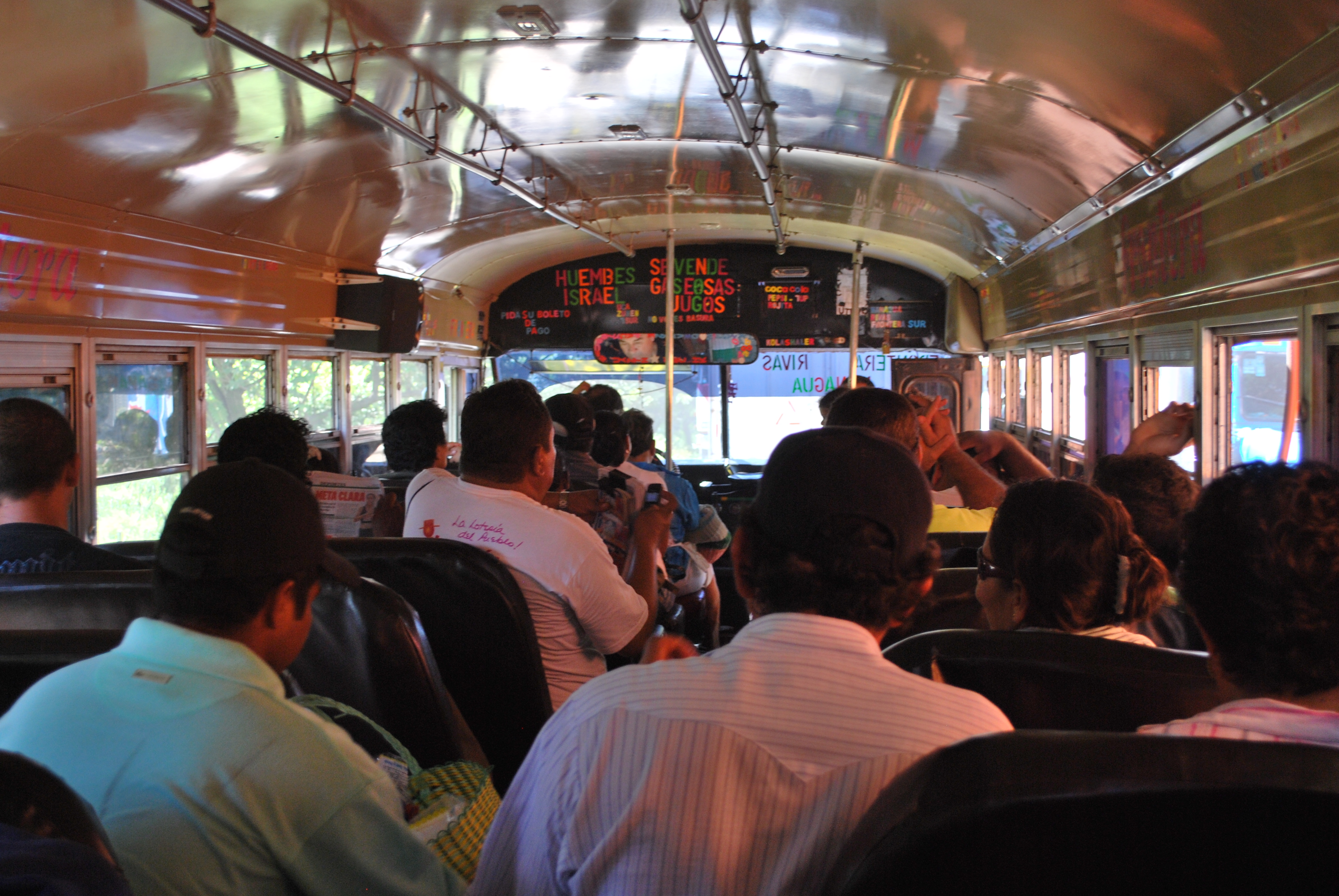
I want to start this series of photographs by showing you the interior of one of the many old decommissioned yellow US school buses that populate Nicaragüan geography. These are usually packed and not very comfortable for long distance trips (they were initially meant for US kids with short legs, not for adults carrying luggage). There is however something unique about crossing the country in these buses: their decoration is colourful, and at every stop women take the opportunity to get on the bus to try and sell all sorts of produces: from water contained in small plastic bags, to fried plantains.

2. Granada, Iglesia de la Merced

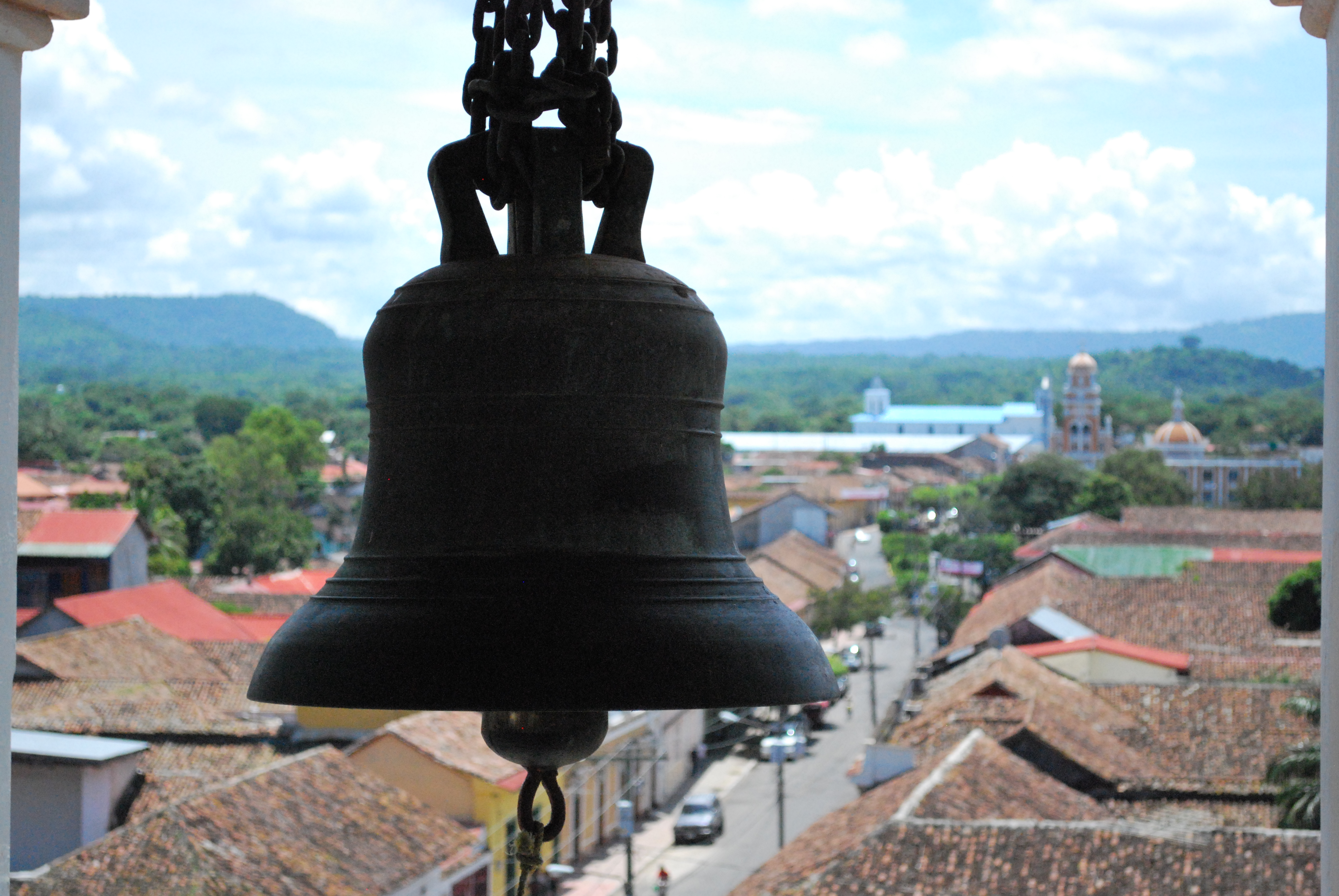
Granada is beautiful, it is silent, it is lonely. It is like many of Spain’s old cities but without the buzz. From the top of this bell tower, I could see Nicaragüa’s lake. Still, quiet, paused. It felt good, it felt as if time had been put on hold.

3. Daily life in Granada

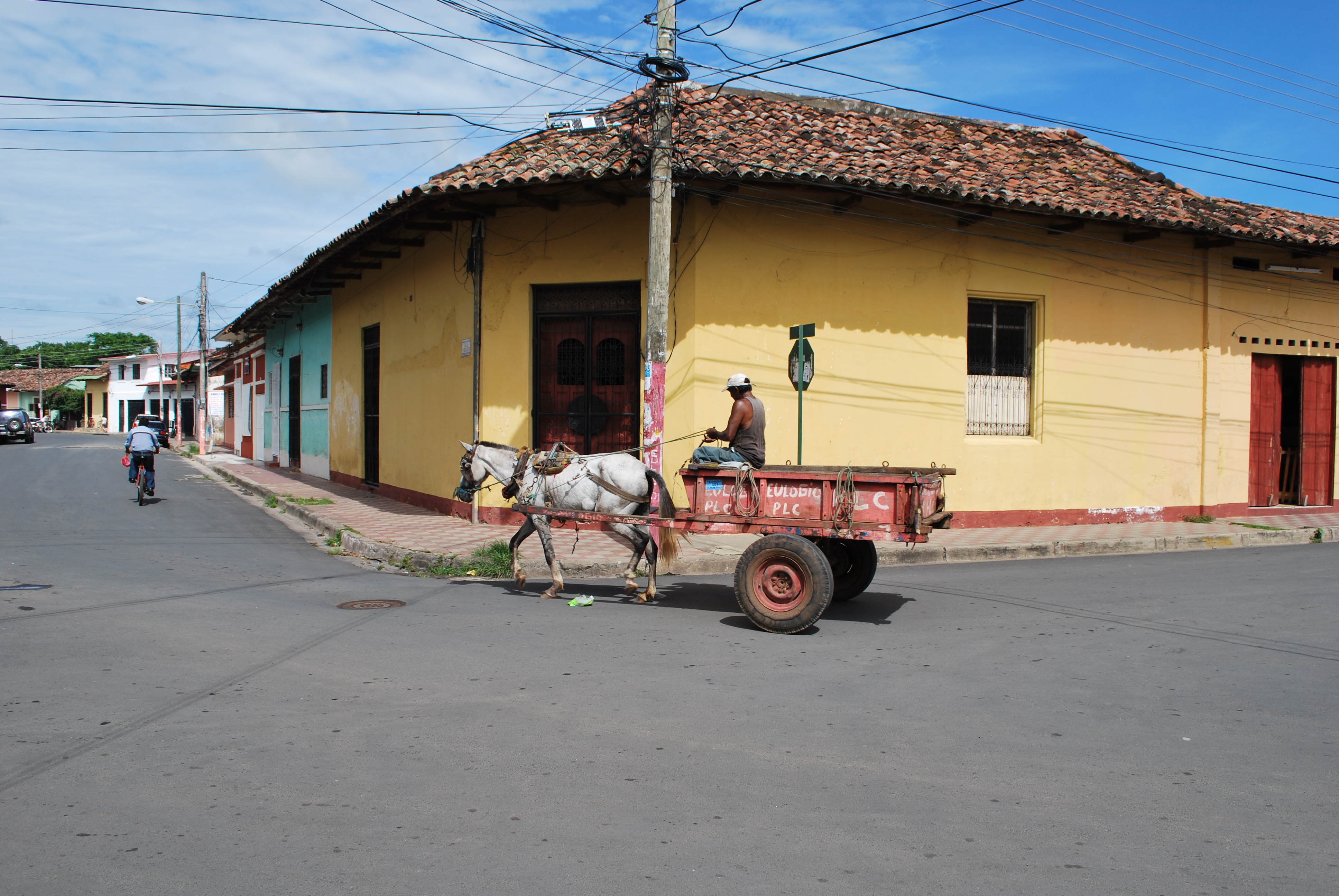
No traffic lights, no street names. Only coloured houses with the typical Spanish tyled-roof. When you ask for directions, don’t be surprised if you get the following answer: ‘walk a hundred meters down the road, then turn right, walk fifty meters and you will see the post-office. It’s ten meters after the post-office’. Skinny, hungry horses pulling old carts are a common sight.

4. Social Centre Tío Antonio

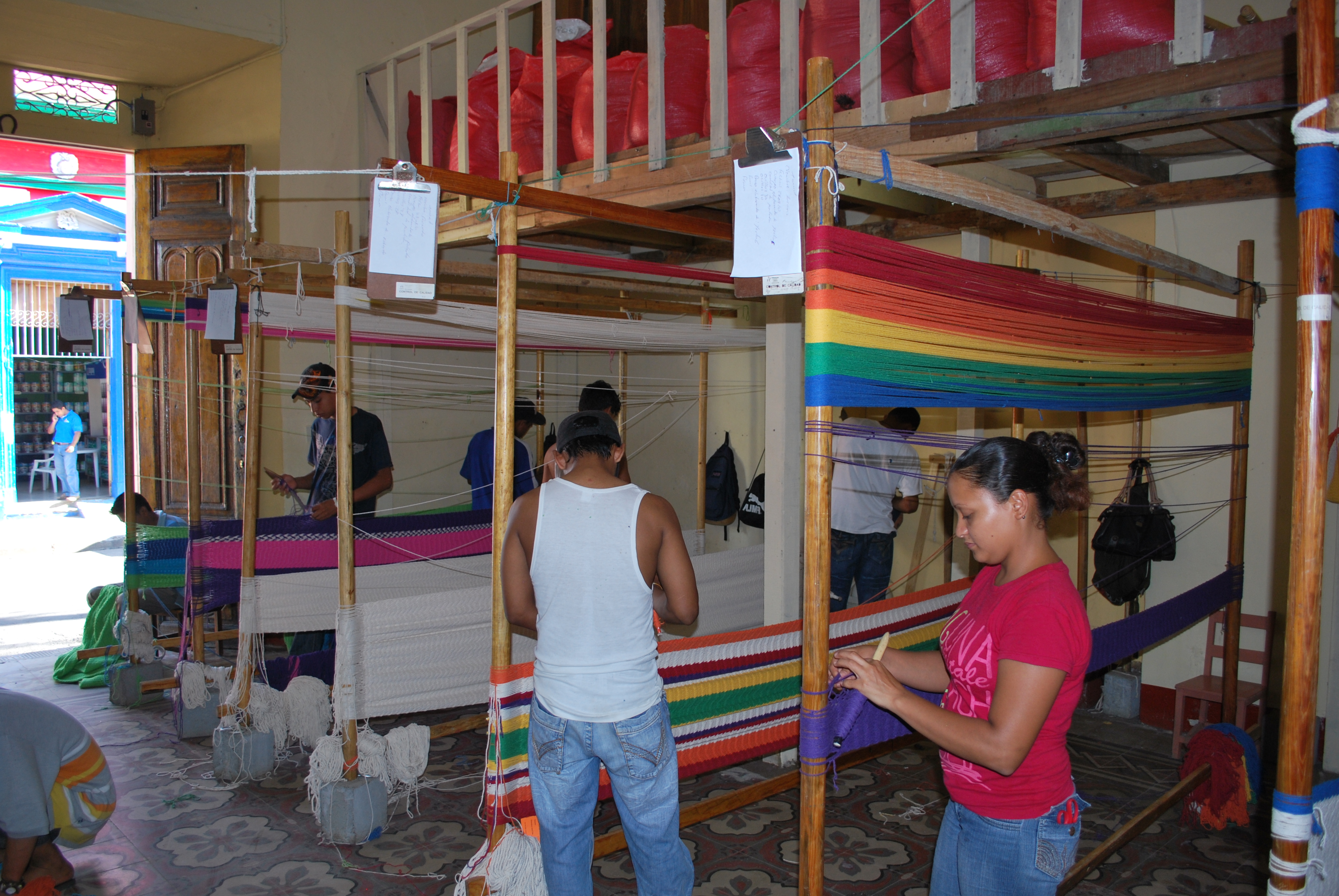
Located in the old colonial city of Granada, this social centre was founded in 2007 by Antonio Prieto, known locally as Tío Antonio. When I got there with a Costa Rican friend I was caught by the slogan of a sign governing the place: ‘Take a rest by helping others’. Though the most touristic city in Nicaragua, Granada has a large population living unde poverty line. In this photograph, impaired boys and girls knit hammocks that will later be sold to finance shelter, education, and other social programmes.

5. León, Museo de la Revolución

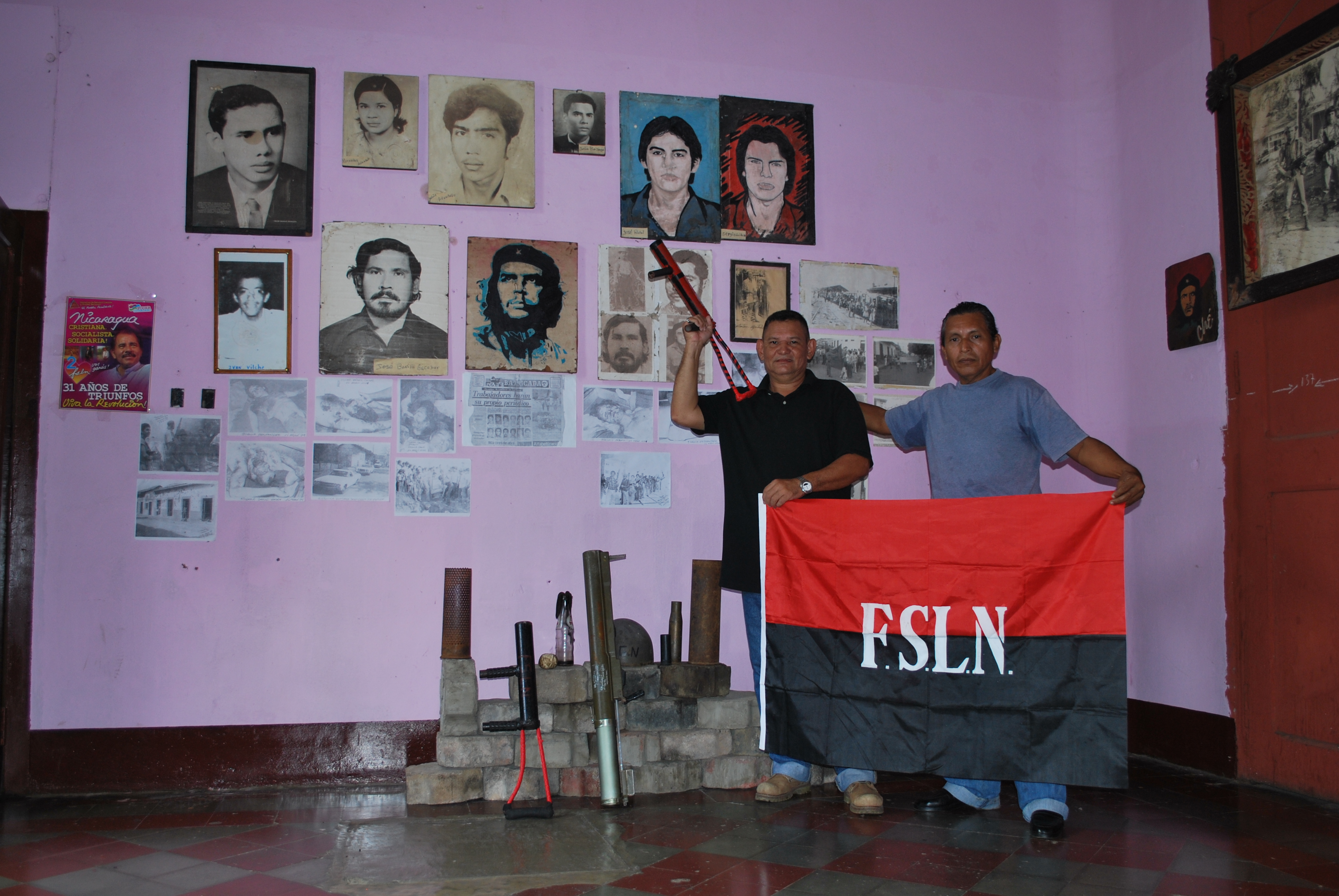
The city of León is fascinating. Compaired to Granada, it is much more chaotic and noisy. It is also more decadent and the home of the Sandinista revolution. In this photograph, two former guerrilla fighters pose at the Museum of the Revolution holding the flag of the Frente Sandinista, leaders of the 1979 revolution that ended more than four decades of ruling by the Somoza family. Upon entering the Museum I saw a big cardboard sign reading ‘No Weapons Allowed’. The gentlemen in the photograph treated me very well and even took me to the roof of the building from which we could see the Cathedral of León.

6. León, Casa Museo de Rubén Darío

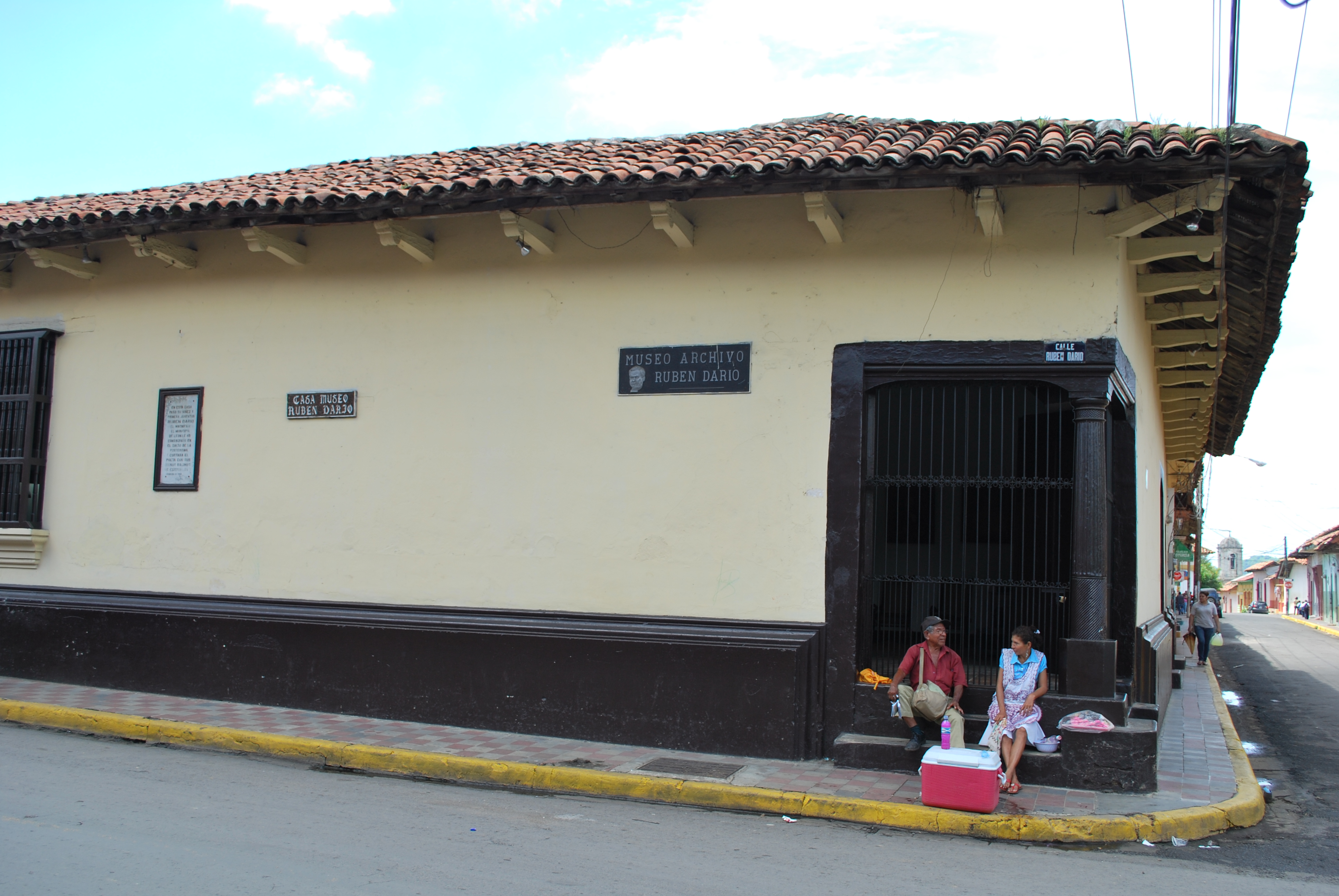
Rubén Darío is one of the greatest Latin American poets of the nineteenth century, known for initiating the literary movement of modernism. Like the magnificient Chilean poet Pablo Neruda, Darío combined his literary work and passion with a diplomatic career that took him to several posts outside his Nicaragüan borders. Poets are said to be solitary souls. If Darío was as solitary as the house where he died in 1916, surely poetry must have been his ultimate refuge.

7. San Juan del Sur

Very close to Costa Rica’s border of Peñas Blancas is San Juan del Sur, a town of fishermen that every year sees the arrival of hundreds of backpackers in search of sun, sea, and surf. Locals are very nice and usually very discreet, they mind their business yet are very friendly. After all, tourism is one of their main sources of income.

8. Beaches near San Juan del Sur

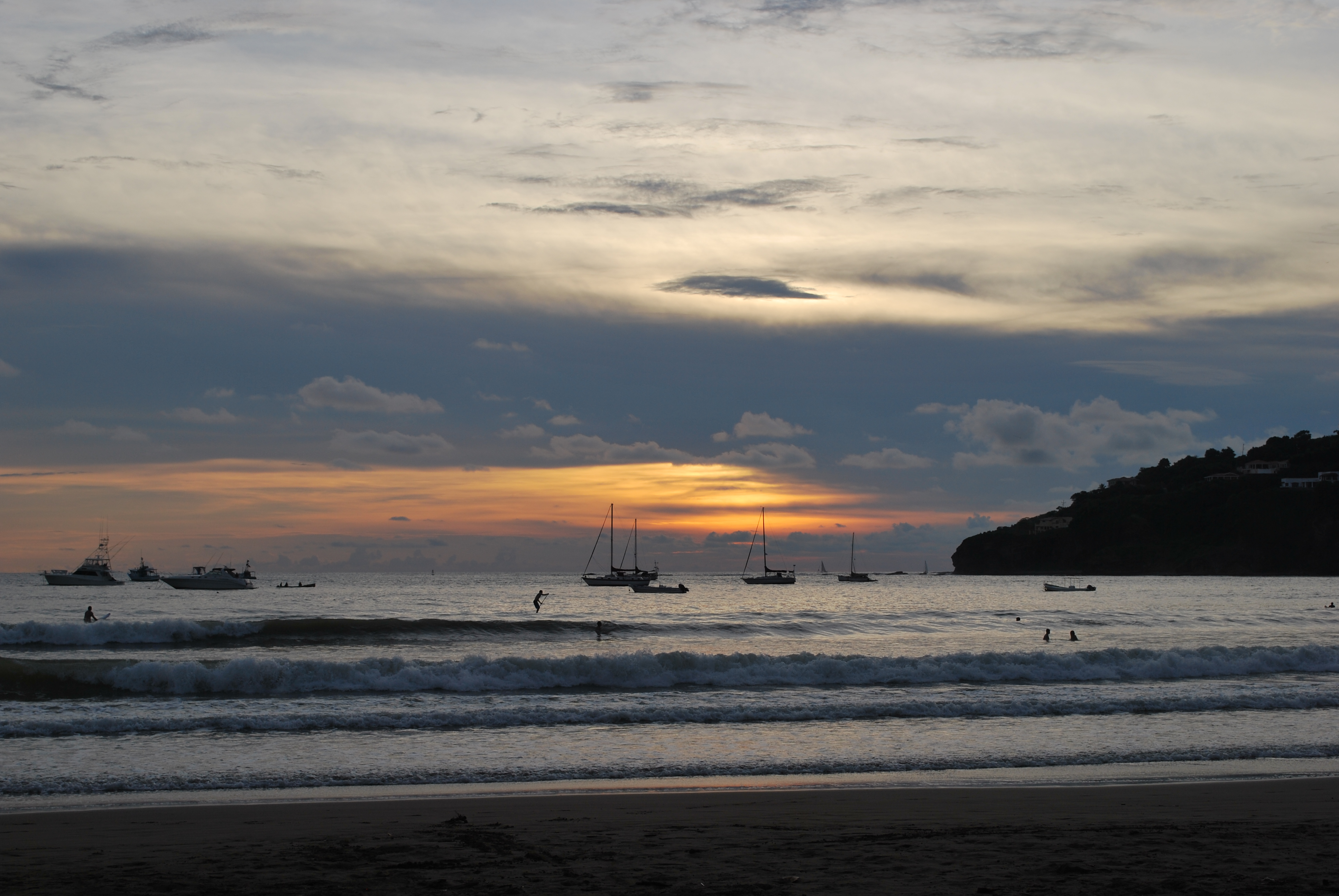
I stayed a few days in San Juan del Sur but instead of practising surf I spent every morning fishing when the tyde is low: I only caught two catfish and one of them sank its spine well into my finger. While not very tasty, catfish is good for making soup. The photograph above shows a beautiful, wild beach near San Juan del Sur where some friends and I spent the day surfing and fishing. It is also, with Playa Maderas, the scenery chosen by different TV programs to shoot reality shows.

9. Isla de Ometepe

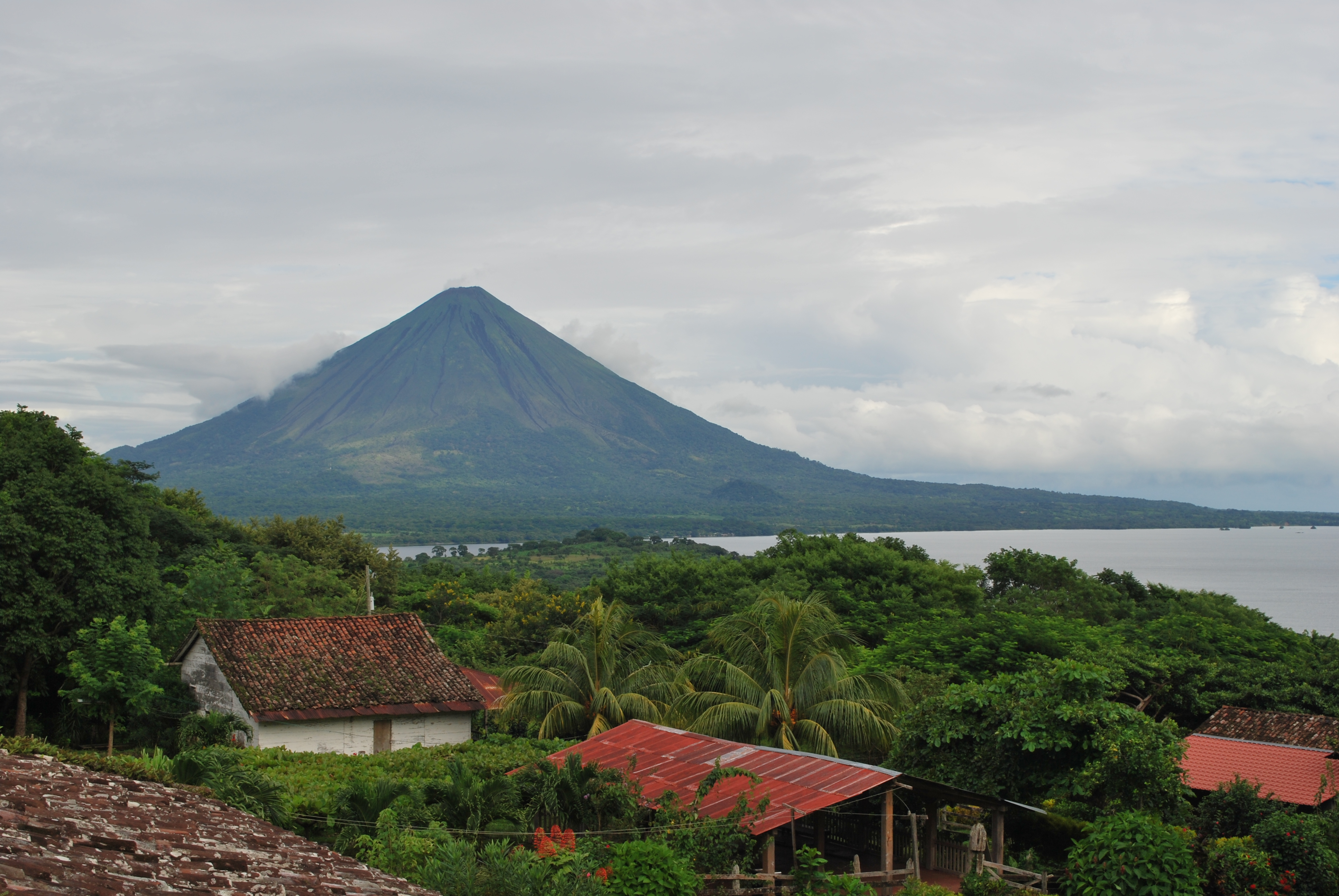
I never thought there could be something like a twin volcano island in the middle of a lake. Until I saw Isla Ometepe, home to the twin volcanoes Concepción (1610 metres) and Maderas (1394 metres), right in the middle of Lake Nicaragüa.

10. Finca Magdalena

When arriving at Isla Ometepe, I suggest you take a local bus to Finca Magdalena, a 350-hectare organic farm and agricultural cooperative stretching along the foothills of Volcán Maderas. The place is fantastic and well kept. Wake up at dawn and hike up the volcano, When you get to the top after some three to four hours, enjoy the view as the crater is inundated with rain water. You can even take a swim, if you dare… Unfortunately for hiking lovers, Volcán Concepción (above) is currently active.

Conclusion

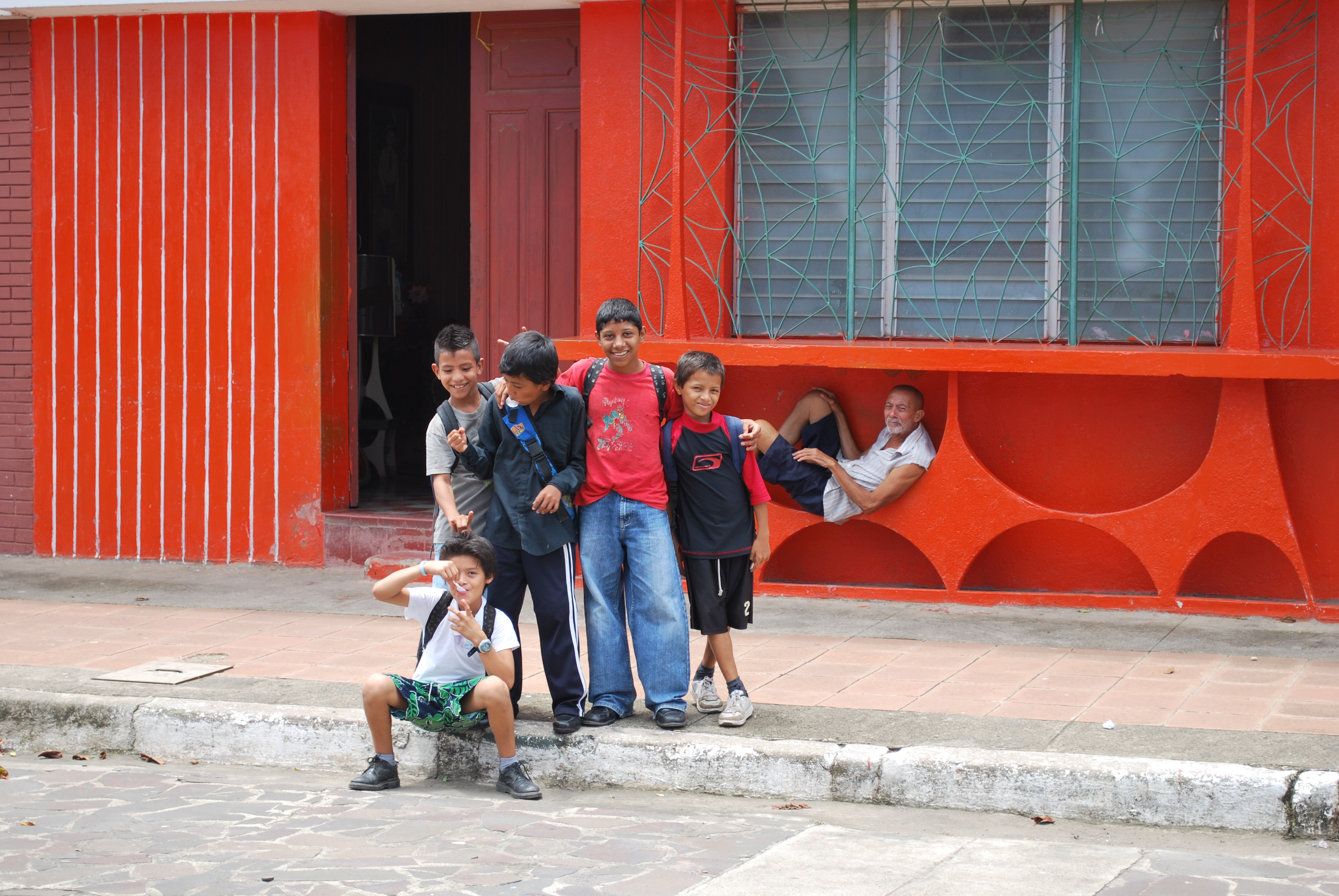
Little else needs be said, The above are only snapshots of some of Nicaragüa’s Eastern spots. Many more places are left unexplored by this series of photographs. As the kids in the opening photograph show us, Nicaragüa can also be all smiles.

Research Project: India’s Grain Storage Problem

This post is the sixth in a series sharing findings from a research project Sam Kornstein and Paul Artiuch are working on throughout the month of January. Paul Artiuch and Samuel Kornstein are graduate students at the MIT Sloan School of Management. Throughout the month of January they are in India researching market-oriented approaches to reducing agricultural food waste.

_________________________________________________________________________________

By Samuel Kornstein and Paul Artiuch

January 18, 2012

India is one of the largest wheat producers in the world, with the most recent harvest bringing in over 80 million tons of grain. As we’ve mentioned in previous posts, the government buys a significant portion of each year’s harvest and distributes it to the poor through ration shops. As part of this program, the government also maintains a grain reserve as a food security measure, and provides farmers with purchase guarantees at a minimum support price. As a result, massive stocks of wheat are kept in government storage every year – 17 million tons was held by the program’s agency, the Food Corporation of India, at the beginning of 2011.

Continue reading

Afghanistan in transition: a reporter’s diary

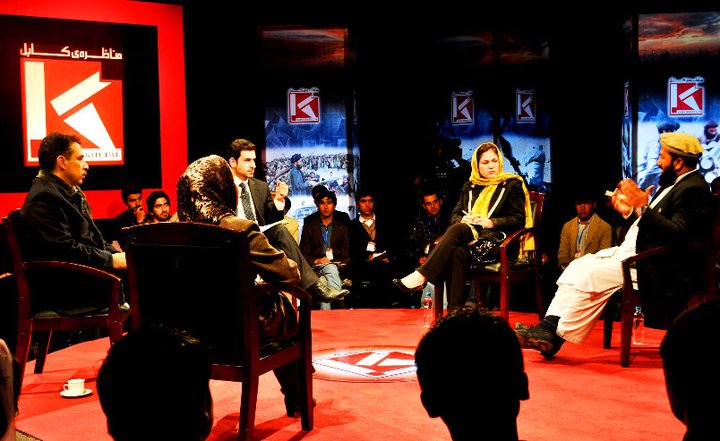
In this post, the author shares notes taken during his attendance to a popular TV show night in Kabul, called ‘Kabul Debate Live’, where participants and audience discussed the issue of ‘Reconciliation with Taliban’.

From the same author:

Photo essay: Stories from Kabul, Part I
Photo essay: Stories from Kabul, Part II

_____________________________________________________________________________________

By Abhishek Srivastava, 26 Jan, 2012

It was just before 11 at night, and I was thinking of calling a cab, when Dr Walid drove up and offered to drop me at my guest house. On any other day, travelling by road would have been an affordable risk to take in Afghanistan: a country fraught with suicide attacks, kidnappings and roadside bombings.

Paul, CEO of 1TV media group, had invited me to be part of a popular television debate called ‘Kabul Debate Live’. A crowd of about two hundred Afghans occupied the swanky studio of 1TV anxiously waiting to talk about the absence of peace, and to voice their opinion on one of the most closely watched debates of the country: ‘Reconciliation with Taliban’.

As the international troops begin to withdraw, especially with America announcing a complete draw down of its decade-long presence by 2014, the Obama administration is now looking at a gradual shift from a military solution to a political one.

“It is interesting and ironic to discuss Taliban reconciliation on a TV debate, when Taliban itself had banned television viewing. Even owning a TV set was a crime. Today, I have travelled a long distance to be a part of this debate. And I hope we get answers”, said Farshad, a second-year Kabul University student.

A study conducted by Altai Consultancy in October 2010 revealed that less than a quarter of Afghanistan’s population has satellite TV equipment. Cable TV is essentially an urban phenomenon, with a penetration of only 5%, while Radio, although a dying medium, has a penetration of 68%.

“TV is mostly used for movies and dramas, while news is accessed through radio sets”, said, Ahmad Rafi Maseer, a Kabul based IT consultant.

Minutes before going live, the host and the brainchild behind this ground-breaking concept, 28 year old Samiullah Mahdi is nervous. “One of the most important speakers of the day declined to participate at the last minute, but we requested a parliamentarian to be a part of the show”, said Samiullah rushing to the studio.

The guest who declined is Taliban’s former ambassador to Saudi Arabia, Habibullah Fawzi.

“It is disappointing not to have a Taliban voice in a discussion that talks about them. It says a lot about their commitment to the peace dialogue”, said Mostafa Mahmoud, News and Current Affairs Director of 1TV.

Samiullah enters the studio, followed by the speakers: Shahla Farid –a law and political science professor in Kabul University; Ahmad Wali Massoud –brother of the founder of Northern Alliance, the late Ahmad Shah Massoud; Professor Aminuddin Muzafary represents the High Peace Council –a loose group of people hand-picked by President Hamid Karzai to broker peace with the Taliban; and Fawzia Kofi –a Member of Parliament from Kabul.

What women want, is rarely a concern’

“Reconciliation with Taliban”, says Sami, throwing open the debate.

“We need to include women in any kind of peace dialogue. Women play an important role in nation-building” interjects Shahla Farid.

It is well documented that groups like Taliban and Hiz-i-Islami (Gulbuddin) have been synonymous with violent repression of women in Afghanistan.

Visuals of a burqa-clad woman squatting in the middle of a Kabul stadium, while bullets were sprayed into her skull point-blank with a Kalashnikov by a Talib, shocked the world and brought to light the barbarism of Taliban rule.

“I don’t think peace talks with the Taliban are possible because of our past experience. During the Taliban regime, women couldn’t go out; they couldn’t work or get an education. The Taliban would rather see a woman die in the streets than go to a restaurant to get food if men were around –these are the kind of people we are talking about”, said a female parliamentarian, on condition of anonymity, in an interview to Human Rights Watch (HRW).

Since the fall of the Taliban, women in Afghanistan have gained some rights and freedoms, but there are still insurmountable problems.

“I personally think the opinion of women is not given much importance in Afghanistan. But looking at the current situation, even if there is resistance they will be present because Americans want to include them, and Afghanistan is run by Americans right now”, intervened Mohammad Asif Ziar, while translating the debate for me, which was a mix of Pashto and Dari.

Majority of Afghan men are mired in a culture and belief system that hides ingrained misogynist policies. While they publicly preach a strict moral code and criminalise female prostitution, they procure young boys and sexually abuse them. The warlords who fought for Afghanistan and its ‘Islamic’ cause kept young boys as their sexual partners for long. Bacha Bazi (boy play) is a lucrative business in Afghanistan. “Just 500 Afghans for the boy to make your night”, said an Afghan friend, while making his offer.

Asif’s intervention reminded me of a conversation I had with a senior editor of a leading news agency in Afghanistan. He had sought my suggestion on marrying his junior colleague. The question seemed a bit odd, because he was already married, and the girl he wanted to marry was as old as his daughter. When I expressed my doubts, he said, “Afghanistan is an Islamic country, and I can marry four times, and the girl I want to marry has crossed her ‘marriageable’ age of 27, and she has no option but to marry elderly, married or divorced, or even handicapped men. So I am the best she can get. This is Afghanistan. What women want is rarely a concern”.

A large number of women in the Pol-e-Charkhi jail in Kabul are languishing on charges of ‘moral crimes’ that include premarital sex, running away from home, and adultery.

“If we intend to include Taliban in the peace process, then it is very important for them to recognise and acknowledge Afghanistan’s Constitution.  That should be the first condition, if they are to be included in mainstream politics”, said Fawzia Kofi. The audience rose in applause.

It is noteworthy that while Article 22 of the Afghan Constitution guarantees equality of both men and women, Article 3 states that no law can contradict the Shari’a. Therefore, even if the Taliban accept the constitution in exchange for power, their interpretation of the Constitution will only curtail women’s rights.

According to a recent BBC report, on November 10th 2011 the Taliban allegedly stoned and shot dead a woman and her daughter in Afghanistan’s Ghazni province. The Taliban had accused the women of ‘moral deviation’ and ‘adultery’. The attack happened just few meters away from the governor’s office in Ghazni city, a place which is yet to be transferred to the Afghan security forces from hands of International forces.

Despite the presence of international forces, there are areas that are still in Taliban control. Women face death threats and even acid attacks regularly. There are those whose lives are in danger for working for the Americans or for not following the Taliban way of Islam. But there are groups that run the risk of opposing the Taliban. Like the Revolutionary Association of the Women of Afghanistan, or RAWA –an underground group that fights for secular democracy and women’s rights.

The debate moves on. A charged audience is anxious to speak after hearing the guests. Samiullah tries his best to steer the 60-minute debate.

‘Taliban, after all, are sons of Afghanistan’

“What has your organisation done for the peace process? Did you make any headway in your talks with the Taliban?”, asks Samiullah.

“People think that talking to the Taliban and bringing them back into mainstream politics will take us back ten years. I want to say that as an organisation promoting peace, we will work only towards that end, and we will care for the rights and prosperity of the Afghans”, says Professor Aminuddin Muzafary, a representative of the High Peace Council.

Afghan President Hamid Karzai formed a High Peace Council in September 2010 to further peace talks with the Taliban and other insurgent groups as part of a reconciliation process. The composition of this 70 member group raises serious concerns over the success of peace negotiations.

Head of this council was former Afghan President, and a jihadist –Professor Burhanuddin Rabbani, who later helped the invading US army topple the Taliban regime in 2001. Others include former warlords Abdul Rab Rasoul Sayaf and Haji Mohammad Mohaqiq who are bitter rivals. Both have fought the Taliban. Sayaf is even accused of massacring Hazaras –a minority community in 1993. These men are an unlikely choice for peace-making with the Taliban.

A big blow to the peace dialogue came on the night of September 20th 2011, when two men pretending to be peace emissaries gained entry to Professor Burhanuddin Rabbani’s house, in a highly secured zone of Kabul, and brutally assassinated him by detonating a bomb, hidden inside the turban.

Assassinations in Afghanistan are an everyday phenomenon. In fact, a surge in the number of high-profile assassinations in recent months –including commander of the northern police zone, General Daoud Daoud; Kunduz Police Chief, Abdul Rahman Sayedkheli; and now Professor Rabbani– is being seen as a swift elimination of people standing in the way of peace favouring the insurgents, especially the Taliban, that is reminiscent of the civil war.

The Taliban has however, repeatedly denied peace talks. They have asserted that they will not enter into dialogue with the government until there is complete withdrawal of all international troops from Afghanistan.

The audience gets impatient. Sami finally takes opinions from the audience.

“All the council members are puppets of the U.S. government. They have been bought and are here only to serve their own interests. We don’t accept them. So there’s no point in them talking peace on our behalf, says Muzhary Fazal Rahman, a young journalist from Kabul.

“Taliban after all are children of Afghanistan. They are sons of our soil. Why alienate them? They are committing acts of violence because we are under American influence”, said an emotional old frail voice among the audience. This was followed by a mild applause, showing not many in the audience seem to agree.

“The High Peace Council is not in favour of omitting the Taliban from Afghanistan’s political ground, we want them to re-think their strategies”, said Professor Aminuddin Muzafary.

“The moment we acknowledge the Taliban and involve them in the ‘peace-process’, we give them the status of a legitimate organisation. So it’s better we avoid that”, said Ahmad Wali Massoud.

The intense debate that lasted 90 minutes ends with an audience poll. More than half (54.4%) say the Taliban should be defeated militarily. The rest want peace talks along with a withdrawal of foreign troops.

The debate did not bring out concrete solutions, but it symbolised hope and change, for about seven years ago such a TV programme with two women speakers would not have been possible.

Assassination

It was ten past eleven. I had finished dinner with 1TV crew and the guest speakers when we heard the news of the assassination of the police chief in Kunduz, Northern Province.

Realising that the situation had turned tense, Dr Walid Roshan, the executive manager of 1TV, walked up to me and offered a ride to my guest house.

The dark night had an eerie silence. Kabul’s streets were cordoned off and a large number of police vehicles with blaring sirens were zipping. Dr Walid had just hit the road when a police personal in an SUV across the road trained the barrel of his gun at us. I could not stop but shout, “Dr Walid, gun”! He immediately stopped and so did the trigger. After a brief chat with the police he continued driving. “Sorry, I did not realise they were coming. They saw a potential threat in us and they don’t hesitate in shooting”, said Walid.

As we made our way through the many checkpoints to reach the guest house, the entire day flashed in front of my eyes; that microcosm made me understand Afghanistan’s impending challenges. Especially the definition of ‘peace’ in a highly volatile and trigger-happy time of Afghanistan.

While Afghanistan assimilates the fragmented peace that prevails in the country, the Taliban and other insurgents groups continue to pull-off a series of spectacular attacks. In a big blow to the US earlier this month, Taliban shot down a US helicopter, Chinook, during a combat mission, killing 31 US special operation troops. According to a latest UN report, more civilians have died in the first six months of 2011 than any other time during this decade long conflict.

All these signs, coupled with the much talked about U.S. troop-withdrawal just as Karzai’s term ends, send out the message that Afghanistan might just slip into an abyss deeper than it was in 2001.

Research Project: The Punjab Potato Party

This post is the fifth in a series sharing findings from a research project Sam Kornstein and Paul Artiuch are working on throughout the month of January. Paul Artiuch and Samuel Kornstein are graduate students at the MIT Sloan School of Management. Throughout the month of January they are in India researching market-oriented approaches to reducing agricultural food waste.

_________________________________________________________________________________

By Samuel Kornstein and Paul Artiuch

January 16, 2012

As we mentioned in our post on cold storage, this year there’s an excess supply of potatoes in India, and prices have plummeted. After spending a day speaking with professors at the Punjab Agricultural University, we learned that there tends to be a 4-5 year cycle for the prices of certain staple crops such as potatoes.

Continue reading

Research Project: A Look at India’s Agricultural Chains

This post is the fourth in a series sharing findings from a research project Sam Kornstein and Paul Artiuch are working on throughout the month of January. Paul Artiuch and Samuel Kornstein are graduate students at the MIT Sloan School of Management. Throughout the month of January they are in India researching market-oriented approaches to reducing agricultural food waste.

_________________________________________________________________________________

By Samuel Kornstein and Paul Artiuch

January 15, 2012

Over the past week, we’ve learned quite a bit about how food gets from farmers’ fields all over India to the plates of the country’s 1.2 billion people. What struck us most is the level of fragmentation across the supply chain, which hinders the country’s ability to plan and quickly make adjustments to the system when necessary. These challenges, coupled with the importance of India’s agricultural sector in feeding the population, have compelled the government to step in and regulate parts of the system. Sometimes this is a good thing – government programs provide food for millions of low-income families – however, these government programs can also be extraordinarily inefficient and wasteful, which we’ll discuss at length in later posts. In the meantime, we thought we’d share a brief overview of how the system works, which will hopefully provide some useful context for subsequent entries.

Continue reading

Research Project: India’s Cold Storage Capacity

This post is the third in a series sharing findings from a research project Sam Kornstein and Paul Artiuch are working on throughout the month of January. Paul Artiuch and Samuel Kornstein are graduate students at the MIT Sloan School of Management. Throughout the month of January they are in India researching market-oriented approaches to reducing agricultural food waste.

_________________________________________________________________________________

By Samuel Kornstein and Paul Artiuch

January 14, 2012

Cold storage facilities, essentially refrigerated warehouses, can reduce agricultural price volatility, helping to minimize food waste and increase income for various supply chain stakeholders. The benefits of cold storage are simple: most types of produce have shelf lives ranging from just a few days to a couple weeks when kept at room temperature. Farmers and traders are forced to quickly get their produce to consumers, even if there’s too much supply in the market. This can result in low prices that often don’t even cover the price of production and transport. In the most extreme cases, when the market is flooded with a particular item, it makes more economic sense for farmers to just let certain crops rot in the field, rather than spend the time and money to harvest them.

Continue reading

United Nations Security Council: Prospects for Reform

In this essay, the author examines the current composition of the UN Security Council and discusses prospects for reform.

_____________________________________________________________________________

By Anna Rabin, 18 Jan, 2012

Established as one of the principle organs of the United Nations (UN), the Security Council bears the ‘primary responsibility for the maintenance of international peace and security.’[i] The Council’s mandate, outlined further in Article 24 of the Charter, coupled with its ability to make legally binding decisions, makes the Security Council arguably the most powerful organ of the UN. The Council has retained its importance in international relations and is arguably of increased importance as a result of heightened international co-operation in the post-Cold War era.[ii] The lack of reform since its creation, has however led to doubts over the Council’s legitimacy and effectiveness in contemporary politics. One observer even referred to its lack of reform as ‘one of the most successful failures in the history of the United Nations.’[iii] The most commonly debated areas for reform revolve around the veto power, the size of the Council and in the event of an enlargement, the powers and selection of new members.

Currently, the Security Council is comprised of five permanent members, referred to as the P-5,[iv] and ten non-permanent members, each elected for a two-year term. In addition to having a permanent seat on the Council, Article 27 of the UN Charter grants the P-5 a veto power. Reform of the Council requires support from two-thirds of the General Assembly and all of the P-5. Whilst reform is not impossible, as seen by the successful 1965 reform that enlarged the Council from eleven to fifteen members, consensus on necessary reform is hard to achieve.

With a seat of the Council seen as ‘a proxy for global influence on peace and security issues’[v] competition for the ten non-permanent seats is high. The size of the Council is therefore a key concern for member states. With the Italian delegation pointing out that 77 countries have never had a seat on the Council and 47 have sat just once,[vi] questions over the Council’s size have been raised. This disparity is due to the fact that, having increased in size just once since its formation, the size of the council is no longer proportionate to the size of the General Assembly. At its formation, the number of member states compared to seats at the Council was 11 to 51, representing a ratio of 1 to 4.6. In spite of the increase in the number of seats on the Council from eleven to fifteen, the dramatic increase in the General Assembly, largely as a result of decolonisation and the break up of the Soviet Union, has seen this ratio increase, reaching 1to 12.[vii]

The significant increase in the number of States in the General Assembly indicates that enlarging the Council is a necessary reform. Enlarging the Council, however, must not hinder efficiency.[viii] The majority of proposals for an increased Council have therefore varied between the low to high twenties. Proposals such as ‘In Larger Freedom’[ix] [x] and ‘Uniting for Consensus’[xi] [xii] for example, recommended an increase to 24 and 25 seats respectively, aiming to enhance ‘both the legitimacy and the efficiency of the Council.’[xiii]

Whilst referred to as ‘the apex body of the United Nations’[xiv] the Council’s current composition is no longer representative of the values of the General Assembly. Formed in the aftermath of World War II, the Council’s composition has not adapted to reflect contemporary political realities, notably decolonisation. The stagnant nature of the Council in turn undermines its legitimacy as according to Hurd, social institutions derive their power from their perceived legitimacy. This means that a reformed Council ‘will find compliance with its rules more easily secured, than in the absence of legitimacy.’[xv] Unlike the large consensus that surrounds calls for the increased size of the Council, plans such as ‘In Larger Freedom’ that call for an increase in permanent members have led to fierce debate. Vocal calls for inclusion as permanent members of an increased Council have largely come from the G4 countries[xvi] and developing countries.

The G4 members states, in particular Japan and Germany, the second and third largest financial contributors to the Council respectively, argue their case for permanent membership on the grounds of Article 23 (1) of the Charter. The Article states that selection to the Council must take into account the country’s commitment to the ‘maintenance of international peace and security and to the other purposes of the Organization’ and ‘geographical distribution’.[xvii] This argument is supported by advocates of the functionalist perspective such as Schwartzberg, in what he refers to as the ‘entitlement quotient’ for entry into the Council.[xviii] Under a functionalist framework, such as Schwartzberg’s, Japan for example would be a more favourable candidate than Nigeria. Whilst Japan contributes more to the UN, this approach does not take into account the fact that Japan has a 4.91 trillion dollar economy and that an Asian country is already a member of the P-5. Nigeria on the other hand is Africa’s most populous country and although home to the most UN members, no African country has a permanent seat at the Council. Whilst taking a more literal approach to Article 23 (1), a purely functionalist perspective places too much emphasis on the financial capabilities and neglects geographic distribution.

The financial requirement of the functionalist perspective also gives preference to developed countries, therefore ensuring the continued underrepresentation of the developing world. It is important to note that the majority of population growth is occurring in the developing world with predictions that in fifty years, the populations of India, Pakistan, China, Indonesia and Nigeria will exceed four billion.[xix] Representation by region would minimize this disparity and give increased geo-political legitimacy to the Council by rewarding both contribution and ensuring regional representation.

The existence of the veto power is possibly the most contentious feature of the Council. Whilst arguably an inevitable reaction to the failure of the League of Nations, the P-5 no longer represents the great powers in international relations. The two-tiered structure of the Council reinforces the notion that ‘some states are more equal than others’[xx] resulting in entrenched institutional elitism within the UN. Whilst ‘a splendidly egalitarian idea’[xxi] to abolish the veto, with the P-5 eager to ‘cling fiercely to their veto privileges’[xxii] and reform requiring unanimous P-5 support, debate surrounding the abolishment or expansion of the veto is largely redundant.

Whilst reforming the veto is unlikely, enlarging and altering the composition of the Council would significantly increase its legitimacy and ensure it remains of contemporary relevance. Although a country’s contribution to the Council is important, the exponential growth of the developing world indicates that regional representation in an enlarged Council is imperative to ensure legitimacy.

_____________________________________________________________________________

References

[i] David M. Malone, ‘Security Council’, in Thomas G. Weiss and Sam Daws (eds), The Oxford Handbook on The United Nations, Oxford, Oxford University Press, 2007, p.117.

[ii] ibid., p.131

[iii] Terraviva Europe, ‘United Nations: Security Council Reform Remains Deadlocked’,  (accessed on 30 March 2010), 6 August, 2009, p.1.
[iv] The P-5 members of the UN Security Council are the United States, the United Kingdom, Russia, China and France.

[v] David M. Malone, The Oxford Handbook on the United Nations, 2007, p.132.

[vi] W. Andy Knight, ‘The future of the UN Security Council’, in Andrew Cooper et al., (eds), Enhancing Global Governance: Towards a new diplomacy, Tokyo, UNU Press, 2002, pp.24-25.

[vii] M. J. Peterson, ‘General Assembly’, in Thomas G. Weiss and Sam Daws (eds), The Oxford Handbook on The United Nations, Oxford, Oxford University Press, 2007, p.106.

[viii] Global Policy Forum, ‘Pros and Cons of Security Council Reform’,  (accessed on 24 March 2010), 19 January, 2010, p.1.

[ix] In Larger Freedom offers two different plans. Plan A would create six additional permanent members and three non-permanent members. Plan B would create eight new members, each of which would hold a four-year renewable seat, and one non-permanent seat.

[x] In Larger Freedom, ‘V. Strengthening the United Nations’,  (accessed on 30 March 2010), p.1.

[xi] Uniting for Consensus would increase the number of non-permanent seats on the Council to 20.

[xii] Press Release GA/10371, ‘United for Consensus’ Group of States Introduces Text on Security Council Reform to General Assembly’,  (accessed on 30 March 2010), 26 July, 2005, p.1.

[xiii] Global Policy Forum, ‘Pros and Cons of Security Council Reform’, (accessed on 24 March 2010), 19 January, 2010, p.1.

[xiv] W. Andy Knight, Enhancing Global Governance: Towards a new diplomacy, 2002, p.19.

[xv] ibid., p.24

[xvi] The G4 countries are Germany, Japan, Brazil and India.

[xvii] Global Policy Forum, ‘Pros and Cons of Security Council Reform’,  (accessed on 24 March 2010), 19 January, 2010, p.1.

[xviii] W. Andy Knight, Enhancing Global Governance: Towards a new diplomacy, 2002, p.27.

[xix] W. Andy Knight, Enhancing Global Governance: Towards a new diplomacy, 2002, p.26.

[xx] Paul Kennedy, The Parliament of Man, London, Penguin Books, 2006, p.52.

[xxi] Paul Kennedy and Bruce Russett, ‘Reforming the United Nations’, in Foreign Affairs, Vol. 74, No. 5, Oct. 1995, pp.56-71.

[xxii] Terraviva Europe, ‘United Nations: Security Council Reform Remains Deadlocked’,  (accessed on 30 March 2010), 6 August, 2009, p.1.

_____________________________________________________________________________

Bibliography:

Research Project: Delhi’s Azadpur Mandi Vegetable Market

This post is the second in a series sharing findings from a research project Sam Kornstein and Paul Artiuch are working on throughout the month of January. Paul Artiuch and Samuel Kornstein are graduate students at the MIT Sloan School of Management. Throughout the month of January they are in India researching market-oriented approaches to reducing agricultural food waste.

_________________________________________________________________________________

By Samuel Kornstein and Paul Artiuch

January 10, 2012

Soon after arriving in Delhi, we took a walk over to a local market and spoke with a man who runs the community produce stand. We asked him where he buys his fruits and vegetables. “I take my truck to Azadpur Mandi every day at five in the morning,” he said. “Is that where all of Delhi’s markets get their produce?” we responded. “Just about, except for the government-run shops.” We probed a bit more about seasonality, food waste, and prices, but found that his operation is fairly simple, and nearly nothing gets wasted at the retail level. Even if food becomes damaged someone in the community finds a use for it.

Continue reading

Photo Essay: Stories from Kabul, Afghanistan – Part II

By Abhishek Srivastava, 16 Jan, 2012

As part of a USAID project, Abhishek Srivastava worked in Kabul, Afghanistan on AMDEP (Afghanistan Media Development and Empowerment Program). The principal goal of the project is to train and assist Afghan journalists and students of Kabul University on the nuances of reporting. Abhishek tells us stories of people and places in Kabul using his photos as a medium. This is the second in a series of photo-essays on Kabul.

Part I can be accessed here: Stories from Kabul – Part I

_____________________________________________________________________________

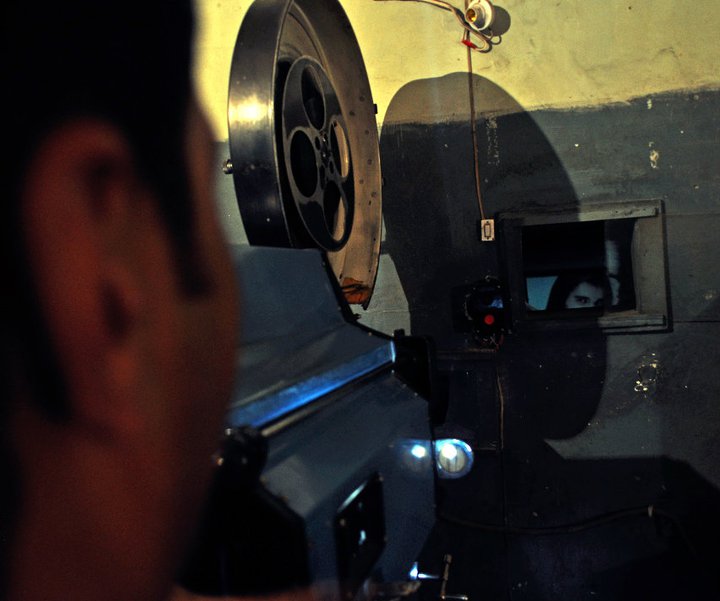
1. The Projection Room

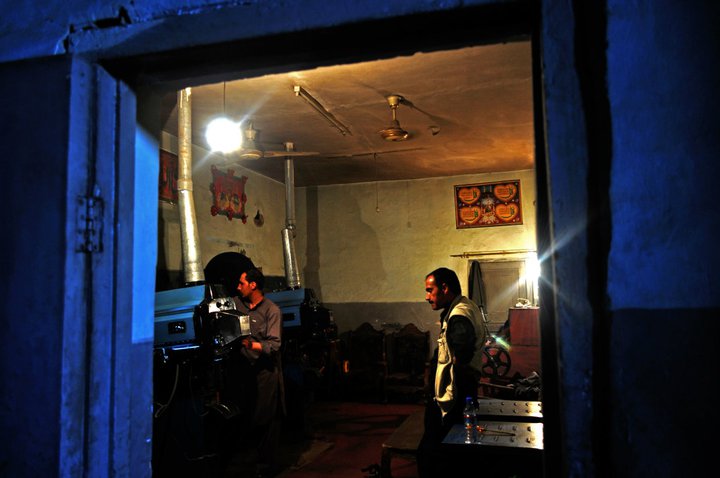
The projection room of Park Cinema in Sher-e-Naw, Kabul

_____________________________________________________________________________

2. Cinema Paradiso

The distorted sounds and scratched prints of Bollywood films mostly, plays in this cinema hall.

In 1996, Taliban banned cinema halls in Afghanistan, but after they were outsed in 2001, the cinema halls were back in ‘action’, playing Bollywood action flicks.  This picture was shot during the screening of  ‘Jimmy‘, Mahakshay Chakraborty’s (Mithun‘s son) debut film.

_____________________________________________________________________________

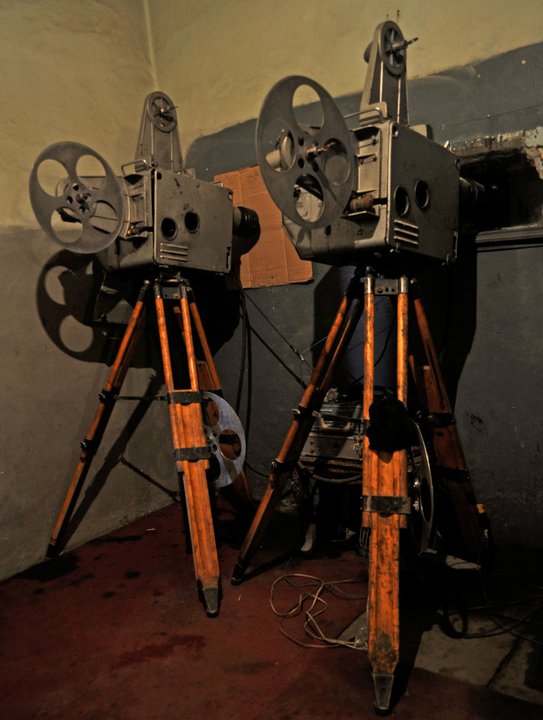
3. Made in Russia

The film projectors are from the Russian era. I think that ‘war’ has been a major part of Russian cinema. It must have been part of spreading communism.

_____________________________________________________________________________

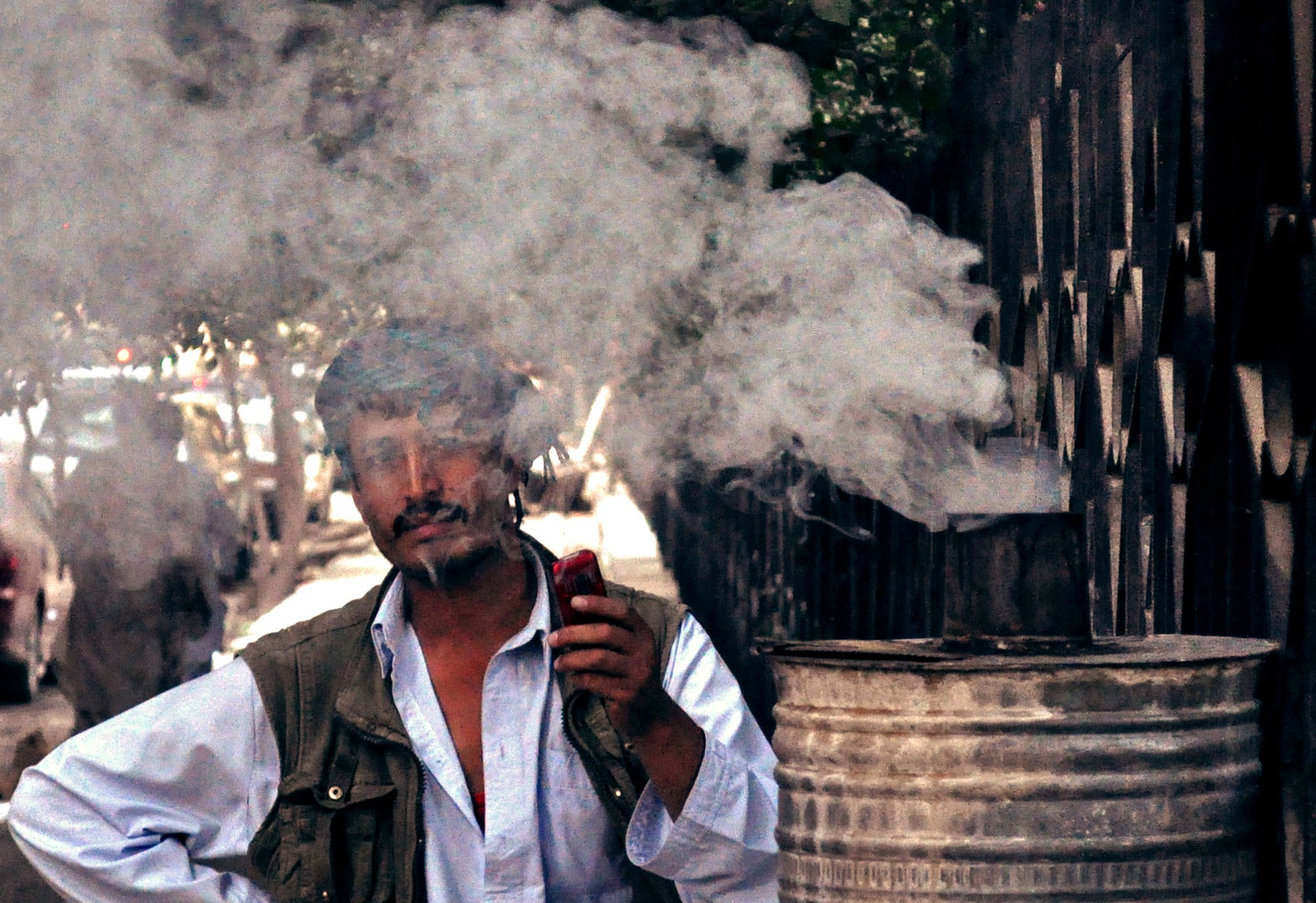
4. Afghanistan’s Starbucks

Afghanistan’s very own green tea.

A common sight on the streets of Kabul is of people – with their friends and families – sharing endless conversations over cups of hot green tea.  The smell of cardamon in the air arrests you, and attracts you to these smoke emitting aluminium containers, which contain the boiling tea leaves.

In Afghanistan, the tea drinking tradition is part of life.

_____________________________________________________________________________

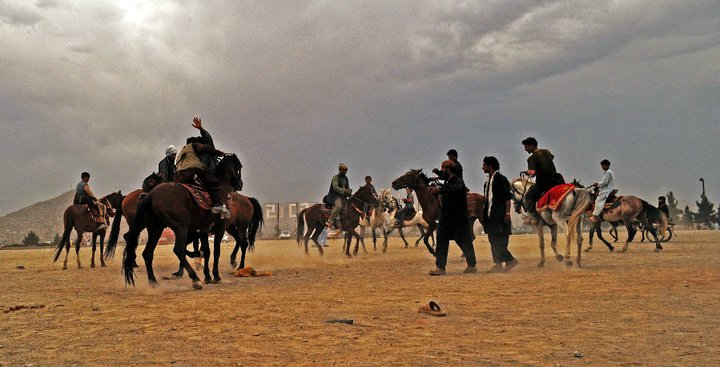
5. Afghanistan’s National Sport – Buzkashi

Afghanistan’s National Sport is the brutal Buzkashi. Traditionally, horse riders would fight over the carcass of an animal, usually a goat. This one, however, was being played with a sand bag. The Taliban does not approve of this game, and has targeted such games with several suicide attacks in the past. As a rule, women are not allowed to watch this game.

_____________________________________________________________________________

6. A Tourist in Afghanistan

Meet Ibrahim, a tourist visiting the town of Kabul.

At the time of the civil war, when the warlords could not handle free Afghanistan, they left the country in shambles. A young man, Naveed, migrated to Karachi, Pakistan, where he fell in love with a Kashmiri woman and married her.

After eighteen years, their son, Ibrahim, visited the land of his father to trace their footsteps and learn the history that forced them out of this country.

____________________________________________________________________________

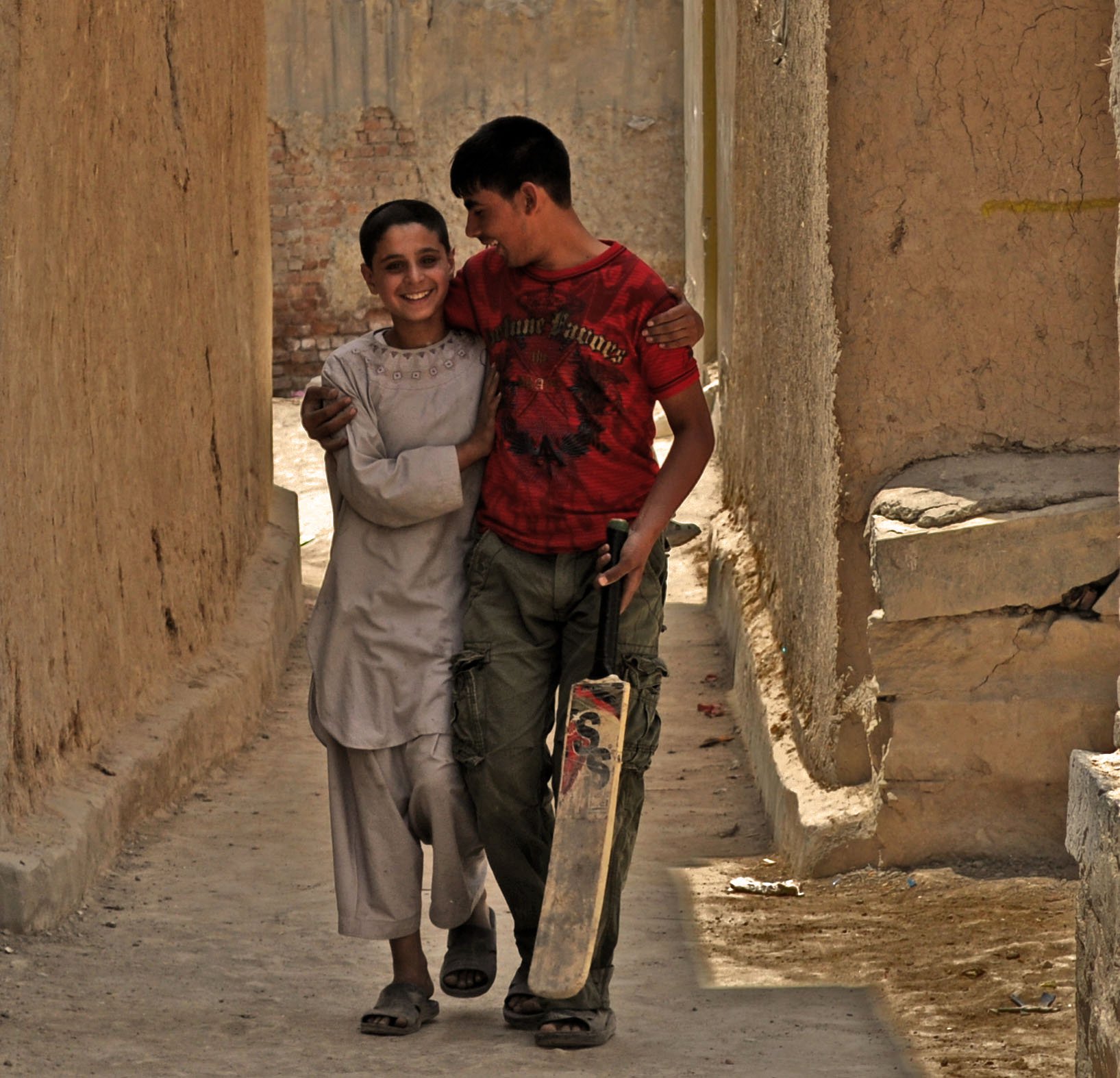
7. Street Cricket

Although football is the most popular game amongst the kids, street cricket is a common sight on Fridays (Jumma).

_____________________________________________________________________________

8. The Birth Lottery

Being born in Afghanistan can indeed be difficult. Imagine the trauma of war that these innocent minds have to grow up with.

Only a quarter of the children get to start their school education, that too at the age of 7, while the others are found ragged on most of the streets tapping on the car window, begging for money. They sometimes ask for specific dollar amounts, or swirl cans of burning charcoal to rid your life of evil spirits. Unfortunately, the war has been brutal and several children often get killed in drone attacks.

_____________________________________________________________________________

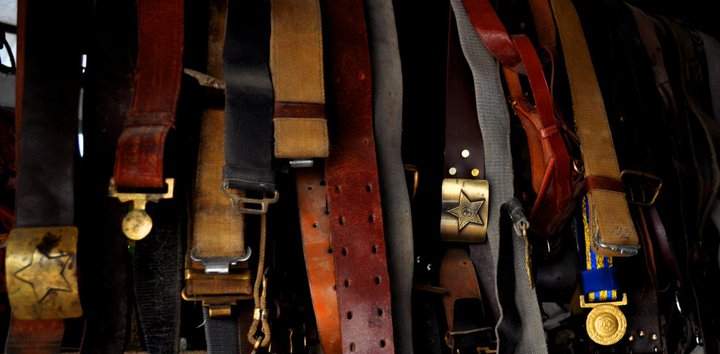
9. Forgotten Waistlands

Belts, circa late 1980’s. The Russian army had invaded Afghanistan and were in a war with Afghanistan’s Mujhahidin fighters.

Mujhahidin fighters, with the help of Americans, brutally defeated the Russians. Some 15,000 Russian soldiers died fighting the war, many of them killed by American surface-to-air-missiles.
Today, in 2012, an antique shop in Kabul, Afghanistan, sells dozens of belts of those dead Russian soldiers, for American dollars.

This, to me, is symbolic of the intention of every American intervention.

_____________________________________________________________________________

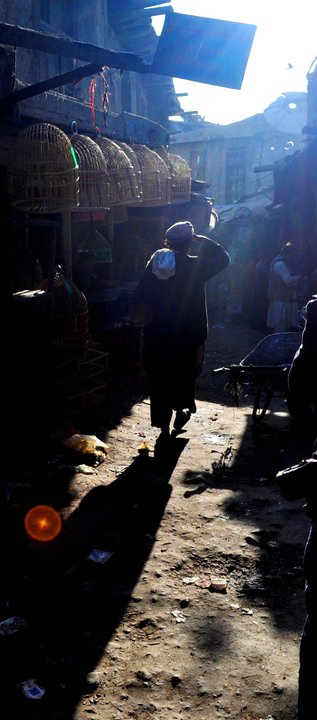
10. Mellifluous Markets

One of the oldest quarters of the Afghan capital, where a bazaar that caters especially to bird-keepers is located. The bazaar is known as Ka Farushi – the “Hay Market”.

The entry to the market is very small, so no vehicle can enter. Hence the air of the bird market – housing some of the world’s most sonorous birds such as canaries – is filled with the melodious sounds of birdsong.

_____________________________________________________________________________

The copyright of all photos are with Abhishek Srivastava. Please do not reprint without permission.

Research Project: Battling Food Waste in India

This post is the first in a series sharing findings from a research project Sam Kornstein and Paul Artiuch are working on throughout the month of January. Paul Artiuch and Samuel Kornstein are graduate students at the MIT Sloan School of Management. Throughout the month of January they are in India researching market-oriented approaches to reducing agricultural food waste.

_________________________________________________________________________________

By Samuel Kornstein and Paul Artiuch

January 9, 2012

Last fall, we each participated in the Development Ventures course in MIT’s Media Lab. The objective of the course was to identify ways to leverage for-profit business models to tackle some of the world’s most pressing international development challenges. As we both had an interest in finding ways to reduce or extract value from waste that occurs in the supply chains of many developing countries, we teamed up to think about how we could make an impact. In the process, we learned something staggering: research shows that 20-40% of the food grown in India ends up spoiling before it ever reaches consumers.

Continue reading

What is Happening in Nigeria? Blood and Oil (Subsidies)

In this article the author looks at the current wave of political and economic turmoil sweeping Nigeria.  With a potential oil shutdown sending waves of panic across Brent Crude prices and terrorism forcing the closure of the borders the state is facing its largest crisis since its return to civilian rule in 1999.

_____________________________________________________________________________________________________________

by Jack Hamilton, 14 Jan, 2012

In 2010 the BBC released the controversial docudrama: ‘Blood and Oil’. It depicted a Nigeria crippled by corruption, protests and terrorism and was slammed for the tropes of endemic sleaze and violence. Executions, inhumane oil politics and the collusion of leading politicians in these atrocities were seen to reflect the Nigeria of the past. This is now the Nigeria of the present and it could be about to get a lot worse.

Occupy Nigeria

Naija Rising

This week the country closed its borders following counter-terrorism advice from the UN and a popular strike threatens to entirely shut down oil and gas production (accounting for over 90% of the export market) on Tuesday if demands are not met. There have been two crucial ultimatums:

1. Boko Haram has threatened to kill all Southerners (read: Christians) in the north if their demands of religious reform are not met. The attacks have already begun.

2. Occupy Nigeria has threatened to grind Nigeria’s export economy to a halt if their demands to maintain the fuel subsidy are not met. The deadline has been extended until Tuesday.

Facing a potential civil war and economic collapse, the Federal Government of Nigeria must act decisively.  There is no quick-fix.

There Might Be Blood – Subsidy Strikes

Who is Drinking Nigeria's Milkshake?

Nigerian oil and gas workers have threatened to shut down the Nigerian oil market, deepening the strikes against the withdrawal of petrol subsidies.  The government and unions are locked in talks which have been extended by two days as of today.  This leaves the government until Tuesday to find a solution or face economic meltdown.

The Petroleum and Natural Gas Senior Staff Association of Nigeria (Pengassan) have put all production platforms on red alert in anticipation of a shutdown. This demonstrates the lack of optimism in resolution being reached in time.

The crisis in Africa’s largest oil exporter has already had an international impact. Oil prices have already risen in anticipation of the shutdown and Nigeria’s export reserves would only last for six weeks.

Brent Crude prices have risen by $1 per barrel in a single day and in a global crude market already shaken by conflict in the Middle East and North Africa, a shutdown in Nigeria could have expansive ramifications. In an election year the last thing a US incumbent would like to see is a pinch at the pumps.

While the true international impact of the crisis is yet to be fully realised, it has already had a devastating impact domestically. The price of fuel has already more than doubled and the prices of other goods, including food, are skyrocketing. People are struggling to get to work, to put food on the table and to run their electricity generators. If the strike turns violent it is these people who will suffer.

Subsidies are seen to be the only benefit most Nigerians receive from the vast oil riches of the country. The argument for their removal is that they cost the state $8 billion per year in funds that could be better used on infrastructure and development. In a country in which government corruption is rife and the trust in the state is dangerously low it is clear that the people would like to see the money conferred through subsidies rather than pilfered by the ‘1%’.

The subsidy involved a huge amount of corruption but its removal does not equate to the removal of the corruption. It is merely a relocation.

Spreading Terror

The north of Nigeria is ‘sliding towards a full-blown guerrilla war’ according to The Economist. Boko Haram bombing campaigns have intensified since the Christmas Day attacks and acts of retribution have been carried out in the Christian south. The burning of a mosque in Benin City, southern Nigeria, demonstrates the dangerous roadmap the northern insurgency could instigate.

Fears abound over the potential links between Boko Haram, a small cult whose primary objective is the removal of secular education, and al Qaeda in the Islamic Maghreb.  Assertions of a broader terrorist network were originally purported by sources in the American military (AFRICOM) and the Algerian Government but on Tuesday this fear was also echoed by the United Nations.

Secretary-General Ban Ki-Moon has stated that ‘concerns will increase’ as the popularity of Boko Haram grows. The alleged sophistication of the attacks, especially the bombing of the UN in Abuja, has provided some substance for these assertions but the most recent activities reflect burgeoning brutality, not capability.

Goodluck Jonathan has responded to the fears of a vast terrorist network by closing the borders of the country. Nigeria’s international borders are now operating on high alert as the latest measures demonstrate the degree of force the Federal Government is willing to use to achieve peace and stability across the country.

Elevated force does not necessarily provide a solution for the state.  They are fighting a guerrilla organisation, galvanised by support from those who fear the encroachment of an over-zealous central government.  Memories of egregious state violence mean that heavy state mobilisation is likely to increase rather than diminish the allure of the Boko Haram message to those who feel alienated from the state.

Will Things Fall Apart?

The Occupy Nigeria protests and Boko Haram attacks are entirely separate movements with the common theme of opposing the Federal Government of the country. With opposition to government threatening the security and the economy of the nation questions abound over the future of Nigeria.

Jonathan has announced palliative measures the mass production of buses to ease the transport issues in the country as well as reducing government salaries by a quarter (although they remain obscenely high in such an impoverished nation).

The most recent response to Boko Haram has been a change in language. Jonathan has acknowledged that the support base may be more than purely criminal. In his speech on Monday he admitted that there may even be members of his government that identify with the organisation.

Talks with Occupy Nigeria have been extended by two days but there is a general lack of optimism for a rapid resolution. Boko Haram are intensifying their attacks and flickers of retribution have begun in the south. At present neither crisis shows signs of abating and the Federal Government is floundering.

Nigeria is being plunged into a future which looks ominously similar to its past. In this scenario ‘Blood and Oil’ appears rosy.

______________________________________________________________________________________________________________

For more on the recent crises in Nigeria and terrorism across West Africa see these articles on InPEC:

The State of Terrorism in Nigeria: The Rising Threat of Boko Haram

Photo Essay: 6 Reasons Terrorism is Gaining Momentum in Northern Nigeria

Securing Emptiness: The Sahara Desert and the Global War on Terror

Exploring the Sino-Indian Maritime Rivalry

In this article, the author explores China and India’s maritime rivalry in context of the recent skirmishes between the two nations in the South China Sea.

_____________________________________________________________________________

By Mikael Santelli-Bensouda, 10 Jan, 2012

In the dying embers of 2011 the sentiment between China and India regarding maritime activities became increasingly antagonistic. China explicitly warned India from any interference in the South China Sea, India demonstrated its increasing naval capability with the induction of its second aircraft carrier – two years ahead of schedule – and China beefed up its physical presence across the Indian Ocean. Emboldened by a sense of strength and necessity both nations are expanding their capability and presence beyond their immediate periphery, directly into the others ‘backyard’. What is the naval security state of affairs between Asia’s rising powers?

Competing claims to Asia’s waterways

As emerging Asian powers, both China and India’s vital security interests have dilated towards regional concerns. Their interests, particularly lie in the Indian Ocean. The strategic focus on the region is predominantly due to its proximity to the energy rich Persian Gulf, a vital transport route for Asia’s energy and commercial interaction with the world market. Specifically, it is the desire to ensure security over vital shipments that has dictated the growing Chinese naval presence in the region. This, in turn, stimulates India’s proactive response of increasing its naval capability whilst projecting their presence in the South China Sea. These parallel policies signal an overlap in their strategic spheres, as both nations aim to stretch their strategic footprint across coastal Asia.

Beijing’s rationale derives largely, but not exclusively, from energy security, as China’s energy import dependency leaves her vulnerable across volatile transport routes. To this extent, the Malacca Dilemma constitutes a potent threat perception. In the event of heightened Sino-Indian tension, India (due to its proximity to the Malacca Strait, of which 85% of China’s energy needs pass through) can physically blockade China’s energy supplies. This narrative is used to justify the Middle Kingdom’s proactive presence expansion into the Indian Ocean. However, Beijing’s expansion also serves to stifle Indian attempts at exercising domain dominance. India, by a coincidence of geography, is the dominant maritime power in the Indian Ocean. Accordingly, the region constitutes India’s sphere of influence wherein New Delhi widely sees that its task is to be the steward of the waterways, safeguarding transit vessels. It is this vital responsibility that many consider to be India’s breakthrough into the global elite of nations. As both nations aim to ensure their national interests, they are increasingly drawn into a competition for supremacy.

The China Threat: String of Pearls

Beijing’s interests in establishing a quasi-permanent presence in the Indian Ocean are contextualised through the narrative of energy insecurity. The desire to express self-determination is an essential characteristic in China’s ‘peaceful development’. Accordingly, China has employed mutually enforcing tactics to facilitate its policies. Firstly, to strengthen its presence, it is taking tempered measures, which consist of diplomatic, economic and military engagement across the ocean’s littoral. Described as the ‘String of Pearls’. Secondly, Beijing is continuing a traditional naval buildup to fully utilise and protect their growing interests.

The String of Pearls strategy has been used to describe the physical manifestations of China’s interests within the Indian Ocean. These ‘pearls’ consist of: the building of container ports and deep-sea facilities in Chittagong, Bangladesh; assistance in constructing Pakistan’s deep-water port of Gwadar; support for the projected construction of a twelve-hundred-mile oil and gas pipeline from a port near Sittwe in Myanmar; and the controversial investment in the construction of Asia’s own Suez Canal that would cut across the Kra Isthmus in Thailand, subsequently bypassing the Malacca Strait.

Supplementing this is a methodical and patient naval buildup. In August 2011 Beijing’s naval ambitions were significantly boosted as China’s first aircraft carrier, the Varyag, completed its maiden voyage. This is noteworthy as aircraft carriers denote strategic importance and subsequently improves China’s maritime deterrence and combat capability. This significant moment is a watershed in the process of developing a capable navy, one that will be able of projecting and defending the Middle Kingdom’s interests.

Such advancement has not gone unnoticed by India, as with any augmentation of military strength and presence expansion comes greater suspicion and acts of counter-balancing. Despite official Chinese rhetoric professing that its actions serve only to safeguard its national security, it does little to alleviate New Delhi’s perceived threat. China’s actions are viewed with suspicion and are widely described within Indian military circles as antagonistic and provocative.

However, from the Chinese perspective the advent of the String of Pearls strategy is itself misleading as it attempts to construct a narrative of the China threat to justify retaliatory and often aggressive means. Beijing claims that it is not in search of any permanent presence in the region and that it wants to ensure security of its energy supplies. Nonetheless, China’s geopolitical intentions cannot be naively overlooked. Beijing may be attempting to exercise power through ensuring its presence across the Indian Ocean. Supplementing this is also the desire to curtail the naval reach and capability of India, suggesting that China deems India a long-term adversary. In essence, Beijing may be exercising a policy of ‘nipping India’s navy in the bud’.

India’s manifest destiny

China’s encroaching presence in the Indian Ocean is cause for Indian ire. India’s interests in Asia’s waterways are a manifestation of its geographical reality; it is the central territorial feature of the Indian Ocean. This feeds India’s inherent naval desire to exercise dominance and hegemony over the Ocean. In an attempt to achieve this, India is consistently upgrading its naval fleet, which last month witnessed the advent of its second aircraft carrier INS Vikramaditya and is soon to be followed by the third. This demonstrates how seriously India takes it perceived role by not limiting itself for future options of force.

Furthermore, India’s augmentation of its naval capability is not pursued exclusively unilaterally. Recently, New Delhi has actively participated and hosted naval exercises with Singapore, Australia, Japan and the US, tentatively signaling the formation of a democratic bloc alliance. Not only does this energise India’s aspirations but it is also intended to act as deterrent to the ever-watchful China. Certainly, a substantial part of India’s naval surge is undoubtedly responding to the perceived reality of the China threat. The China threat was first raised in the 2004 The Indian Maritime Doctrine claiming explicably that China poses a maritime challenge to India. It highlighted China’s “determined drive to build a powerful blue water maritime force” and the “imperative for India, therefore, [was] to retain a strong maritime capability in order to maintain a balance of maritime power in the Indian Ocean, as well as the larger Asia-Pacific region”. This indicates that not only has the China question has been an active defence consideration for some time but also effective measures are being taken, and have been taken, to address the concern.

Additionally, India has moved to balance China’s creeping influence with its own strategically targeted maritime presence in the South China Sea. This firmly locks them both into an intense zero-sum relationship, or put rudimentarily, a tit-for-tat encounter. New Delhi’s Look East Policy, a similar strategy to that of Beijing’s, is becoming critical for strategic deterrence against China and sustained presence in the South China Sea is a crucial national security imperative. The establishment of closer ties with Japan, Taiwan and Vietnam ensure that India holds some power of deterrence whilst enabling their military to project its presence into the heavily disputed Sea. Whilst China is frustrated with India’s newfound strategic relationship with all these nations, the most troublesome of late has been Vietnam. This is largely due to the increasing tenacity with which China is pursuing its disputed territorial claims, an issue it vehemently warns New Delhi should steer clear of.

As both nations aim to outmaneuver their rival in order to secure national interests by manipulating Asia’s waterways, it is clear that both are jostling for strategic space across Asia’s littoral. The active-reactive nature of the maritime rivalry between China and India dictates that the emergence of interests in opposing strategic zones increases the likelihood of confrontation; especially considering patrol boats and strategic relationship from both nations expand their Asian footprint. The wider implication of this rivalry is that it severely effects the fragile security situation across the continent, by engendering fractious responses to any future incidents.

Deck the Halls with Boughs of Homophobia: the 2012 Republican Presidential Primaries and the Evangelical Connection


GOP Candidates

In this article, the author looks at the evangelical presence in the 2012 Republican presidential primaries and how the issue of gender equality has resurfaced in the civil rights debate.

_____________________________________________________________________________

By Matthias Pauwels, 9 Jan, 2012

With the United States Republican Party presidential primaries in full swing, the issue of marriage equality has regained considerable momentum over the past weeks in American national politics. In early December, it was beginning to look a lot like Christmas – until Rick Perry decided to deck the halls with rabid homophobia rather than holly. In a bizarre ad, Perry equated the repeal of “Don’t Ask, Don’t Tell[1]” to a blatant attack on people of faith. Michele Bachman, perhaps one of the most extreme and contested anti-gay candidates in the GOP presidential contest, has an impressive anti-gay track record, including likening being gay to being a “part of Satan”.  However, Bachman has suspended her campaign following a poor result in the Iowa caucus of January 3rd, 2012.

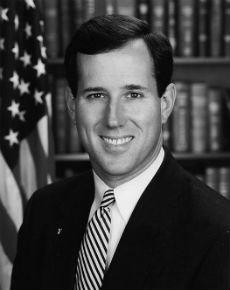
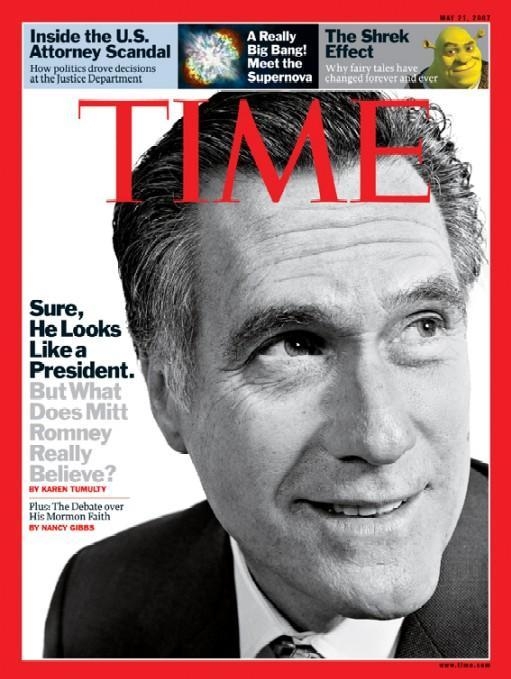
When the Iowa votes were in on that first Tuesday of 2012, Mitt Romney won the caucuses after publicly promising to support an amendment to the United States constitution barring same-sex couples from marriage. But perhaps the one to watch on the marriage equality front is Rick Santorum, who came in a close second to Romney and continues to court the support of extremist organizations and has strong ties to many anti-gay groups. Santorum has a long track record of trying to score political points by bashing the LGBT community. In Iowa, his anti-gay stance almost led him to victory. In New Hampshire however, Santorum’s anti-gay rhetoric got an icy reception as he got booed off stage after comparing marriage equality to polygamy.

Rick Santorum

Rick Santorum

Santorum and the Anti-Gay Lobbyist Force

Religious Right activists are positively giddy over the new momentum behind Rick Santorum’s candidacy for presidency, praising his appeal to women and evangelical centers on a desire for authenticity. In many ways, the conflict over marriage equality and gay rights represents what is arguably one of the dominant cultural cleavages of the post-material era in the United States. The specific battle over gay marriage represents a cultural cleavage between religious traditionalism on the one hand and progressivism on the other. In a similar fashion to the highly contested Proposition 8[2] vote in California and the legislative battle of the Marriage Equality Act[3] in New York, the evangelical movement was quick to jump on the anti-gay bandwagon in the presidential primaries. But Rick Santorum isn’t just close to traditional Religious Right organizations and activists: the former Pennsylvania senator even has ties to the most fringe parts of the movement. Santorum, for example, is a heavy supporter of Ron Luce’s cult-like group “Teen Mania”, which focuses on challenging a youth-culture that, in Luce’s words, promotes homosexuality. Luce’s organization Teen Mania, which hosts teen-oriented prayer rallies, was recently featured in the MSNBC documentary Mind Over Mania, where former interns described Teen Mania’s cult-like practices, such as faith healings and enduring verbal abuse and extreme sleep deprivation.

Last month Santorum attended the Presidential Pro-Life Forum hosted by Personhood USA, accompanied by fellow Republican presidential candidates Michelle Bachman and Newt Gingrich. As a radical anti-choice activist group, Personhood USA’s ultimate goal is to ban abortion and even common forms of birth control without exception. Earlier the group launched unsuccessful referenda in Colorado and Mississippi on the matter, characterizing President Obama as “the Angel of Death” and likening opponents of the proposed abortion ban to Nazis.

But perhaps there are three other organizations whose connection to Santorum is more worrisome, especially on the LGBT-front. For the Presidential Pro-Life Forum, Santorum was in close contact with Lou Engle’s The Call, also a host of the forum. In 2009, Engle used his The Call prayer rally to bolster Ugandan legislation that would criminalize and in some cases give the death penalty for homosexuals. The other organization is the highly evangelical Oak Initiative, a project of South Carolina pastor Rick Joyner. Joyner has previously argued that hurricane Katrina was God’s punishment for the advancement of gay rights. And last but certainly not least, there is Focus on the Family, a non-profit group that, despite its warm and fuzzy name, is in tenor and in practice an anti-gay hate group. Focus on the Family is a recurrent factor in the evangelical ability to create powerful networks and was instrumental in gearing up to endorse Proposition 8 in California. Santorum has been a regular guest on Focus on the Family radio broadcasts, engaging in topics such as gay marriage and the repeal of “Don’t Ask, Don’t Tell”, stating that injecting social policies into the military weakens its morale and that there is no place for “any type of sexual activity in the military”. Additionally, Santorum has found support in the Family Research Council, Focus on the Family’s political lobbying arm.

Santorum’s sentiments on homosexuality have often contradicted his own statements. He has spoken ardently in favor of personal freedoms, opposing the McCain-Feingold campaign finance bill[4] in 2002 on the grounds that it was an “affront to personal freedom and liberty.” But at the same time, Santorum argues that states do have a right to “limit individuals’ wants and passions” – striking an eerie resemblance to his comparison of marriage equality to polygamy and the need to curtail “any type of sexual activity” in the military and reinstate “Don’t Ask, Don’t Tell.”

Evangelicals and Politics: Hit or Miss?

Santorum’s views didn’t affect him negatively in Iowa, where evangelical Christians make up a large part of the Republican electorate. The religious groups voted heavily in his favor and helped propel him to top status just days before the Iowa caucus. But the story is different in New Hampshire, a state where gay marriage is legal and which boasts a much more moderate set of Republicans. So while Santorum’s views on traditional marriage and the sanctity of life might serve him well with certain constituencies, he is also alienating and bashing an entire community of his fellow Americans. Santorum’s views could be problematic for him in less conservative states – hence the icy reception he got in New Hampshire, which is next on the list in the 2012 Republican Party presidential primaries.

Santorum is likely to receive a more friendly welcome in South Carolina, but nationally, his views could come back to haunt him. But Santorum is no fool – enter the PR machine. One of his former aides who is openly gay recently jumped to Santorum’s defense, saying the former senator is not homophobic but simply opposes gay marriage.

It remains to be seen, however, whether or not an intricate set of evangelical lobbying networks can create a favorable power momentum for either Rick Santorum or Mitt Romney when focusing on social issues such as marriage equality. In Lobbying Against Progressivism: The Evangelical Power of Mobilization Against LBGT Rights in the United States I have previously argued that it is highly debatable whether the approval of Proposition 8 in California was exclusively enmeshed in evangelical lobbyist efforts. The legislative struggle for gender-neutral marriage in both California and New York testifies to the fact that it is still a deeply divisive and emotional issue on both sides of the fence. California’s highly contested approval of a ban on gender-neutral marriage and New York’s legislation of marriage equality – taken into account its long legislative struggle – still echo the growing pains of equality. For many Christian Right groups, opposition to gay rights has been a major agenda item for the past 30 years and in many ways, it has been their rallying cry.

But does having the support of American Evangelicals as a grassroots movement create any real political power, or is any outspoken religious affiliation more of an obstacle rather than an asset in the Republican presidential primaries? Many political observers in the Republican camp have been adamant on de-emphasizing Mitt Romney’s Mormon conviction as a member of the Church of Jesus Christ of Latter-Day Saints. For many Republicans, Romney is an appealing candidate with compassionate conservative allure. Moreover, we would all like to believe that a politician’s religious affiliation is not an obstacle to higher office. Americans have indeed become more religiously tolerant, but Romney – as the first Mormon to run for President – will clearly have to change some minds. In the late 1960s, the percentage of Americans who said they would not vote for a Jewish or Catholic presidential candidate was in the double digits; by 1999, those numbers had fallen to 6 and 4 percent, respectively. Compare that to the 17 percent of Americans who currently say they would have qualms electing a Mormon to the White House. That number has not changed one bit since 1967, the year that Romney’s father considered a presidential run.

Mitt Romney

Mitt Romney

In the end, it remains to be seen how both Romney and Santorum will wield their newly gained status as the Republican answer to Obama, and whether or not Santorum is looking to further intensify his relationship with evangelical movements.


[1] “Don’t Ask, Don’t Tell” was a controversial military policy barring openly gay, lesbian, and bisexual soldiers from military service. It was only recently, under the Obama administration, that a congressional bill to repeal the aformentioned military policy was enacted, setting the official end date of “Don’t Ask, Don’t Tell” for September 20, 2011.

[2] Proposition 8, also known under its ballot title “Eliminates Rights of Same Sex Couples to Marry: Initiative Constitutional Amendment” was a 2008 ballot proposition and constitutional amendment which added a new provision to the California Constitution. This initiative measure, additionally cited as the California Marriage Protection Act, aimed to add section 7.5 to the California Constitution, stating that “only marriage between a man and women is valid or recognized in California.” The ballot proposition passed in the California state elections on November 4, 2008 but was later overturned by a federal judge on grounds of unconstitutionality.

[3] The Marriage Equality Act was a senatorial bill in the state of New York legalizing same-sex marriage. The law took effect on July 24, 2011.

[4] The McCain-Feingold Bill was a bill which was introduced to the United States Senate in 2002 in an attempt to reform campaign financing in the United States.

India’s Anti-graft Protests: Why Demands for Inclusiveness are Not a Distraction From Fighting Corruption

In this article, the author brings to light some of the criticism that the Anna Hazare led anti-corruption agitation is facing on counts of not being inclusive enough.

_____________________________________________________________________________

By Arvind Iyer, 5 Jan, 2012

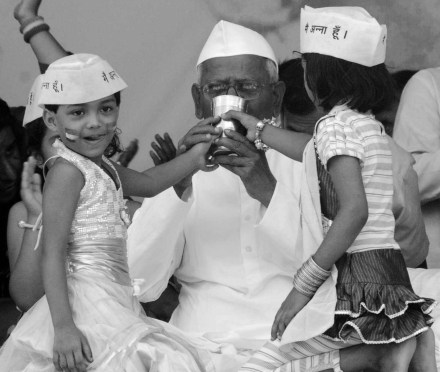
Team Anna, as the group of largely ex-bureaucrat activists headed by anti-graft agitator Anna Hazare has been christened by commentators, had earned praise through much of 2011 for being able to articulate a unanimous-sounding consensus of Indian civil society across the barriers that render it notoriously fractious. Even some of their detractors had conceded Team Anna’s success in rallying a typically apathetic citizenry around a cause backed by a mobilization and momentum which is thought of by many educated city-dwellers as grievously lacking in a parliamentary system crippled by the ‘politics of identity’ and coalition compulsions.

By the year-end however, the response to Anna Hazare’s latest edition of his hunger-strike protest was underwhelming and the growing unease with an apparent authoritarian streak in Team Anna became palpable. What was just months ago one of the most successful campaigns in recent Indian history looked no less dysfunctional than the Parliament it takes potshots at. The dilemmas of ‘Coalition Dharma’ which complicate governance in India are no less applicable to Team Anna if it claims to represent Indian society in its identity. The manufactured unanimity of Team Anna seems sustained by a self-assured insularity from dissenting voices, which if heeded would give Team Anna pause. This is in part because activists besides the telegenic Team Anna get scanty mainstream media coverage, thus creating an illusion of nationwide consensus. Following are some voices which ought to give Team Anna and its supporter’s pause, if not from their legislation-obsessed agitation, at least from their repeated accusations of their critics as divisive and unpatriotic.

  • Team Anna’s way of addressing concerns about inclusiveness have been transparently stage-managed and tokenist. Shekhar Gupta, the editor of the Indian Express daily, writes: “Representative inclusiveness, they probably believed, was part of our cynical electoral politics though that did not stop them from having a Dalit and a Muslim girl help Anna break his fast, making it the first time that a child was described as “Dalit” on a public stage in a mass rally.” The photo-op which seems to have been hastily ‘Photoshopped’ on to a movement largely indifferent to concerns of diversity, also raised concerns among some viewers about the unintended consequences of religious labeling of children.

  • The boundaries of ‘peaceful protest’ are always in the risk of being breached by Team Anna’s implicit endorsement of elements whose commitment towards adhering to constitutional propriety and prevention of civil unrest, seems questionable. A case in point is a black-flag demonstration against Prime Minister Manmohan Singh by alleged supporters of Team Anna, during his New Year visit to the Golden Temple at Amritsar. The choice of protest venue in Amritsar was irresponsible for the obvious reason that it could potentially open the wounds left by the upheavals of the 1980s in the said shrine, which is viewed by a significant portion of the said community as a site of a government assault on their faith. If this irresponsible choice of protest venue did not lead to something untoward, it is in part due to the unimpressive numbers of the protestors and the overwhelming security presence. Better civic sense is expected of a movement supposedly representing ‘Civil Society’ than such an exacerbating of security concerns. Also, a better explanation is expected from Team Anna than doublespeak simultaneously defending and disowning supporters, if it is to retain its credentials as movement insisting on public probity.

  • When it is well-known that India suffers more from lack of enforcement of existing laws than the absence of laws in statute books, the Lok Pal model is inordinately obsessed with augmenting the lists of penalties, leaving intact the slackness of enforcement and lack of transparency that provide the opportunity for corruption in the first place. Also, an informer-rewarding ‘police-state’ that the proposed Jan Lok Pal regime resembles, may have the side-effect of inducing officials to recruit and reward officials who are pliable and willing to exchange favours for silence, thus exacerbating inequities like nepotism and workplace discrimination in government offices which affect delivery of service to citizens besides graft.

  • Inclusiveness has rightly been part of the national agenda at least in letter if not in spirit and Team Anna’s attitude towards mechanisms of inclusiveness has been either indifferent or borderline hostile. There has been a tendency among Team Anna supporters in online discussions to accuse anyone raising concerns about inclusiveness of playing ‘identity politics’ and being establishment lackeys. A case for critics of government intervention for inclusiveness to consider, is this measure by the Karnataka government for inclusive hiring in school-meal kitchens. A point to ponder for critics of the ‘politics of representation’ is, would people divided by caste have voluntary chosen to mingle in a school kitchen without that nudge from the elected government?

  • Team Anna’s vision of an India which, far from its professed aim of ‘Direct Democracy’ involves a replication of the Ralegan Siddhi model nationwide i.e. a series of ‘Ashram-cracies’ revolving around a patriarch, in a proto-industrial setting with curtailed civil liberties, is a vision that does not resonate with much of India’s aspirational youth.

  • Land acquisition policies and resulting displacements, the denuding of natural resources by a corporate-political nexus and imposition of near-martial-law conditions in some parts via the Armed Forces Special Powers Act, are contributing on at least as large a scale as government corruption in disenfranchising citizens and even turning some towards insurrections; thus calling into question Team Anna’s description of corruption as the greatest national risk which must be fought mindless of all others.

In the interest of genuinely playing their legitimate and very timely role as a civil-society group, this is an opportune moment for Team Anna to introspect on how their protests can sometimes be counterproductive, how the loose cannons among their supporters can be appropriately restrained and marshalled and how to broaden their dwindling base of support.

From Fiesta to Siesta: Spain, Merkozy, and Neo-Eurosclerosis

In this article, the author analyses the Euro crisis by taking a look at Spain and fiercely criticises European conservatives’ obsessive focus on austerity, a trend that is inevitably leading the old continent towards a state of Neo-Eurosclerosis.

_______________________________________________________________________________________

4 Jan, 2012

European politics is a tough game: on the one hand, there is the political struggle in which parties seek to win a domestic electorate with old-fashion programs covering issues such as the level of state intervention, economic growth, and social integration and protection. Here the talk is usually centred on taxes, employment, state regulation, and welfare programs. On the other hand, European integration and monetary union are forcing member states to strengthen their positions in an attempt to resist challenges to state sovereignty. Here the talk is usually centred on fighting back transnational forces and financial markets, enhancing national identity, and resisting the transference of sovereignty. Hence, political parties find themselves in the odd situation of having to win two battles: one with a domestic electorate, and one with the effects of European integration. Three battles if we include the struggle against financial markets that do not seem to respect boundaries of any sort. The 2008 economic crisis and subsequent sovereign debt crisis and crisis of the euro have only exacerbated these trends. The case of Spain comes in handy here.

When Mariano Rajoy of the conservative People’s Party was elected Spain’s President in November he stated that Spain “will stop being part of the problem and start becoming part of the solution”. Later, in his first address to Parliament he confirmed that he would not raise taxes as a measure to reduce public budget deficit (one of his electoral promises). Yet this week the government that Mr Rajoy presides announced the most severe measures since Spain turned into a democracy in 1978, including very large cuts in public expenditure and a significant rise in income tax rates. This, it was argued, is what Spain needs to do in order to meet the European budget deficit target of 4.4% by the end of 2012.

The current exact figure of Spain’s public deficit is a matter of serious debate. According to the outgoing socialist government, Spain’s deficit is of the range of 6% whilst the incoming conservatives estimate the figure is closer to 8% thus justifying extraordinary measures. But Spain is a semi-federal state in which a large proportion of the current aggregated national public deficit is dependent on the deficit incurred by each of the different autonomous communities. This means that the debate over the exact figure of public deficit is in turn cascaded down to the politics of each of the autonomous regions (the majority of which are now in control of the conservative government). In other words, numbers and figures are political. Those seeing things through red lenses believe the figures provided by the incoming government have been inflated; those seeing things through blue lenses claim that the outgoing government was too optimistic about the level of public deficit.[1]

Regarding the measures announced by Mr Rajoy, two points come immediately to mind. First, Mr Rajoy’s measures will tax employees and therefore hit the middles classes, and not big companies or the richest strands of society (despite the argument that he has chosen to raise taxes on income over taxes on consumption on the basis of the former’s equity and progressivity –however, there are already rumours that VAT, a tax on consumption, will be increased in or after March. That may explain, inter alia, what Mr Rajoy’s number two Soraya de Santamaría meant when she claimed that the measures announced this week are only ‘the beginning of the beginning’). Second, the conservative government has justified these measures on the grounds that resolving the debt crisis must be Spain’s top priority. Cutting public expenditure (in other words, social welfare) is not enough and so an additional increase in taxes is what Spain needs to do to achieve the paradisiacal budget deficit of 4.4%. This, according to the conservatives, will not worsen the economy and, if it does, their position is that reducing public deficit is more important than reactivating a stagnant economy. Yet reactivating the economy and creating jobs was the promise and the campaign slogan of the conservative party presided by Mr Rajoy (official data says Spain has 4.42 million unemployed).

So what has happened here? Have Mr Rajoy and his cabinet changed their minds or did they know the policies they would adopt and implement once they found themselves in power? I think any doubts in this regard may offend the reader. Spain is no movie like others, but the script is the same elsewhere in Europe these days: see Greece, (in that case though the government of Mr Papandreu lied about public accounts), Ireland, Portugal, and Berlusconi’s Italy where the new government has not even been democratically elected. Then came Spain, with Mr Rajoy making pacts with Merkel. In this regard, not only is the Franco-German axis abusing intergovernmental cooperation to worrying levels, bypassing regional integration and European institutions such as the Commission, but they are also increasingly perceived as dictating what other countries must do.

In an essay published in November by the Centre for European Reform the authors provide an excellent analysis of what exactly is going on in Europe. According to the authors, the principal problem is that the monetary union was never coupled with a fiscal union. The introduction of the euro therefore triggered a flow of debt from core, creditor countries in the North, to periphery, debtor countries in the South, ‘spurring the emergence of enormous macroeconomic imbalances that were unsustainable, and that the eurozone has proved institutionally illequipped to tackle’. But the Franco-German axis and North-European policy-makers, with the backing of conservatives elsewhere, do not agree with this interpretation and instead of acknowledging the institutional pitfalls of the eurozone, they blame the crisis on the behaviour of certain member states (the so called PIGS that Paul Krugman rightly prefers calling GIPS), namely on government profligacy and loss of competitiveness.

Hence, Spain is forced to apply stricter rules to emulate the virtuosity of creditor countries like Germany as if Germany itself had played no role in the run-up to the crisis (by lending money irresponsibly and far from innocently). Yet experts like Krugman are very clear about the impact that an obsession with austerity and low inflation is having on European economies: austerity in times of crisis inevitably leads to more recession and not necessarily to a decrease in bond yields. IMF’s Chief Economist Olivier Blanchard has backed this view by declaring that ‘some preliminary estimates that the IMF is working on suggest that it does not take large multipliers for the joint effects of fiscal consolidation and the implied lower growth to lead in the end to an increase, not a decrease, in risk spreads on government bonds’.

Krugman claims that nobody understands debt and he cites a quote by John Maynard Keynes that all governments, blue or red, should learn by heart: “The boom, not the slump, is the right time for austerity at the Treasury”. I think though that Krugman is making a very benevolent interpretation of the current state of play. Surely Mr Rajoy (and Sarkozy and Merkel) understand debt, but their lenses are blue. It was Roosevelt and not Hoover that led the US and the world to recovery during the last Great Depression, and he did so by injecting money in the economy, not by enforcing austerity. The eurozone suffers from institutional flaws that need to be sorted (such as the lack of ‘real’ fiscal union). Some experts believe the latest agreement reached by the 17 members of the eurozone on 9 December 2011 is a ‘fiscal union’ only in paper (this may explain the reaction of the financial markets which, after taking a brief break, are back on their feet ready to take on another victim).

The question therefore is whether there is anything that will satisfy the financial markets. In this regard the answer seems to lie in Blanchard’s statement according to which financial investors are schizophrenic because they first react positively to austerity and then negatively when they realise that austerity does not lead to growth. Which means that the key to this puzzle is as simple as it is old: financial markets want to recover their investments, and the way to guarantee such outcome is by generating growth, not by enforcing austerity. Mr Rajoy in the meantime, guided by European conservatives’ obsession with austerity, continues to hit the wrong button; let’s hope it will not be too late before European leaders realise that their lenses are leading Europe towards a state of Neo-Eurosclerosis.


[1] Blue is the colour of Spain’s conservative People’s Party but blue is later used throughout the rest of the article to refer more generally to conservatives across Europe